

Al-Kitab Quran School - ICWN
Our mission
Al-Kitab Quran School fosters a nurturing environment for students to learn the Quran and Islamic values, promoting personal growth, community engagement, and cultural understanding through educational programs and activities.

More ways to support us
Donation
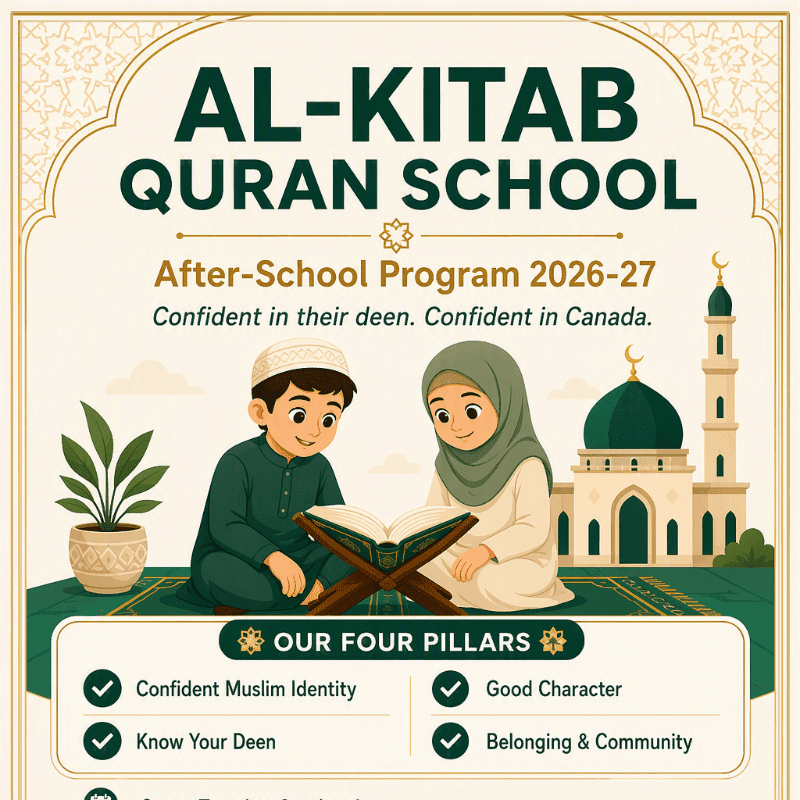
AL-KITAB QURAN SCHOOL 2026-2027
Our VisionAl-Kitab Quran School works with parents to nurture a generation of Canadian Muslim youth who feel a strong sense of belonging, are grounded in their Islamic identity and values, and are confident in contributing positively to the diverse society around them. Our StrategyWe connect Islamic learning (Qur’an and Sunnah) and character development (Islamic Studies) with the everyday realities of growing up Muslim in Canada. Our Four PillarsEvery class, every term, and every activity is built around these four pillars. They are how we turn our vision into something your child actually experiences every Tuesday and Thursday. Pillar 1 — Confident Muslim Identity“I know who I am, and I’m proud of it.” We want children who can say “I’m Muslim” at school without hesitation, and who can explain the basics of what they believe in simple, age-appropriate words. What we do: Stories of the Prophet ﷺ and the Sahabah, simple aqeedah (who Allah is, why we worship), and short “what would you say if…” discussions on questions kids get asked at school. What you’ll see at home: Your child answering questions about Islam with confidence instead of embarrassment. Pillar 2 — Know Your Deen (The Basics, Done Well)“I can read Qur’an, I can pray, and I know right from wrong.” A clear, realistic foundation: Qaida and Qur’an with tajweed, short surahs and daily du’as, Arabic letters and vocabulary, and the fard basics of salah, wudu, halal/haram and adab. What we do: Qaida/Qur’an recitation, tajweed basics, Arabic, memorization of short surahs and du’as, and practical fiqh of purification and prayer. What you’ll see at home: Steady progress in reading, a child who can pray correctly, and du’as used in everyday moments. Pillar 3 — Good Character & Real-Life Skills“I act on what I know — at home, at school, and online.” Knowledge that doesn’t change behaviour isn’t doing its job. We link every lesson to akhlaq: honesty, respect for parents and teachers, kindness, patience, and handling the pressures kids actually face. What we do: Short, age-appropriate discussions on friendships, peer pressure, screens and social media, anger, bullying, and standing up for what’s right — always tied back to Qur’an and Sunnah. What you’ll see at home: Better manners, better choices, and a child who can explain why. Pillar 4 — Belonging & Community“This is my community, and I want to be here.” Many children are the only Muslim in their classroom. Al-Kitab gives them Muslim friends, a masjid that feels like theirs, and a reason to keep coming back. What we do: Team-based learning, seasonal events and competitions, Ramadan and Eid activities, and social nights through the year. What you’ll see at home: A child who asks when the next class is.
Donate today
Membership
Al-Kitab Quran School Registration 2026/2027
Our VisionAl-Kitab Quran School works with parents to nurture a generation of Canadian Muslim youth who feel a strong sense of belonging, are grounded in their Islamic identity and values, and are confident in contributing positively to the diverse society around them. Our StrategyWe connect Islamic learning (Qur’an and Sunnah) and character development (Islamic Studies) with the everyday realities of growing up Muslim in Canada. 1. Our Four PillarsEvery class, every term, and every activity is built around these four pillars. They are how we turn our vision into something your child actually experiences every Tuesday and Thursday. Pillar 1 — Confident Muslim Identity“I know who I am, and I’m proud of it.” We want children who can say “I’m Muslim” at school without hesitation, and who can explain the basics of what they believe in simple, age-appropriate words. What we do: Stories of the Prophet ﷺ and the Sahabah, simple aqeedah (who Allah is, why we worship), and short “what would you say if…” discussions on questions kids get asked at school. What you’ll see at home: Your child answering questions about Islam with confidence instead of embarrassment. Pillar 2 — Know Your Deen (The Basics, Done Well)“I can read Qur’an, I can pray, and I know right from wrong.” A clear, realistic foundation: Qaida and Qur’an with tajweed, short surahs and daily du’as, Arabic letters and vocabulary, and the fard basics of salah, wudu, halal/haram and adab. What we do: Qaida/Qur’an recitation, tajweed basics, Arabic, memorization of short surahs and du’as, and practical fiqh of purification and prayer. What you’ll see at home: Steady progress in reading, a child who can pray correctly, and du’as used in everyday moments. Pillar 3 — Good Character & Real-Life Skills“I act on what I know — at home, at school, and online.” Knowledge that doesn’t change behaviour isn’t doing its job. We link every lesson to akhlaq: honesty, respect for parents and teachers, kindness, patience, and handling the pressures kids actually face. What we do: Short, age-appropriate discussions on friendships, peer pressure, screens and social media, anger, bullying, and standing up for what’s right — always tied back to Qur’an and Sunnah. What you’ll see at home: Better manners, better choices, and a child who can explain why. Pillar 4 — Belonging & Community“This is my community, and I want to be here.” Many children are the only Muslim in their classroom. Al-Kitab gives them Muslim friends, a masjid that feels like theirs, and a reason to keep coming back. What we do: Team-based learning, seasonal events and competitions, Ramadan and Eid activities, and social nights through the year. What you’ll see at home: A child who asks when the next class is. 2. Setting Clear Expectations We’d rather be honest about what two hours a week can and cannot do. Please read this before registering. What Al-Kitab Is A part-time, after-school program: Tuesdays and Thursdays, one hour per class. A foundation program — the basics of Qur’an, salah, character and identity, taught well and taught consistently. A partnership with parents. What we start in class needs to be continued at home. A place where your child builds Muslim friendships and feels connected to the masjid. What Al-Kitab Is Not Not a hifz program. We are not aiming to produce huffadh in two hours a week. Not an ‘alim/scholar track or a full-time Islamic school. Not a replacement for learning at home — we support parents, we don’t replace them. Not daycare. Attendance, punctuality and respect for teachers are expected. Realistic Outcomes by the End of the Year With regular attendance and support at home, in shaa Allah your child will: Move forward in Qaida or Qur’an reading with improved tajweed. Know how to make wudu and pray salah correctly, with a few short surahs and everyday du’as memorized. Be able to explain the basics of Islam and answer common questions with confidence. Show stronger character — manners, honesty, respect — and have real Muslim friends at the masjid. How Parents Can Help Send your child on time every Tuesday and Thursday, consistently — attendance is the single biggest factor in progress. Review 5–10 minutes at home on non-class days. Pray with your child at home so salah becomes normal, not a class topic. Ask your child one question after each class: “What did you learn today?” Talk to the teachers. Tell us what’s working and what isn’t.
View membership

Membership
Al-Kitab Quran School - ICWN's Memberships
Al‑Kitab Quran School – ICWN memberships help sustain a welcoming masjid home for our community. 🕌 Your support strengthens youth Quran education, spiritual guidance, and programs that care for families and elders alike.By becoming a member, you share in our work of nurturing faith, preserving our rich Islamic heritage, and offering practical support to Muslims across West Niagara. 🤝 Join as a member and walk with us in service, learning, and unity.
View membership
Our website
https://www.icwn.ca/
Contact information
admin@icwn.ca