

Offered by
Tour de la Réussite
About this shop
Boutique The Essential

Delivery
$20
Please add this shipping fee to your cart if you are not picking up your order at our office (in that case, please schedule a pickup time with us by writing to [email protected]).
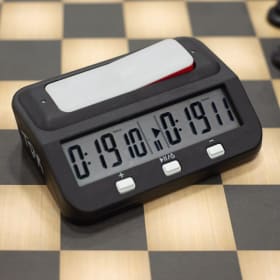

HQT 101 clock
$35
Perfect for young children (ages 5–12) or beginners discovering chess. Very easy to use, ideal for first school competitions or casual games at home. Clearly displays the remaining time for each player. Basic game modes included (blitz, rapid, classical). Sturdy, lightweight, and easy to carry. A great choice for a first purchase or casual use.

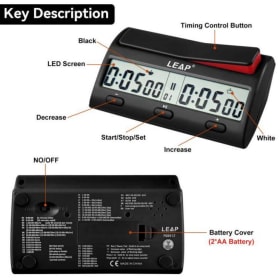

Leap clock
$55
**Leap – The Easy All-Rounder for Young Competitors** Designed for young players aged 8–16 who are already familiar with competitions or play in a club. Offers more modes than the HQT101, including formats used in tournaments (increment, delay). Very easy to program despite its advanced features. Clear display and good battery life. Also suitable for other games (Go, Shogi, Scrabble). A great choice for an active player in a club or competitive school setting.


DGT 2010 clock
$80
DGT 2010 – The Official Classic for Clubs and Schools Ideal for teenagers (ages 10–18) who are seriously involved in chess, especially in competitions. FIDE-approved clock, used in many official tournaments. Highly accurate with numerous pre-programmed modes, perfect for getting used to competition settings. Very reliable with a good lifespan. Slightly more complex to set up, but still accessible with a bit of guidance. A solid choice for a young player who regularly plays in a club and participates in tournaments.
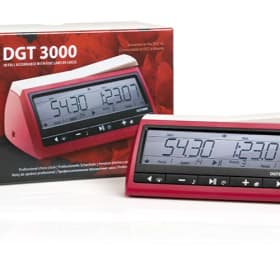
DGT 3000 clock
$90
DGT 3000 – The most complete and professional clock. Ideal for advanced youth players (ages 12–18) and serious competitors; also suitable for coaches and clubs. Large screen with ultra-clear display, including seconds from the very start. Supports all time controls (Fischer, Bronstein, Byo-Yomi, etc.). Compatible with DGT electronic boards for digital game tracking. Highly precise and used in major international tournaments. The right choice for a highly dedicated young player or for professional and connected use.
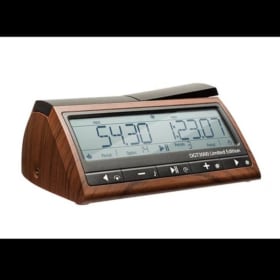
DGT 3000 clock - Limited edition
$100
**DGT 3000 – The Most Complete and Professional** Ideal for advanced youth players (ages 12–18) and serious competitors; also suitable for coaches and clubs. Large screen with ultra-clear display, including seconds from the very start. Supports all time formats (Fischer, Bronstein, Byo-Yomi, etc.). Compatible with DGT electronic boards for digital game tracking. Extremely precise and used in major international tournaments. The right choice for a highly dedicated young player or for professional, connected use.


Vinyl chess set with carry bag
$30
This chess set includes a blue vinyl chess board (50.8 x 50.8 cm, 5.8 cm squares) and a sturdy nylon canvas carrying bag. Convenient and lightweight, the shoulder bag allows easy transportation of the game anywhere, with enough space for the pieces, the rolled-up board, and other small accessories like pens or mini clock. Ideal for young players on the go, at school or in tournament.
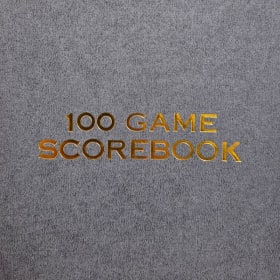
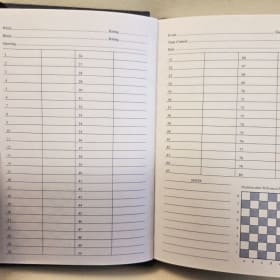

Scorebook
$15
100 games scorebook (english)

Carnet de notation (vert)
$15
Carnet de notation pour 100 parties (en anglais) - Couverture verte, pages en bleu.

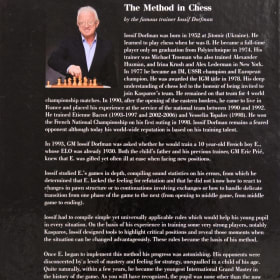
The method in chess (english book)
$85
The Method in Chess by the famous trainer lossif Dorfman lossif Dorfman was born in 1952 at Jitomir (Ukraine). He learned to play chess when he was 8. He became a full-time player only on graduation from Polytechnique in 1974. His trainer was Michael Trosman who also trained Alexander Huzman, and Irina Krush and Alex Lederman in New York. In 1977 he became an IM, USSR champion and European champion. He was awarded the IGM title in 1978. His deep understanding of chess led to the honour of being invited to join Kasparov's team. He remained on that team for 4 world championship matches. In 1990, after the opening of the eastern borders, he came to live in France and placed his experience at the service of the national team between 1990 and 1992. He trained Etienne Bacrot (1993-1997 and 2002-2006) and Vesselin Topalov (1998). He won the French National Championship on his first outing in 1998. lossif Dorfman remains a feared opponent although today his world-wide reputation is based on his training talent. In 1993, GM lossif Dorfman was asked whether he would train a 10 year-old French boy E., whose ELO was already 1930. Both the child's father and his previous trainer; GM Eric Prié, knew that E. was gifted yet often ill at ease when facing new positions. lossif studied E.'s games in depth, compiling sound statistics on his errors, from which he determined that E. lacked the feeling for refutation and that he did not know how to react to changes in pawn structure or to continuations involving exchanges or how to handle delicate transition from one phase of the game to the next (from opening to middle game, from middle game to ending). lossif had to compile simple yet universally applicable rules which would help his young pupil in every situation. On the basis of his experience in training some very strong players, notably Kasparov, lossif designed tools to highlight critical positions and reveal those moments when the situation can be changed advantageously. These rules became the basis of his method. Once E. began to implement this method his progress was astonishing. His opponents were disconcerted by a level of mastery and feeling for strategy, unequalled in a child of his age. Quite naturally, within a few years, he became the youngest International Grand Master in the history of the game. As you will have recognized, the pupil was none other than the now well-known Etienne Bacrot. Today, lossif Dorfman keeps on using his knowledge to help gifted youngsters. The method is transparent. It can be understood and applied by any player and, because of its great efficiency, it has become a keystone in the edifice of modern strategic thought.


La méthode aux échecs (french book)
$45
"We are given no guidance on method," trainees often complain. Providing a method, a set of working rules to help chess players — that is the aim of this book. It offers a dual approach: both theoretical and practical. The theoretical part of the method analyzes the concept of statics and dynamics, as well as the various elements that shed light on the latter. Understanding the foundations of the method will allow the chess player to better apply the rules in the practical section of the book. Thus, emphasis is placed on various tools for analysis and synthesis. This book is driven by a clear purpose: to enable chess players to understand what strategy is required by the nature of any given situation. That is the strategy you will find explained in this work.


Le moment critique (french book)
$45
In chess, as in everyday life, our personality is constantly put to the test. We are immersed in a competitive world that constantly demands performance from us. One must know how to assert oneself and convey one's ideas. The purpose of this book is to describe the working method for positions where the game takes a decisive turn. Above all, it serves as a reference document for all teachers, who will find within it the necessary elements for designing their lessons. Players already familiar with The Method in Chess will find material to deepen and refine their understanding of the dynamics of the struggle. This method of analyzing critical moments in chess is the result of my research and experience. It has the advantage of being the synthesis of a career both as a player and as a trainer. Now, it belongs to you.

Pièces avec poids
$15
Ensemble de pièces avec poids. Idéales pour les parties rapides et les blitz. Augmente le confort et la classe dans une partie d'échecs! *pièces seulement, échiquier non inclus*
Add a donation for Tour de la Réussite
$
Did you know? We fundraise with Zeffy to ensure 100% of your purchase goes to our mission!