
Hosted by
American Cetacean Society San Francisco Bay Chapter
About this event
Second Annual Silent Auction By American Cetacean Society San Francisco Bay Chapter

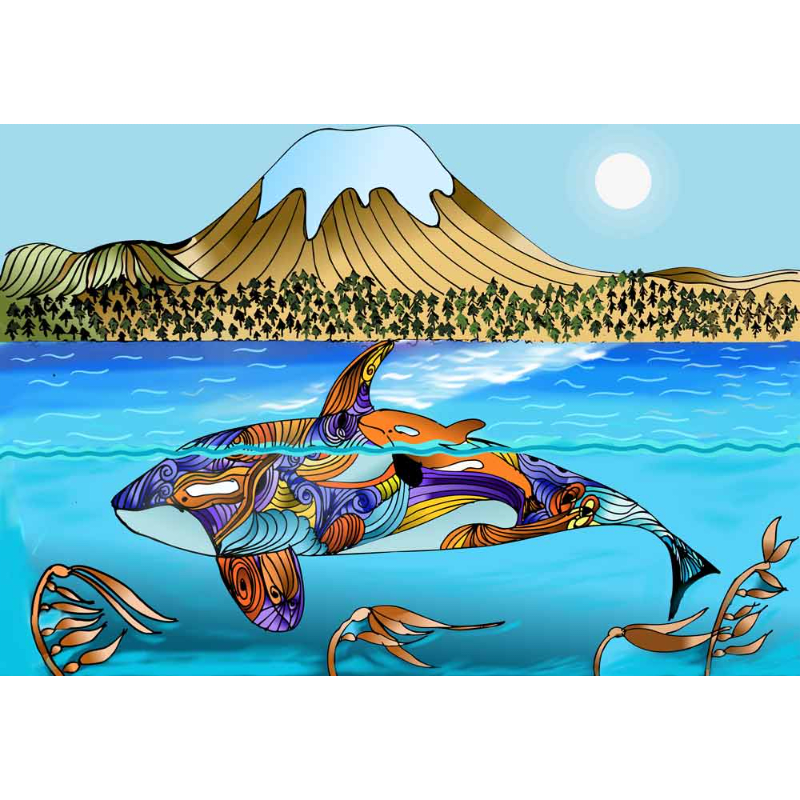
J62 and Her Mom in the Salish Sea
$250
Starting bid
Print on canvas
Limited Edition Certification
Picture Dimension 19 ¾” x 27 ¼ ”
Picture with frame, Dimension 24″ x 36″ (Item is sold without a frame*)
Mixed Media – Hand-drawn images are converted into digital art.
(Only 4 out of 5 exclusive signed copies are available)
*Contact [email protected] to learn affordable framing suggestions
Set in an imagined Haro Strait with Mount Baker lifting above the San Juan Islands, this piece honors the bittersweet arrival of J62, a newborn in the critically endangered Southern Resident Killer Whale (SRKW) community. Kelp curls in the foreground while mother and calf slip through bands of luminous blue, grounding the scene in the Salish Sea.
The patterned surfaces are drawn from whale sounds, motifs inspired by spectrograms and echo-like waves. Look closely and you’ll see whale sound waves/patterns reflected across the mother’s body, a visual metaphor for how sound inhabits and defines orca life: it is how they find salmon, navigate, and communicate, passing knowledge through matrilines from grandmother to mother to calf.
J62’s birth—confirmed on New Year’s Eve 2024—arrived the same day the community learned of the loss of another newborn, J61, a stark reminder of SRKW fragility. That J62 is female matters deeply: future recovery depends on reproductive females, and she was born into a strong line her mother J41 “Eclipse,” siblings J51 “Nova” and J58 “Crescent,” and grandmother J19 “Shachi.”
You’ll notice J62 is painted in orange. Newborn killer whale calves naturally show orange-tan patches—especially where the “white” will later be—because their blubber is still thin and blood vessels show through, giving a warm, amber cast that fades to crisp white as they grow. That neonatal glow is a symbol of beginnings, so I let it shine here.
The work also bears witness to a hard truth. Recent research underscores how noise pollution elevates stress, disrupts communication, and impedes foraging for Chinook salmon, the whales’ primary prey. Against that din, the mother’s resonant patterns and the calf’s bright arc become a vow and a hope: that a quieter sea will let their voices carry, their families thrive, and their future unfold.
For more Information please visit
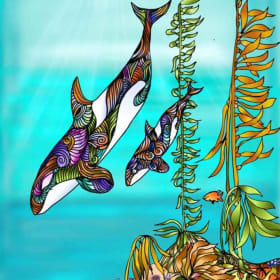
J63 and her Mom Diving into the Kelp Forest
$250
Starting bid
Limited Edition Certification
Print on Canvas
Picture Dimension 19 ¾” x 27 ¼ ”
Picture with frame, Dimension 24″ x 36″ (Item is sold without a frame*)
Mixed Media – Hand-drawn images are converted into digital art.
(Only 5 exclusive signed copies are available)
*Contact [email protected] to learn affordable framing suggestions
Set in an imagined kelp forest of the Salish Sea, this piece follows J63 and her mother J40 “Suttles” as they drift through golden fronds and shafts of turquoise light. The patterned surfaces on both whales are drawn from sound—spirals, ripples, and nested waves that echo spectrograms—because for Southern Residents, life is organized by listening: they navigate, find Chinook salmon, and keep family contact through sound.
Kelp here is more than backdrop. It is the nursery and refuge that helps seed the food web supporting salmon—sheltering juveniles and feeding the smaller creatures they depend on. When kelp thrives, salmon have a better start, and the whales’ chances improve.
At the heart of the scene is Suttles, J63’s mother, guardian, teacher, and acoustic anchor. Born to the late matriarch J14 “Samish” in the J14 matriline, Suttles carries forward a storied lineage. In 2025, researchers documented J63 as Suttles’ first known calf (later confirmed female). For a critically endangered community, every surviving calf matters; a new daughter holds the promise of future generations. In matrilineal orca culture, mothers like Suttles teach hunting tactics, salmon routes, and dialects, keeping calves within the family’s “acoustic bubble” and modeling cultural behaviors.
Those behaviors include a newly described social tradition: allokelping—Southern Resident killer whales biting off bull kelp and rolling it between their bodies like a shared grooming tool. It likely reinforces bonds and may aid skin care—a rare example of social tool use in marine mammals. The long, ribboning kelp stems in the artwork nod to this tactile language of touch, while the sound-wave motifs across Suttles and J63 suggest the constant, intimate conversation that binds them in the dim green water.
References
- Weiss, M. N., et al. (2025). Manufacture and use of allogrooming tools by wild killer whales. Current Biology.
For more information:
https://orangeorca.art/j63-and-her-mom-diving-into-the-kelp-forest/
Did you know? We fundraise with Zeffy to ensure 100% of your purchase goes to our mission!