

Hosted by
Center for Snake Conservation
About this event
My Nature Lab Halloween Naming Silent Auction


Gargoyle Gecko
$100
Starting bid
Name Our Gargoyle Gecko!
This striking little lizard is a Gargoyle Gecko (Rhacodactylus auriculatus), a species found only on the island of New Caledonia in the South Pacific.
Gargoyle geckos get their name from the raised, horn-like bumps on their heads that give them a slightly dragon-like appearance. They are primarily nocturnal, spending their nights climbing through vegetation in search of fruit, insects, and other small prey.
Like many geckos, they are excellent climbers—but unlike some of their relatives, gargoyle geckos can also drop their tails when threatened and regrow them later, an impressive survival adaptation.
Now this gecko needs something equally distinctive: a name.
The highest bidder in our Halloween Naming Silent Auction will earn the right to officially name this animal at My Nature Lab. Choose something spooky, funny, scientific, meaningful, or completely unexpected.
Your winning bid does more than give this gecko an identity. It helps support the animal care, hands-on science education, and conservation work that make My Nature Lab possible.
Bid big, get creative, and give our gargoyle gecko a name worthy of that face.


East African Sand Boa
$100
Starting bid
Name Our East African Sand Boa!
Meet one of the most unusual snakes at My Nature Lab: the East African Sand Boa (Eryx colubrinus).
Native to dry regions of eastern Africa, sand boas spend much of their lives buried beneath loose soil and sand, with only their eyes and the top of their head exposed. This hidden lifestyle makes them excellent ambush predators. Rather than chasing prey, they wait beneath the surface and strike when a small animal passes within reach.
Their short, powerful bodies are perfectly adapted for burrowing, and their blunt tails can even make it difficult at first glance to tell which end is which.
Now this incredible little snake needs a name.
The highest bidder in our Halloween Naming Silent Auction will earn the right to officially name our East African Sand Boa at My Nature Lab.
Choose something spooky, clever, scientific, meaningful, or wonderfully ridiculous.
Every bid supports the animal care, hands-on science education, and conservation work that make My Nature Lab possible.
Dig deep, bid big, and give this underground hunter a name worthy of one of nature’s coolest ambush predators.


African Bullfrog
$150
Starting bid
Name Our African Bullfrog!
Big, bold, and built like a tank, the African Bullfrog (Pyxicephalus adspersus) is one of the largest frogs in the world.
Native to parts of sub-Saharan Africa, these powerful frogs spend much of the year underground, waiting for seasonal rains. When the rains arrive, they emerge to feed and breed in temporary pools.
African bullfrogs are anything but delicate. They have strong jaws, tooth-like structures called odontoids, and an enormous appetite. In the wild, they will eat insects, other frogs, reptiles, small mammals, and just about anything else they can overpower.
They are also remarkably adapted to surviving harsh conditions. During dry periods, they can bury themselves underground and enter a state of dormancy called aestivation, conserving energy until conditions improve.
Now this impressive amphibian needs an equally impressive name.
The highest bidder in our Halloween Naming Silent Auction will earn the right to officially name our African Bullfrog at My Nature Lab. Make it spooky, funny, intimidating, scientific, or completely absurd.
Every bid supports the animal care, hands-on science education, and conservation work that make My Nature Lab possible.
Bid big and give this giant frog a name as unforgettable as its appetite.

Florida Softshell Trio
$200
Starting bid
Three turtles. Three personalities. One chance to name the whole crew.
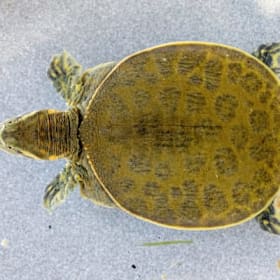
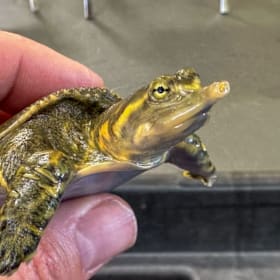
Our Florida Softshell Turtles (Apalone ferox) are some of the most unusual turtles at My Nature Lab. Instead of a hard, bony shell like most turtles, softshells have a flattened, leathery shell that helps them move quickly through the water and bury themselves in soft sand and mud.
Native to the southeastern United States, Florida softshells are highly aquatic predators. Their long, snorkel-like noses allow them to breathe while keeping most of their bodies hidden beneath the surface, and their powerful jaws help them capture fish, crayfish, insects, and other aquatic prey.
They are fast, alert, and very different from the slow-moving turtle most people picture.
The highest bidder in our Halloween Naming Silent Auction will earn the right to officially name all three turtles as a trio. Give them matching names, a themed set, a famous trio, something spooky, or three completely ridiculous names that belong together.
Every bid supports the animal care, hands-on science education, and conservation work that make My Nature Lab possible.
Three turtles means three names—so get creative and give this softshell squad an identity of their own.

Spotted Python
$150
Starting bid
Name Our Spotted Python!
Small for a python but packed with personality, the Spotted Python (Antaresia maculosa) is native to Australia and is one of the smallest python species in the world.
Spotted pythons are nocturnal hunters that spend much of their time around rocky areas, caves, and crevices. In the wild, they feed on small mammals, lizards, and other vertebrates. They are expert bat catchers! Like other pythons, they are nonvenomous constrictors, subduing prey with powerful coils rather than venom.
Their beautiful pattern of dark brown blotches gives them excellent camouflage and makes every individual look a little different.
Now this python needs a name as memorable as its markings.
The highest bidder in our Halloween Naming Silent Auction will earn the right to officially name our Spotted Python at My Nature Lab. Go spooky, clever, scientific, meaningful, or completely ridiculous.
Every bid supports the animal care, hands-on science education, and conservation work that make My Nature Lab possible.
Bid big and give this beautifully patterned little python a name that sticks.
Did you know? We fundraise with Zeffy to ensure 100% of your purchase goes to our mission!