
Hosted by
Village of Riverside
About this event
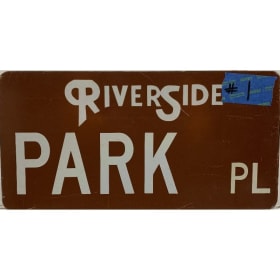
1. Park Place
$100
Starting bid
This street was part of Beebe's Central Subdivision ("Jim Town"). The name referred to Kimbark Woods directly to the north (now the Maplewood Road area) which was a favorite picnic location around the turn of the century.

2. Parkview Road
$100
Starting bid
This street was laid out, but not named by Olmsted. The name was apparently borrowed from Brookfield, which has a series of "___view" streets, including Parkview, Greenview, Southview, and at one time, Riverview (now the east part of Southview).
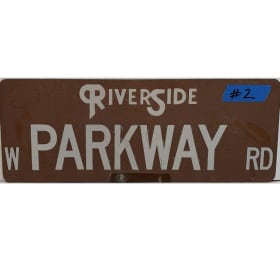
3. W. Parkway Road - Last remaining!
$100
Starting bid
The name "Parkway" was taken from the name of an Illinois Central Railroad station that used to be located just east of the present 26th Street rail crossing.
Last one - Don't miss out!

4. Pine Avenue - Last remaining!
$100
Starting bid
This was a part of Wesencraft's Homestead Addition. Although Olmsted did not lay out this area, he did mention in his preliminary survey that there was a good stand of pines here.
*Last one! Don't miss out!
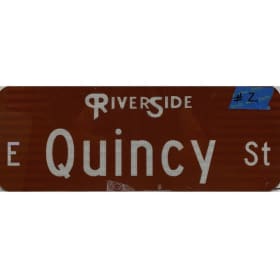
5. E. Quincy Street
$100
Starting bid
A name assigned by Olmsted in reference to the Chicago, Burlington, & Quincy Railroad (now Burlington Northern) which the street now parallels.
Quincy is a town in southern Illinois.
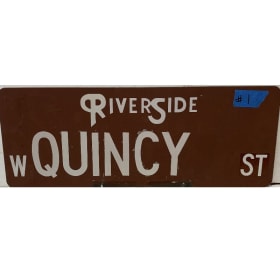
6. W. Quincy Street
$100
Starting bid
A name assigned by Olmsted in reference to the Chicago, Burlington, & Quincy Railroad (now Burlington Northern) which the street now parallels. Quincy is a town in southern Illinois.

7. Repton Road
$100
Starting bid
Named by Olmsted for Humphry Repton (1752-1818) an English landscaper and landscape writer.
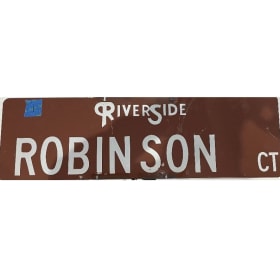
8. Robinson Court
$100
Starting bid
Olmsted laid this street out, but did not name it directly in his plan. He designated the south end of Delaplaine Road as Robinson Road. When the name Delaplaine was extended to cover Robinson Road, the name Robinson was moved to the present Robinson Court.
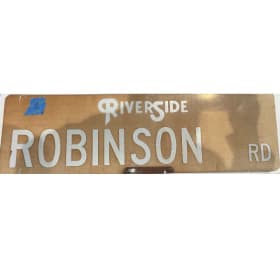
9. Robinson Road
$100
Starting bid
The name of this street is sometimes attributed to Alexander Robinson, who was an Indian chief friendly to white settlers, but there is nothing to suggest that Olmsted knew of Chief Robinson. It is more likely that Robinson Road is named after one of Olmsted's personal friends, William Robinson.

10. Scottswood Road
$100
Starting bid
This area was probably already named Scott's Wood when Olmsted came to plat Riverside. It refers to the American General Winfield Scott (1786-1866) who camped his troops here in 1832 to avoid a cholera epidemic then raging in Chicago. The soldiers were there to fight in the Black Hawk War.
Olmsted actually only named the east (southern-most) arm of Scottswood Road in his plan. The west (northern-most) arm was left unnamed. For a time, in the first part of the 1900's the arm appears on maps as West Common Road.
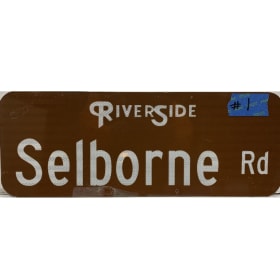
11. Selborne Road
$100
Starting bid
Named by Olmsted possibly for Roundell Palmer, First Earl of Selborne (1812-1895), a noted English jurist, member of Parliament, and writer on natural history.
Another possibility could be for Gilbert White (1720-1793), Anglican priest and author of "Natural History of Selborne," with which Olmsted was quite familiar.

12. Shenstone Road
$100
Starting bid
Named by Olmsted for William Shenstone (1714-1763), an English poet, essayist, and landscaper.

13. Southcote Road
$100
Starting bid
Named by Olmsted for British landscaper Philip Southcote (flourished, 1735).
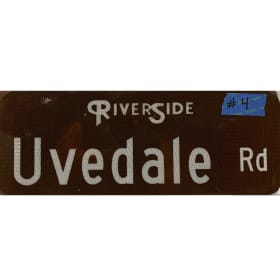
14. Uvedale Road
$100
Starting bid
There are two possible derivations of this name. There was an English horticulturalist named Robert Uvedale (1642-1722), whom Olmsted may have known of, and there was also a Sir Uvedale Price (1747-1829) who was a writer on the "picturesque" style, who heavily influenced Olmsted.
It is rather unusual to use a person's first name for a road, but Price's connection with Olmsted is well-documented, while Robert Uvedale's is not.
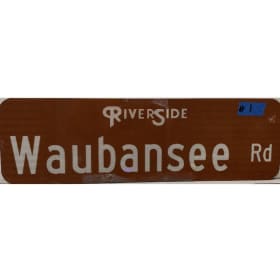
15. Waubansee Road
$100
Starting bid
Named after Olmsted's time, Waubansee was the chief of a small band of Pottawatomi, Chippewa, and Ottowa Indians who were friendly to white settlers and helped protect them during the Ft. Dearborn Massacre in 1815.
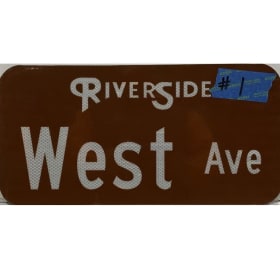
16. West Avenue
$100
Starting bid
This street was named for its location - at the west end of Wesencraft's Homestead Subdivision.

17. Woodside Road
$100
Starting bid
A name constructed by Olmsted for its physical characteristics. When Olmsted designed the village, the Maplewood Road area was not developed so there was nothing but woods on that side of town.

18. York Road
$100
Starting bid
Named for Sgt. Alvin C. York (1887-1964), the American World War I hero who single-handedly captured 132 German soldiers. Put in after 1939, York Road has been referred to as Thirty-First Street on at least one map.
Did you know? We fundraise with Zeffy to ensure 100% of your purchase goes to our mission!