

Art for Action - Benefit Auction
Helina Metaferia
$15,500
Starting bid
Retail Price: $ 15,500
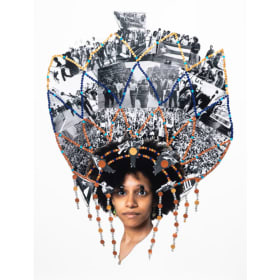
Headdress 74, 2025
Hand-cut and assembled media collage
30 × 40 in.
Unique
Helina Metaferia is an interdisciplinary artist whose work brings overlooked histories of activism into conversation with the present. Working across collage, performance, video, sculpture, and social engagement, she explores how histories of resistance are carried from one generation to the next. Headdress 74 is part of Metaferia’s ongoing By Way of Revolution series, which centers women of color whose contributions to social justice movements have often gone unrecognized.
Metaferia photographs contemporary activists and adorns their portraits with elaborate, hand-cut headdresses assembled from archival images of earlier generations of BIPOC activists. The crown becomes both archive and tribute: history quite literally rests upon the sitter’s head. Headdress 74 elevates its subject while making visible the generations of activism that precede and surround her. The result is at once an individual portrait and an image of collective power.
Helina Metaferia
$11,600
Starting bid
Retail Price: $ 14,500
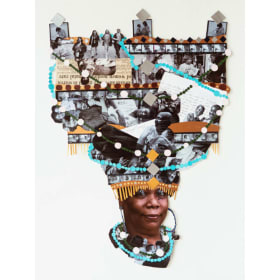
Crowning Care 1, 2021
Hand-cut and assembled media collage
26 × 38 in.
Unique
Helina Metaferia’s interdisciplinary practice brings visibility to histories and forms of labor that are too often overlooked. She is particularly interested in the roles women of color have played in sustaining families, communities, and movements for social change. Crowning Care 1 emerged from By Way of Care, a year-long project in which Metaferia worked with doulas and birth workers from Philadelphia’s Maternity Care Coalition.
Created as a meditation on caring for those who care for others, the series honors the invisible labor surrounding pregnancy, birth, and motherhood. Metaferia photographed participating birth workers and crowned them with collaged archival images drawn from the organization’s 40-year history of supporting pregnant women and young children. The headdress becomes both an emblem of honor and a visual archive.

Shinique Smith
$25,500
Starting bid
Retail Price: $30,000
Gathering Stars, 2025
Vintage African indigo cloths, artist’s clothing, denim, bleached and dyed fabrics from Breathing Room performances, and ribbon on wood panel
38 × 25 × 5 in.
Unique
Shinique Smith transforms clothing and textiles into richly layered abstractions that carry traces of personal memory, cultural history, and lived experience. Through gestures of gathering, folding, binding, and wrapping, everyday materials take on new physical and emotional weight.
In Gathering Stars, Smith brings together vintage African indigo cloths, denim, her own clothing, and bleached and dyed fabrics used in her Breathing Room performances, binding them with ribbon onto a wood panel. The dense, wall-mounted bundle connects to the sculptural forms for which Smith is known, while its deep blues and blacks draw us into her longstanding exploration of indigo. These same materials carry the memory of the body and performance into a new form—an accumulation of history, ceremony and personal experience held tightly together.
Mary WD Graham
$4,800
Starting bid
Retail Price: $ 6,000
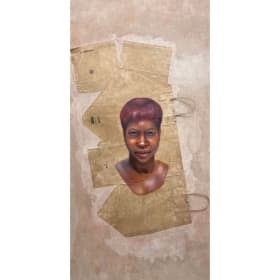
Value Test: Brown Paper – Rutherford, 2025
Oil on brown paper mounted on linen
24 × 48 in.
Unique
Mary W.D. Graham employs portraiture to investigate history, ancestry, and the ways ideas about identity and value are passed from one generation to the next. Her paintings often move between the individual and the collective, creating imagined figures that nevertheless feel strikingly present.
In Value Test: Brown Paper – Rutherford, the painting’s surface is integral to its meaning. The work refers to the historic “brown paper bag test,” is part of Graham’s ongoing exploration of colorism and the ways value has historically been assigned to gradations of skin tone. Painted directly onto brown paper, Rutherford is a fictional portrait assembled from multiple photographic sources. By creating an imagined individual from many faces, Graham shifts our attention away from categorization and toward personhood—inviting us to consider how inherited systems of value might be recognized, questioned, and ultimately transformed.
Mary WD Graham
$4,800
Starting bid
Retail Price: $ 6,000
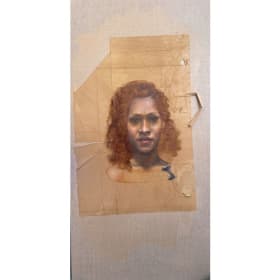
Value Test: Brown Paper – Murray, 2025
Oil on brown paper mounted on linen
24 × 48 in.
Unique
Mary W.D. Graham is a visual and performance artist whose work explores Black liberation, history, ancestry, and intergenerational exchanges. Moving between portraiture, sculpture, and performance, she considers how the past shapes both our understanding of ourselves and the possibilities we imagine for the future.
Value Test: Brown Paper – Murray belongs to Graham’s ongoing exploration of colorism and the ways value has historically been assigned to gradations of skin tone. The series references the “brown paper bag test,” a painful legacy of color-based social hierarchies within American life. Graham paints directly onto brown paper, transforming a material once associated with measuring and categorizing skin color into a surface for representation. Murray is not a portrait of a single individual, but a character constructed from multiple photographic references—allowing Graham to explore a collective history through an imagined, singular presence.
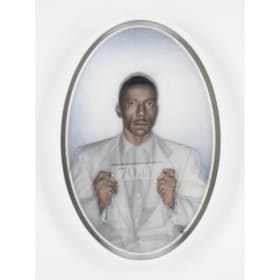
McCallum & Tarry
$6,300
Starting bid
Retail Price: $ 9,000
More Bishop (arrest #7041),
Study for The Evidence of Things Not Seen, 2008
Oil on linen, toner on silk
21¾ × 14¾ in. (framed)
Unique
Working collaboratively for more than a decade, Bradley McCallum and Jacqueline Tarry created art that examined race, representation, and remembrance. Their 2008 series The Evidence of Things Not Seen honors 104 people arrested during and following the historic 1955–56 Montgomery Bus Boycott.
More Bishop (arrest #7041) is based on the police mug shot taken at the time of Bishop’s arrest. McCallum & Tarry transformed this image by layering a finely rendered oil portrait on linen with the original arrest photograph printed on translucent silk. The two images coexist: the police record remains visible, but Bishop emerges from it as an individual rather than an arrest number. She reminds us that history is shaped not only by its most recognized figures, but by ordinary individuals willing to stand together for change.
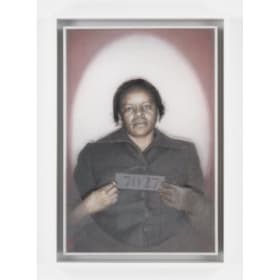
McCallum & Tarry (Copy)
$6,300
Starting bid
Retail Price: $ 9,000
Alberta J. James (arrest #7027),
Study for The Evidence of Things Not Seen, 2008
Oil on linen, toner on silk
20 × 14 in. (framed)
Unique
Bradley McCallum and Jacqueline Tarry’s collaborative practice often returned to questions of race, history, and whose lives enter our collective memory. In The Evidence of Things Not Seen, they turned their attention to 104 people arrested during and following the 1955–56 Montgomery Bus Boycott.
Alberta J. James (arrest #7027) began with a police mug shot. McCallum & Tarry recreated the image as an oil portrait on linen, then suspended the original photographic record, printed on sheer silk, over the painted surface. The arrest photograph—made to document and identify an alleged offender—becomes something very different when placed in dialogue with the long tradition of painted portraiture. James is presented not as evidence of an arrest, but as a person whose individual act of resistance formed part of a much larger struggle.

Daapo Reo
$6,400
Starting bid
Retail Price: $ 8,000
Top
the fabric of grief , 2026
Deconstructed U.S. flag, textile, twigs, raw cotton, iron
21 × 39 in.
Unique
Nigerian-born and based in New York, Daapo Reo reimagines national flags and textiles as materials through which personal and collective histories can be unraveled and remade. Drawing on his own experience of migration and belonging, his work explores the complicated promises embedded in national symbols.
In The Fabric of Grief, Reo deconstructs the American flag, combining its familiar fabric with raw cotton, twigs, textile, and iron. The flag becomes something more fragile and bodily—a material that can carry histories of loss as readily as ideals of freedom and belonging. Here, grief becomes something woven into the national fabric itself—held in bodies, families, communities, and the materials through which those histories endure.

Daapo Reo
$8,000
Starting bid
Retail Price: $ 8,000
Bottom
the fabric of hate, 2026
Deconstructed U.S. flag, textile, twigs, raw cotton, iron
21 × 39 in.
Unique
Daapo Reo uses flags and textiles to examine how national identity is constructed—and who is permitted to belong within it. Born in Nigeria and now living in New York, Reo brings autobiographical experience into conversation with larger histories of migration and power.
In The Fabric of Hate, Reo pulls the American flag apart and reconstructs it with textile, twigs, raw cotton, and iron, transforming a symbol of national unity into something fractured, tactile, and unsettled. The title points to the political and social divisions shaping contemporary life. By physically dismantling and remaking the flag, Reo reveals national identity as continually shaped by the histories—and conflicts—we choose to carry forward.
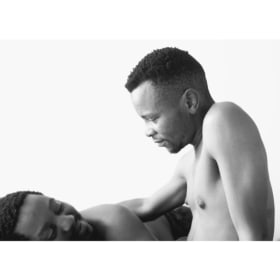
Lulu Mhlana
$1,920
Starting bid
Retail Price $2,400
Uthando Lwendoda (The Love of a Man), 2022
Hahnemühle Photo Rag 308 gsm
12½ × 17 in. (framed)
Edition 1 of 8
South African photographer Lulu Mhlana uses portraiture to explore intimacy, identity, and everyday life through a distinctly queer lens. Her photographs are often quiet and deeply personal, creating space for Black queer lives to be seen with tenderness and complexity.
Uthando Lwendoda (The Love of a Man), from Mhlana’s Uthando (Love) series, turns the camera toward the intimate spaces shared between partners. Mhlana photographs Black queer love it simply as part of life—as affection, companionship, desire, and belonging. Rendered in black and white, the image has an understated intimacy that draws the viewer close without making them intruders. Mhlana gives us a glimpse of love on its own terms: private yet recognizable, specific yet universal.

Nengi Omuko x Ituen Basi
$1,800
Starting bid
Retail Price: $ 1,800
To purchase stools visit the Benefit Exhibition Site
Edong Sheep Stools, 2026
Handcrafted stools upholstered in Aso Oke textile
Dimensions variable
Unique
Nengi Omuku is best known for her ethereal oil paintings on sanyan, a pre-colonial handwoven Yoruba textile whose history and material presence are integral to her work. With the Edong Sheep Stools, that relationship to Nigerian textile histories moves beyond the painted surface and into the realm of functional design. Created in collaboration with celebrated Nigerian fashion designer Ituen Basi, the stools are handcrafted and upholstered in Aso Oke, another Yoruba handwoven textile.
Conceived especially as a fundraiser for Omuku’s nonprofit organization, The Art of Healing (TAOH), each is a unique object that brings together contemporary art, Nigerian craft, and social purpose. Proceeds from the stools will support TAOH’s renovation of a state psychiatric clinic in Lagos that serves more than half of the city’s mental health cases. In these joyful, tactile objects, art and design become a direct path to care.

Alexandru Salceanu
$2,400
Starting bid
Retail Price: $3,000
Witness Collaborative – Genny Lim, 2025
Video portrait
Dimensions variable
Edition 1 of 3
Romanian-American artist Alexandru Salceanu explores migration, memory, and belonging through photography, video, and social practice. Drawing on his own experience of immigration, his work centers the personal histories we carry across cultures and generations. Witness Collaborative is his ongoing series of autobiographical video portraits created with immigrants and refugees.
This 2025 portrait features Genny Lim, the ninth San Francisco Poet Laureate, whose poetry and theater have given voice to generations of Chinese American experience. In Salceanu’s quietly observed video portrait, the act of remembering becomes an act of affirmation. Part portrait and part living archive, Witness Collaborative – Genny Lim preserves one individual’s experience while asking us to consider the larger histories of migration, resilience, and belonging carried within a single life.
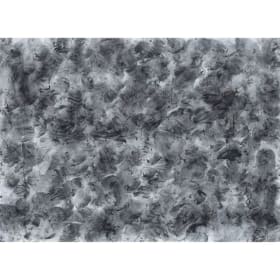

Jasmine Narkita Wiley
$8,900
Starting bid
Retail Price: $8,900
for the purpose of economics, self portrait, 2026
Indigo, acrylic, bleached denim
60 × 72 in.
Unique
Jasmine Narkita Wiley is an interdisciplinary artist and writer whose work brings together textiles, craft, the body, and the image to explore Black identity, visibility, and the gaze. Moving between the political and the spiritual, she is interested in how materials can hold histories while creating possibilities for repair.
Created during Wiley’s 2026 Black (Space) Residency at Minnesota Street Project, for the purpose of economics, self portrait is an abstract portrait made through direct contact with the artist’s body. Wiley applied indigo to her skin and pressed herself against cream-colored denim, leaving behind sweeping, abstract traces of her physical presence. The artists' body is recorded through gesture, pressure, and touch. Indigo and denim bring their own histories of labor, commerce, and Black experience to this intimate act of mark-making. At six feet wide, this self-portrait allows us to encounter the body through the marks she has chosen to leave behind.
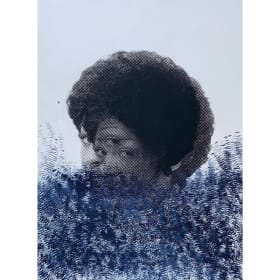
Jasmine Narkita Wiley
$1,900
Starting bid
Retail Price: $ 1,900
Watch_001, 2026
Indigo, acrylic, handwoven baskets, archival image from vintage Ebony magazine on Rives BFK
22 × 30 in.
Unique
In her interdisciplinary practice, Jasmine Narkita Wiley explores the complicated relationship between visibility and power—who gets to look, who is watched, and how Black subjects can reclaim agency over their own representation. Created during Wiley’s 2026 Black (Space) Residency, Watch_001 brings together indigo and acrylic, handwoven basket patterns, and an archival image from a vintage Ebony magazine.
These materials carry different forms of memory: the intimacy and labor of handcraft alongside a printed image drawn from an enormously influential archive of Black American life and representation. The title Watch turns looking into an active proposition, asking us to consider the difference between being seen and being watched—and what happens when the person or image under observation looks back. By bringing the handmade and the archival together, she creates a layered meditation on Black visibility, memory, and the power to shape one’s own image.


Thero Makepe
$1,080
Starting bid
Retail Price: $1,350
Outside Ruins (SADF Raid on Gaborone, 1985),
2020
Pigment print on Hahnemühle Photo Rag Baryta
40⅛ × 26¾ in.
Edition 3 of 10
Botswana-born photographer Thero Makepe explores the intertwined histories of Botswana and South Africa through the lens of his own family. Combining documentary photography, staged images, archival material, and reenactment, his ongoing series We Didn’t Choose to Be Born Here considers how political histories of apartheid resistance and loss are carried across generations.
Outside Ruins (SADF Raid on Gaborone, 1985) recalls the 1985 South African Defence Force raid on Gaborone, which targeted South African exiles and those believed to be supporting the anti-apartheid struggle. Makepe’s own family, who had sheltered political activists, survived the attack. Makepe photographs a place that reminded him of the houses targeted in the raid, creating a quiet and haunting image in which past and present converge and the landscape becomes a vessel for histories that endure long after the events themselves.


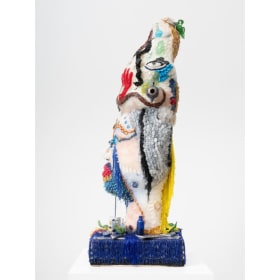

vanessa german
$51,000
Starting bid
Retail Price: $60,000
joy ritual # 1, 2025
Wood, plaster, plaster gauze, love, a tiny mirror, turquoise, the heat of making a new thing, beaded glass trim, carnelian, tiny mug that reads “forget me not,” blue glass bottle, jade, dyed howlite, cut glass, a way forward that does not require a gun
44 × 19½ × 16½ in.
Unique
vanessa german is a self-taught artist whose sculptures, performances, and communal rituals explore the transformative possibilities of love, creativity, and human connection. Her distinctive sculptural “power figures” combine wood, plaster, found objects, beads, glass, and gemstones with what german calls their less tangible ingredients: memory, joy, grief, hope, and the energies summoned through the act of making.
In joy ritual # 1, the materials tell the story. Turquoise, carnelian, jade, a tiny mirror, a blue glass bottle, and a miniature mug reading “forget me not” coexist with “love,” “the heat of making a new thing,” and, strikingly, “a way forward that does not require a gun.” Each is an ingredient, carrying its own history and potential power. Gathered into the form of a bust, they transform the sculpture into something more than an assemblage of objects: a vessel for joy, protection, remembrance, and possibility—a proposition that what we make, gather, and imbue with meaning, might help us imagine another way forward.

Sipho Nuse
$1,840
Starting bid
Retail Price: $2,300
Ncese II, 2023
Baryta print
24 × 16 in.
Edition 2 of 8
South African artist Sipho Nuse employs photography and self-portraiture to explore identity, masculinity, cultural heritage and his experience of growing up queer. His body becomes a space where vulnerability, cultural belonging, and self-definition meet.
In Ncese II, Nuse reflects on his experience of a Xhosa coming-of-age initiation marking the passage from boyhood to manhood. Crouched on cracked earth, his body covered with clay and wrapped in a white blanket edged in red, he meets the viewer’s gaze with vulnerability and resolve. The ritual carried conflicting expectations around masculinity and his queer identity. Nuse holds these tensions together, claiming the freedom to belong to his culture while defining manhood—and himself—on his own terms.





Ana Silva
$26,000
Starting bid
Retail Price: $ 26,000
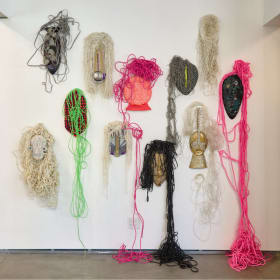
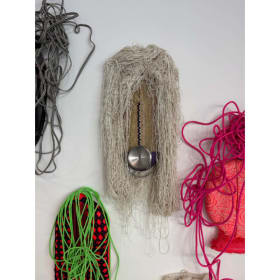
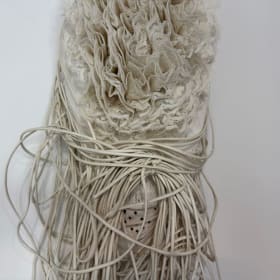
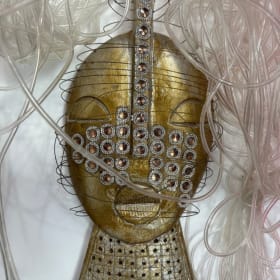
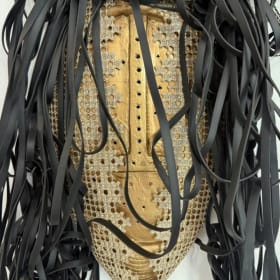
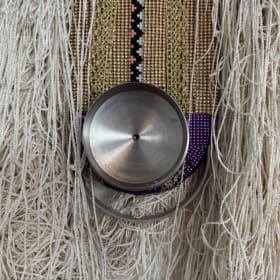
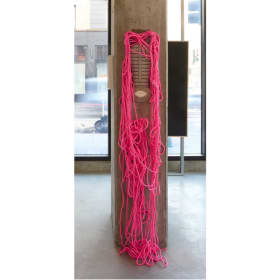
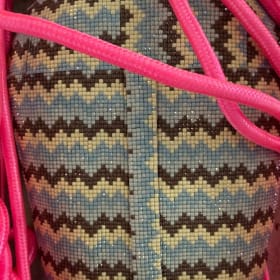
11 Masks, 2025
Wood, cords, fabric
Dimensions Variable
Ana Silva (born 1979, Calulo, Angola; based in Lisbon) builds a fiercely imaginative practice rooted in memory, material transformation, and the psychic charge of women’s histories.
Working on second-hand fabrics and woven plastic bags, Silva reclaims discarded materials to narrate women’s struggles, environmental precarity, and the fragile continuities of textile traditions. Her masks project extends this ethos. By revisiting and embroidering semi-abstract masks, she demystifies the African mask and restores its contemporary force. These reincarnations propose a modern Africa that honors ancestral knowledge while anticipating new futures.

Ana Silva
$2,800
Starting bid
Retail price: $ 3,500
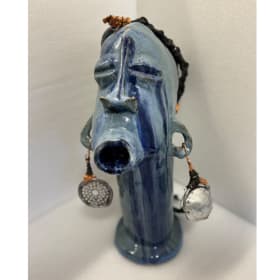
Single Mask, 2025
Wood, cords, fabric
Dimensions Variable
Ana Silva (born 1979, Calulo, Angola; based in Lisbon) builds a fiercely imaginative practice rooted in memory, material transformation, and the psychic charge of women’s histories.
Working on second-hand fabrics and woven plastic bags, Silva reclaims discarded materials to narrate women’s struggles, environmental precarity, and the fragile continuities of textile traditions. Her masks project extends this ethos. By revisiting and embroidering semi-abstract masks, she demystifies the African mask and restores its contemporary force. These reincarnations propose a modern Africa that honors ancestral knowledge while anticipating new futures.


Leilah Babirye
$31,500
Starting bid
Retail Price: $ 35,000
Batebe (Princess) , 2026
Clay, found materials
9 x 15 x 21 in.
Unique
Leilah Babirye is a Ugandan-born, New York–based artist whose work transforms the violence of exclusion into a radical, communal affirmation. A member of the Buganda LGBTQ community, she fled Uganda in 2015 after being publicly outed and threatened. Babirye builds a sculptural world where queer kinship, chosen families, and human dignity take center stage.
Working with found wood, discarded metal, ceramics, and repurposed everyday objects, she creates figures she calls “royals,” “clanspeople,” and “queer spirits.” These beings—at once tender and defiant—reimagine traditional Buganda clan symbolism through a queer lens. By elevating cast-off materials, Babirye mirrors the resilience of communities forced to live at the margins, insisting that what society rejects can become powerful, sovereign, and beautiful.
Did you know? We fundraise with Zeffy to ensure 100% of your purchase goes to our mission!