
Hosted by
Ukrainian Institute of America
About this event
Sales closed
UIA Online Auction | SAINTS: Photographs by Sasha Maslov

Roman Trokhymets, 32
$500
Starting bid
Photograph by Sasha Maslov (41” x 31” framed) | Before 2014, Roman studied at university, was into breakdancing, and organized parties — “Life was beautiful.” In 2015, Roman volunteered for the military but later returned to civilian life, studied psychology, and started working in real estate. In January 2022, Roman was vacationing at his friend’s villa in Montenegro. However, news of the impending invasion was already spreading. On February 23rd, Roman hosted a farewell party in Kyiv and headed to the Azov base, where he had served in 2015. “I always said I wouldn’t see the capture of Kyiv because either they won’t take it, or we’ll all lay dead defending it.” Roman fought near Kyiv until April, 2022, and then he and his unit were sent to the border between Zaporizhzhia and Donetsk regions. Once, with a single shot from an NLAW13, he destroyed a Russian IFV14, saving his entire platoon. After the campaign in South Ukraine, Trokhymets went to fight as a sniper in Bakhmut.
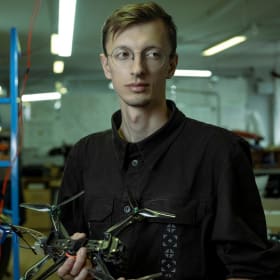
Maksym Sheremet, 28
$500
Starting bid
Photograph by Sasha Maslov (41” x 31” framed) | Before the full-scale war, Maksym worked as an engineer and was involved in the production and development of commercial as well as military drones. He worked for the large state defence company Ukroboronprom. Later, he worked for Evolve Dynamics, an engineering company specializing in UAVs. In March 2022, he founded Dronar- nia, his own small volunteer organization with ten members, and they began assembling combat drones. At that time, the team couldn’t have foreseen that the ongoing war with Russia would become a drone war, with both Russians and Ukrainians using drones extensively on the battlefield. A year on, the Ukrainian Armed Forces have used reconnaissance drones, kamikaze drones, and FPV drones for deliveries, and underwater drones now attack the Crimean Bridge and Russian ships in the Black Sea, while other domestically developed drones are reaching Moscow and striking targets hundreds of kilometers inland of Russia. There have also been cases when drones saved the lives of civilians or delivered food, medicine, and communication equipment to soldiers who were encircled. Now, Maksym Sheremet’s volunteer organization has grown, with over a 100 employees and more than two hundred volunteers involved in research and development. They manufacture and repurpose hundreds of various drones in their laboratory.

Lyudmila Huseynova, 62
$500
Starting bid
Photograph by Sasha Maslov (41” x 31” framed) | For Lyudmila, the war began in 2014 when her hometown, Novoazovsk, was occupied. She helped care for children abandoned when a local orphanage was shut down. For five years, she crossed the separation line, bringing aid from Mariupol to Novoazovsk. In 2019, Lyudmila was arrested by the so-called Donetsk People’s Republic for possessing a photo of a Ukrainian flag with the words “To the Patriots of Novoazovsk.” Accused of extremism and espionage, she was held at the notorious Izolyatsia prison, enduring psychological and physical abuse, before being transferred to a detention center in Donetsk with harsh but less degrading conditions.
After over three years in captivity, she was released in a prisoner exchange in October 2022. Since then, she has supported women suffering violence under occupation and advocated for those still detained. “These women have spent years in prison, missing their children and denied basic needs,” she says. Despite her ordeal, Lyudmila inspires others, proving that life can go on after unimaginable horrors. Holding a painting gifted by a cellmate in prison, she reflects on freedom: “To walk, to feel your people nearby — that is freedom.”

Yurii Kuznetsov, 54
$500
Starting bid
Photograph by Sasha Maslov (41” x 31” framed) | Yurii Kuznetsov, an orthopedic traumatologist in Izium, has spent most of his life in the city. When the war began on February 24, 2022, he picked up his son from Kharkiv but never considered leaving his hometown. By March, bombs were hitting Izium, and many doctors fled. On March 7, bridges were blown up to slow the Russian advance, cutting Yurii off from his family on the other side of the river.
Yurii’s shift lasted six months, from March to September. During the occupation, he treated 800 patients in a hospital with shattered windows, no electricity, and limited supplies. At first, he was the only doctor, working with a small team of nurses and trading medicine for fuel to run a generator. Russian soldiers stationed at the hospital frequently inspected the staff and patients, creating a constant sense of unease. Despite these challenges, Yurii managed to care for the wounded and chronically ill.
After the city’s liberation, Yurii remains a symbol of resilience, recalling with humor how two women later asked him to deliver their babies. “But now we have obstetricians,” he laughs.

Yulia Romanchenko, call sign Romashka, 43
$500
Starting bid
Photograph by Sasha Maslov (41” x 31” framed) | Junior sergeant Yulia leads a group of sappers in the Support Forces of the Armed Forces of Ukraine. She worked as a policewoman, however, she joined the army in 2020, and has been serving as
a sapper since 2021. Throughout the fall of 2022, Yulia was demining the de-occupied territories of the Kharkiv region. Most often, they were neutralizing Russian mines near power lines to restore electricity to the devastated villages and towns, especially as winter was approaching. The Russians intentionally targeted transformer substations and blew up utility poles to cut off power. Yulia’s team tried to demine all of these facilities, but the territory was vast, and sometimes, they could only locate the mines and place warning signs. During their work in the Kharkiv region in the fall, four civilians were blown up by landmines despite warnings not to enter an uncleared area.
Romashka worked in Bakhmut and the surrounding areas throughout the winter. She laments the loss of the city, saying, “It’s a shame that the city is no longer there, landmarks are gone and houses destroyed.” Despite the constant risk involved in a sapper job, Julia believes that it’s her calling and that one can quickly determine whether this line of work is suitable for them during training. It requires balance, composure, and caution.
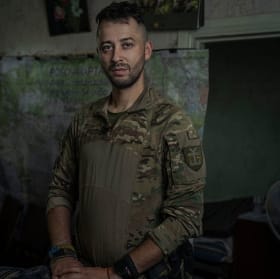
Kyrylo Veres, 35
$500
Starting bid
Photograph by Sasha Maslov (41” x 31” framed) | Kyrylo Veres has been a legend in military circles since he began fighting in Donbas in 2014 at just 24. Among his achievements was capturing two Russian intelligence agents later exchanged for Nadia Savchenko. Over nine years, he rose from soldier to major, spending all his time on the front lines. A Hero of Ukraine, he commands the renowned K2 battalion of the 54th Mechanized Brigade.
A modern-day Cossack in spirit and leadership, Veres thrives on outsmarting the enemy. Since the full-scale invasion, his unit has held one of the toughest front-line positions in Donetsk without rotation. In March 2023, they stormed Russian positions with tanks, one flying the Ukrainian flag. When questioned, Veres replied: “It’s not just a tank—it’s our flag weighing 50 tons.” Bold, strategic, and relentless, he embodies the future of Ukraine’s military.
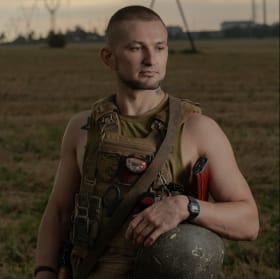
Viktor Pylypenko, call sign Frenchman 37
$500
Starting bid
Photograph by Sasha Maslov (41” x 31” framed) | Junior sergeant Viktor Pylypenko evacuates wounded soldiers from the town of Vuhledar in the southern Donetsk region, where there are now no buildings left standing. Pylypenko is a member of the evacuation team of the 72nd Brigade named after the Black Zaporozhians. "I constantly see death, often horrific death. Our battalion is mechanized, and people are constantly burning alive in the vehicles. I am also afraid of getting burned because we evacuate the wounded in an armored evacuation vehicle. The worst is when young guys, 20–21 years old, die, and you remember how they cried before going into battle. It doesn't affect you directly, but I've been through several stages of PTSD— depression, apathy, and I can see it coming for many," says Viktor. Pylypenko had a successful career and a contract job in Dubai when the Euromaidan Revolution started. He took a vacation leave from his job in the UAE to be on the Maidan and, eventually, after this short leave, he quit his job, stayed at the Maidan, and joined the Self-Defence Groups. He later went to fight for a year and a half in the Donbas Volunteer Battalion and took part in combat for Shyrokyne near Mariupol. When he returned from the war, he faced post-traumatic stress disorder (PTSD). "I came back, my wounds were healing, and then this issue with 'gays at war' started. Those who weren't in combat were the ones pushing this narrative, and I came back from the front, and they were telling me, 'You weren’t even on the front line, and you're enemies of the people.'" That's why in 2018, Pylypenko decided to come out publicly as gay. "It was my fight for justice. I really like the name of the 2014 revolution — the Revolution of Dignity. And to me, it's that word 'dignity' — I fight for that too." He says that since then, he has only encountered two cases of homophobia. "In 2019, I was standing near the memorial wall for the fallen near St. Michael's Golden-Domed Monastery, talking to a wounded soldier I had pulled from the battlefield. A priest who had been in the Donbas Battalion with me, my comrade, attacked me. He found out that I had come out, and he attacked me." Another incident occurred during this ongoing war when a soldier didn't want Pylypenko to check his first aid kit because he knew Pylypenko was openly gay. "I heard them whispering behind my back, but my comrades took care of them. I don't think the Ukrainian army is homophobic now. In the community I lead, there are 370 LGBTQ+ military members. Most of them are discreetly gay. But I don't see them having many problems, and if they do occur, they get resolved." "Homophobia is Russia," Viktor says — it becomes obvious when looking at the ranks of the Ukrainian Army today.
Did you know? We fundraise with Zeffy to ensure 100% of your purchase goes to our mission!