We use cookies to improve your experience on our platform. By clicking “Accept all cookies”, you agree to the storing of cookies on your device to enhance site navigation, analyze site usage and assist in our marketing efforts.
Cookies required for basic website functionality.
Cookies used to deliver content most relevant to you and your needs.
Cookies used to deliver content most relevant to you and your needs.
Cookies that help understand the performance of the website, how users interact with it and to identify bugs.
How is Zeffy free?
How is Zeffy free?
Zeffy relies entirely on optional contributions from donors. At the payment confirmation step - we ask donors to leave an optional contribution to Zeffy.
December is the busiest giving month of the year. According to the M+R 2026 Benchmarks, 37% of annual online revenue comes in during December, and the last week alone drives 10% (with Dec. 31 by itself at 4%). For a small nonprofit, that one month can be the difference between hitting your annual goal and starting January in the hole.
Here is the honest read most holiday-ideas lists skip: picking five ideas is the fastest way to burn out a three-person team. And running any of them on a platform that clips 3–6% in fees means a $10,000 December fundraiser quietly leaks $300–$600 before it reaches your mission.
This list scores 17 ideas the way a small nonprofit actually has to think about them: cost to run, volunteers needed, realistic revenue, lead time, and a plain verdict on whether a three-to-eight-volunteer team can pull it off in 8 weeks. Grouped by lane, events, markets, contests, campaigns, cheapest and highest-yield first.
Small-NPO recommendation: pick ONE event that fits your volunteer count, plus ONE always-on peer-to-peer campaign running Nov 1 through Dec 31. Not five. One and one.
Why holiday fundraising matters for nonprofits in 2026
The math is real: December is 37% of your online year, and the final week is 10% (M+R Benchmarks 2026). That is not a "nice to have" season. It is your single biggest fundraising window.
But here is where small nonprofits lose the bump: fees. A typical platform charges a platform fee plus payment processing (often around 2.9% + $0.30 per transaction). Stack those and you are looking at 3–6% gone before the money lands. On a $10,000 December push, that is $300–$600 that funds someone else's platform instead of your mission.
Zeffy is built so $100 in equals $100 out. The ideas below all assume you are running them on infrastructure that does not skim the proceeds, because at this volume, the platform you choose decides whether December dollars fund your mission or get clipped before they arrive.
For a small nonprofit: the season works in your favor only if you do less, not more. One realistic event plus one always-on peer-to-peer page beats five half-finished campaigns every time.
Holiday events that bring your community together
Event ideas are the highest-yield lane, but they demand the most volunteer hours and the longest lead time. Cheapest, smallest-team ideas first.
1. Holiday movie night
Rent a local theater, community center, or outdoor space and screen a holiday classic. Sell tickets, run a concession table (popcorn, hot chocolate, candy), and add a pre-show activity like caroling or a visit from Santa.
Cost: $ (venue + film license, $100–$400)
Volunteers: 3–5
Revenue range: $500–$3,000
Lead time: 4–6 weeks
Verdict: ✅ realistic for small teams. Lowest-effort event on this list. Sell tickets for free with Zeffy and skip the per-ticket fee that most ticketing tools take.
2. Holiday storytelling night
People share favorite holiday memories or traditions, or invite Santa or Mrs. Claus to read a few tales. Add hot chocolate, baked goods, and a small merch table. Low setup, high warmth.
Cost: $ (venue donation often available)
Volunteers: 3–4
Revenue range: $400–$2,000
Lead time: 4–6 weeks
Verdict: ✅ realistic. Best fit for orgs with a library, church, or community partner who will donate space.
3. Holiday-themed DIY workshop
Run a 2-hour workshop (online or in person) where guests make tree ornaments, wreaths, holiday cookies, or cards. Charge a ticket price that covers materials plus a margin. People show up empty-handed and leave with something they made.
Cost: $$ (materials, $150–$600)
Volunteers: 4–6 (one instructor + helpers)
Revenue range: $800–$3,500
Lead time: 6–8 weeks
Verdict: ✅ realistic if one of your team can teach a craft. Use ticketing to cap attendance to your material count.
4. Santa's workshop with a suggested donation
Smaller towns often lack a public Santa visit. Step in: book a Santa (often a volunteer), set up games, storytelling, and a photo station. Charge a suggested donation for entry and an add-on for printed photos.
Cost: $$ (Santa costume + props, $200–$500)
Volunteers: 6–10
Revenue range: $1,500–$6,000
Lead time: 8–10 weeks
Verdict: ✅ realistic if you have a volunteer parent network. Skip unless you can secure a free or sponsored venue.
5. Pet photos with Santa
Partner with a local pet store, groomer, or shelter. Charge per photo, sell branded pet-related merch on the side, and let dogs and cats steal the show on social media.
Cost: $$ (props + photographer, $300–$700)
Volunteers: 4–6
Revenue range: $1,200–$4,500
Lead time: 6–8 weeks
Verdict: ✅ realistic and Instagram gold. Best fit if you have a pet-store partner willing to host.
6. Holiday gala
Formal attire, multi-course dinner, live music, dancing, and a live or silent auction. Bring in a keynote speaker or beneficiary to tell the impact story. This is the highest-revenue idea on this list, and also the highest-risk.
Cost: $$$ (venue + catering, $3,000–$15,000)
Volunteers: 15+
Revenue range: $10,000–$75,000+
Lead time: 4–6 months
Verdict: ❌ skip unless you have 15+ volunteers, a real donor list, and at least 4 months. Galas reward orgs with infrastructure and punish orgs without it. If you do run one, run the auction for free on Zeffy so the bid total is what your mission actually gets.
Holiday sales and markets
Sales lanes have lower revenue ceilings than gala-type events but lower risk too. Most can be run by 2–4 volunteers and use simple tooling: a free online store and a way to take cards in person.
7. Gift wrapping service
Set up a wrapping station at a mall, bookstore, or local retailer during shopping season. Tiered pricing by gift size. Volunteers wrap, donors give. Zero inventory risk.
Cost: $ (wrapping paper + ribbon, $50–$150)
Volunteers: 4–6 across shifts
Revenue range: $400–$2,500
Lead time: 3–4 weeks
Verdict: ✅ the easiest entry-level idea on this list. Collect on-site with Tap to Pay, turn a volunteer's phone into a card reader with no extra hardware.
8. Holiday bake sale
Volunteers bake; you sell cookies, pies, breads, and pre-made gift baskets at a community center, local business, or alongside a holiday market. Offer a vegan and gluten-free tier to widen the buyer base.
Cost: $ (ingredients donated by volunteers)
Volunteers: 5–8
Revenue range: $300–$1,800
Lead time: 2–4 weeks
Verdict: ✅ classic for a reason. Pair with a raffle table to lift average spend per visitor.
9. Virtual holiday market
Set up an online marketplace where local artisans, crafters, and small businesses sell holiday products. Charge vendors a flat participation fee, take a percentage of sales, or both. You handle promotion; they handle fulfillment.
Cost: $ (mostly your time)
Volunteers: 2–3
Revenue range: $1,000–$8,000
Lead time: 6–8 weeks
Verdict: ✅ best fit if you already have artisan contacts. Open a free online store to host the market without giving up margin to platform fees.
10. Gingerbread house kits
Pre-assemble decorating kits (gingerbread pieces, icing, candy) and sell them online or at a market. Lower margin than baked goods but a higher unit price.
Cost: $$ (supplies, $200–$500)
Volunteers: 4–6
Revenue range: $600–$3,000
Lead time: 5–7 weeks
Verdict: ✅ realistic but inventory-heavy. Pre-sell through your online store before you buy supplies so you do not overproduce.
11. Holiday cookbook
Collect favorite holiday recipes from your community (volunteers, board, beneficiaries, local restaurants) and compile them into a printed or digital cookbook. Sell year after year as evergreen merch.
Cost: $$ (design + print run, $400–$1,500)
Volunteers: 3–5
Revenue range: $500–$4,000
Lead time: 3–4 months
Verdict: ❌ skip unless you can start in August. The lead time kills this one in November. Worth it as a multi-year asset if you plan ahead.
Fun competitions and contests
Contests work because they invite participation, not just donation. Each one pairs naturally with a peer-to-peer fundraising page, every entrant becomes a fundraiser for you.
12. Ugly sweater contest (online)
Donors enter by sharing a photo with a specific hashtag and a donation. Award prizes for ugliest, funniest, and most creative. Runs almost entirely on social media with basically zero production cost.
Cost: $ (prize budget, $50–$200)
Volunteers: 2–3
Revenue range: $300–$2,500
Lead time: 2–3 weeks
Verdict: ✅ the cheapest idea on this list. Best fit for orgs with an active social following.
13. Gingerbread house contest
Entrants pay to submit; community votes online or in person. Charge a small voting fee on top of entries. Pairs naturally with a market or bake sale.
Cost: $ (judging materials, $50–$150)
Volunteers: 3–4
Revenue range: $400–$2,000
Lead time: 4–6 weeks
Verdict: ✅ realistic. Run the voting through a simple donation form where each $1 = one vote.
14. Ugly sweater run/walk
5K or fun run where participants wear their most outrageous holiday sweaters. Hot drinks and snacks at the finish line, prizes by category, registration fee per runner, and team-based fundraising pages that turn every runner into a fundraiser for you.
Cost: $$ (route permits, signage, $300–$1,200)
Volunteers: 8–12
Revenue range: $3,000–$25,000+
Lead time: 3–4 months
Verdict: ✅ very high yield, but only if you run it as a free peer-to-peer campaign. The fundraising pages from individual runners are where the real revenue lives, registration fees alone do not justify the lift.
Creative holiday campaigns
Campaign-style ideas run longer than a single event. They reward consistency, not a single big night. Most can run with two or three core volunteers if the tooling does the work.
15. Carol-gram fundraiser
Sell personalized carol-grams (virtual or in person) where your team sings or plays holiday songs for donors or businesses. Add-ons: candy canes, eggnog delivery, Santa appearance.
Cost: $ (mostly time)
Volunteers: 4–6 (singers)
Revenue range: $400–$2,500
Lead time: 4–6 weeks
Verdict: ✅ realistic and memorable. Best fit if you have musical volunteers and a local business district.
16. Advent calendar fundraiser
A digital or physical advent calendar that reveals a small surprise each day from Dec 1 to Dec 24, a holiday joke, donor story, video message from beneficiaries, or a daily donation prompt. Sell calendars individually or ask for a daily donation to unlock each day.
Cost: $ (digital) to $$ (printed)
Volunteers: 2–3
Revenue range: $500–$4,000
Lead time: 8–10 weeks (must start in October)
Verdict: ✅ realistic but unforgiving on lead time. Skip unless you start in October.
17. Donations as gifts
Position a donation in someone's name as the gift itself. It works for teacher gifts, hosts, secret Santa, hard-to-shop-for relatives, and corporate gifting. Offer a printable card or e-card the donor can hand off.
Cost: $ (card design)
Volunteers: 1–2
Revenue range: $1,000–$10,000+
Lead time: 4–6 weeks
Verdict: ✅ the highest-yield-per-volunteer-hour idea on this list. Works for orgs of any size, a free donation form with a "this gift is in honor of…" field is all the tooling you need.
The polar plunge (honorable mention)
If you have a local body of water and brave volunteers, a polar bear plunge pairs perfectly with peer-to-peer fundraising. Participants ask family and friends for sponsorship donations to support their icy endeavor. Add a hot-chocolate competition at the finish and sponsor a few local-business prize donors. Cost: $$ (permits, safety), Volunteers: 6–10, Revenue: $2,000–$15,000, Lead time: 8–10 weeks. Verdict: ✅ realistic if you have water access. Run it as a peer-to-peer campaign so every plunger raises from their own network.
How Horses Without Humans Rescue raised $40,000 and kept every dollar
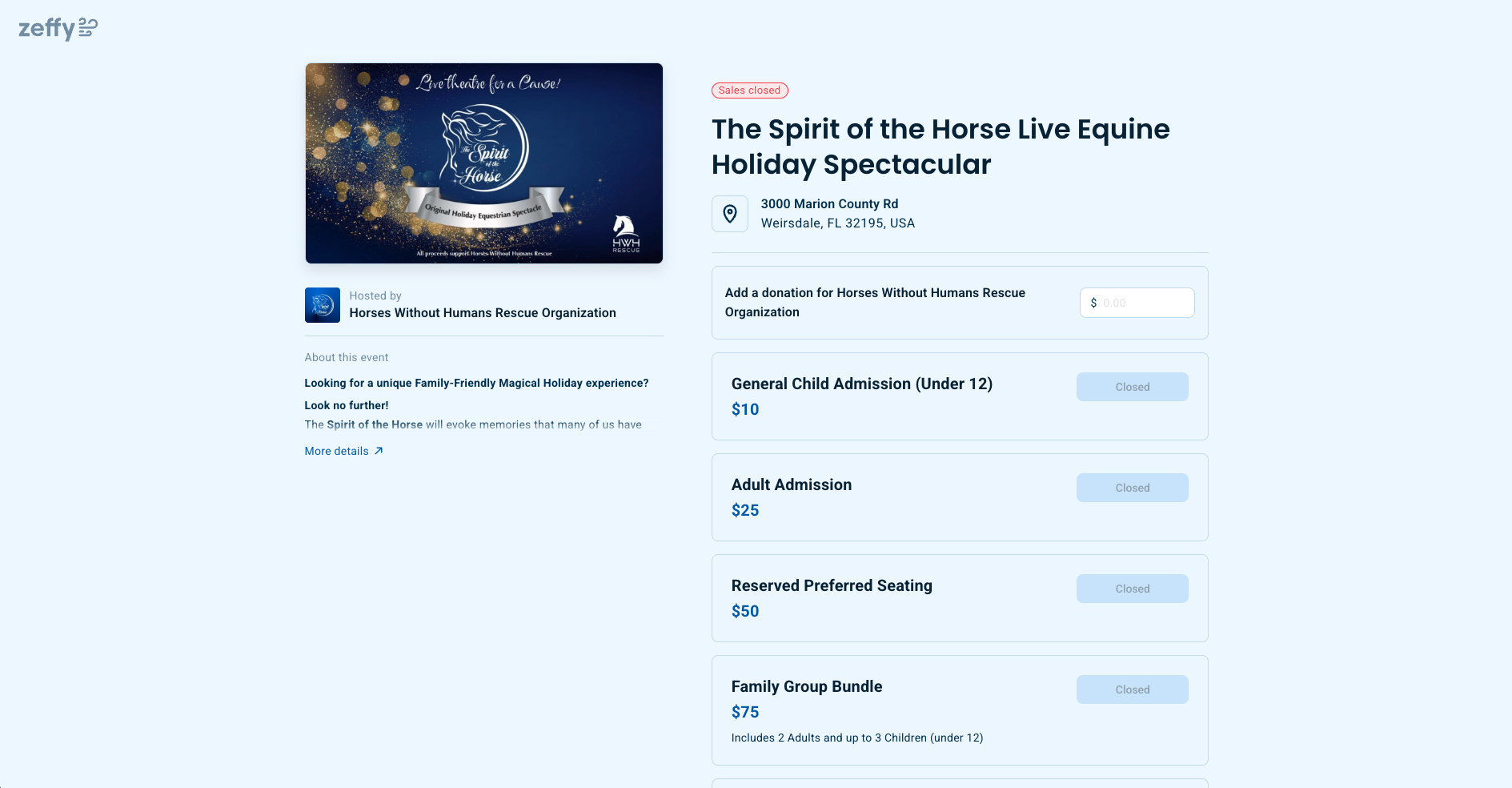
Horses Without Humans Rescue, an organization that rescues, trains, and educates riders on improving equine welfare, ran a holiday campaign called The Spirit of the Horse Live Equine Holiday Spectacular to fund its mission.
They needed a ticketing platform that was customizable (branded page, multiple ticket types) and that did not skim the proceeds. With Zeffy, they built a branded fundraising page, sold tickets, and ran the whole campaign without paying a platform cent. The result: $40,000 raised and $2,000 saved in fees.
That $2,000 is the standpoint of this whole article in microcosm. It is one more month of feed, one more vet visit, one more rescue. The idea matters. The platform underneath it decides how much of the idea reaches your mission.
Start 3–4 months early. The orgs that hit their December numbers started in August. Build a timeline with key milestones, campaign design, content, donor segmentation, tech setup, and protect November and December for connecting with donors. For a deeper planning guide, see our peer-to-peer fundraising guide. For a small nonprofit: the best gift you can give your future December self is a calendar booked in August.
Use peer-to-peer to multiply reach. Peer-to-peer turns your supporters into fundraisers. Each one taps a network you would never reach on your own. Halifax Lancers set a $15,000 goal, recruited 50+ individual and team pages, and surpassed it by over $10,000, more than $25,000 raised in just a few days. Even a 5-person team can recruit 20–30 peer fundraisers and double their reach.
Be transparent about goals and progress. Spell out the goal in concrete terms ("We're raising $50,000 to provide 1,000 holiday meals") and show how the money will be used. Share mid-campaign progress and results after the campaign closes. The Endowment Fondation de Jonquire Health runs a Campaign of Lights every year: each donation buys a light for the Christmas illumination in front of the Jonquire hospital, with a live thermometer on their website. Donors see exactly what their money did. A one-paragraph progress update on Dec 15 lifts final-week donations more than a third email blast does.
Follow up mid-campaign and at year-end. People mean to give and forget. Send a mid-campaign update with a new story and a clear ask, then a final-week reminder built around the deadline. December 31 alone drives 4% of annual online revenue (M+R 2026). And thank donors properly after the gift comes in. Two well-timed reminders beat ten clever ones.
Run your holiday fundraiser for free with Zeffy
Zeffy is the only 100% free fundraising platform for nonprofits. 100K+ nonprofits trust Zeffy to run donation forms, event ticketing, peer-to-peer campaigns, online stores, and Tap to Pay, every tool you need for any of the 17 ideas above, all in one place, all free. Together, those nonprofits have raised $2B+ on the platform.
That is how Halifax Lancers raised over $25,000 on a $15,000 goal. That is how Horses Without Humans Rescue raised $40,000 and saved $2,000 in fees. Every dollar not spent on platform and processing fees is one more meal, one more ornament, one more rescue funded.
For a team of 3–8 volunteers with a limited budget, the highest-yield-per-hour ideas are donations as gifts, gift wrapping services, and an online ugly sweater contest. All three cost almost nothing to set up, take 2–4 weeks of lead time, and pair well with an always-on peer-to-peer page. Skip the gala unless you have 15+ volunteers and a 4-month runway.
It depends on your idea and team size. A simple online ugly sweater contest might land $300–$2,500. A holiday market or DIY workshop typically lands $800–$3,500. A peer-to-peer ugly sweater run/walk can land $3,000–$25,000+. A gala with the right donor list can clear $75,000+ — but galas also carry the highest cost and risk. Set a goal based on past years and break it into concrete milestones.
3–4 months before launch. For a December campaign, that means starting in August or September. The biggest preventable mistake small teams make is starting in October and trying to compress 12 weeks of work into 6. Advent calendars, galas, holiday cookbooks, and ugly sweater runs all need the longer runway.
According to M+R 2026 Benchmarks, 37% of annual online revenue happens in December, the last week of the year alone accounts for 10%, and Dec. 31 by itself accounts for 4%. End-of-year giving is driven by a mix of tax deductibility, holiday generosity, and intentional year-end campaigning. Miss December and you miss roughly a third of your online year.
Most platforms charge a platform fee plus payment processing — commonly around 2.9% + $0.30 per transaction — which together typically runs 3–6% of what you raise. On a $10,000 December push, that is $300–$600 gone before the money reaches your mission. Zeffy charges no platform fee, transaction fee, or credit card fee. Keep 100% of every donation.
Look for one that supports individual and team fundraising pages, a campaign thermometer you can embed on your website, and no per-transaction fees. Halifax Lancers built 50+ individual and team pages on Zeffy in a few days and ended up raising more than $25,000 on a $15,000 goal. Zeffy's peer-to-peer tooling is free for nonprofits.
Look for people who attend related events, follow relevant Facebook groups, or subscribe to aligned newsletters.These aren’t just potential donors—they’re your future advocates.
Look for people who attend related events, follow relevant Facebook groups, or subscribe to aligned newsletters.These aren’t just potential donors—they’re your future advocates.






.webp)

