How is Zeffy free?

How is Zeffy free?
Zeffy relies entirely on optional contributions from donors. At the payment confirmation step - we ask donors to leave an optional contribution to Zeffy.
Learn more >

Giving Tuesday 2026 is Tuesday, December 1: plan about four weeks out with one goal, one audience, one dedicated form and three emails. Our guide on how to run a Giving Tuesday campaign has the full week-by-week timeline. Plan your thank-you before the day, because Giving Tuesday runs straight into year-end giving.
The first eight campaigns raised money on Zeffy around Giving Tuesday 2025; the last three are from earlier years. They range from $38,226 down to $2,081. Each entry shows what the campaign raised, when, and the tactic you can copy.
1. House Rabbit Network: a match with a short, clear window
2. Phoenix Animal Rescue: a match plus a monthly ask
3. Home for Good Dog Rescue: a live progress bar
4. Congregation Beth Sholom: gifts tied to the season
5. Redmond Academy of Theatre Arts: supporter pages and a local perk
6. Marian Anderson Neighborhood Academy Supporters: show what gifts buy
7. Athens Area Homeless Shelter: one family's holiday, priced
8. Hobe Sound Tennis Academy: a job for every gift size
9. 100 Humanitarians International’s Giving Tuesday Gala
10. Centraide Outaouais’s Snowsuit Giving Tuesday Campaign
11. Hudson County Complete Streets’ Giving Tuesday Campaign
House Rabbit Network is a rabbit rescue. It raised $38,226 from 378 gifts on Zeffy between November 24 and December 12, 2025.
What to copy: Tell donors each gift will count twice through a match, and give the match a short, clear window. Say what gifts pay for. Here, that was emergency vet care and safe shelter.
Phoenix Animal Rescue is a dog rescue. It raised $14,102 from 135 gifts on Zeffy between November 21 and December 13, 2025.
What to copy: Promise matched gifts up to a set amount (theirs was $5,200) and tell donors what a gift buys, like vaccines that protect puppies. Then invite your Giving Tuesday donors to give monthly.
Home for Good Dog Rescue is a dog rescue. It raised $12,440 from 113 gifts on Zeffy between November 20 and December 13, 2025, past its $7,000 goal.
What to copy: Put your goal on a live progress bar. List what gifts pay for, from heartworm treatment to a safe ride north.
Congregation Beth Sholom is a synagogue. It raised $10,191 from 17 gifts on Zeffy between November 26 and December 8, 2025.
What to copy: Give each gift a job tied to the season, from Chanukah candles to the eternal light in the sanctuary. A small, loyal community can give a lot when every gift has a clear purpose.
Redmond Academy of Theatre Arts is a youth theater. It raised $4,463 from 10 gifts on Zeffy between November 17 and December 3, 2025.
What to copy: Let supporters start their own fundraising pages under your campaign. Name what gifts cover (costumes, performance rights, scholarships), and thank larger gifts with a local perk.
Marian Anderson Neighborhood Academy Supporters is a school support group. It raised $2,956 from 23 gifts on Zeffy between December 1 and 9, 2025.
What to copy: Show what gifts pay for (robotics clubs, desks, teacher mini-grants) and let supporters start their own pages.
Athens Area Homeless Shelter is a homeless shelter. It raised $2,163 from 16 gifts on Zeffy between November 25 and December 13, 2025.
What to copy: Price one family's holiday in gift cards, and say where extra funds go (here, childcare and shelter costs). Have groups fundraise as teams.
Hobe Sound Tennis Academy is a youth sports program. It raised $2,081 from 13 gifts on Zeffy between December 2 and 5, 2025, past its $1,500 goal.
What to copy: Give each gift a job at every size, from $10 for two cans of tennis balls to a week of summer camp. Put the goal on a live progress bar.
What these campaigns have in common: one clear need, a visible goal or a match, and an ask to share.
100 Humanitarians International earned $18,500 with an engaging Giving Tuesday gala. The evening of community and giving invited donors to come together to celebrate with a clear goal: to support families in Kenya.
The organization sold tickets to the gala through Zeffy’s ticketing forms and clearly outlined the fundraiser's purpose, which was to encourage further generosity. Because Zeffy is free to use and doesn’t charge additional transaction fees, 100 Humanitarians International was also able to save $925 that could go back to the cause.
Inspiration for your campaign
Centraide Outaouais made a big impression with a Giving Tuesday campaign with a simple mission: to raise donations to provide a snowsuit for a needy child. The free donation form they set up through Zeffy helped them raise $19,360, which provided 322 snowsuits at $60 a piece.
Even more, the $968 they saved in fees helped them provide 16 additional snowsuits to the underprivileged youth they serve. A clear goal and visual impact of every donation helped rally community members to make a big difference for the timely winter season on Giving Tuesday.
Inspiration for your campaign
Hudson County Complete Streets cleverly combined its Giving Tuesday and End-of-Year Gift campaigns to maximize fundraising during the holiday season. Kicking off on Giving Tuesday, the campaign called on donors to contribute to safer streets with an enticing donation match from a Founding Donors group.
The organization raised $13,112 and saved $655 in fees with Zeffy’s free fundraising platform. It used its campaign page to educate supporters and welcome them to join its mission.
Inspiration for your campaign
For a small nonprofit, the takeaway is simple: none of these campaigns needed a big team. They needed one clear story and one place to give.
You don't need all of these. Pick one, maybe two. Each idea is tagged so you can skim:
Want a head start on the writing? Get Giving Tuesday emails and posts written for your cause, then come back and pick your idea.
1. Build a dedicated Giving Tuesday form ✅
2. Run a lapsed-donor comeback campaign ✅
3. Show what each gift buys ✅
4. Send a three-email Giving Tuesday sequence ✅
5. Post a Giving Tuesday countdown on social media ✅
6. Use the #GivingTuesday hashtag ✅
7. Run a storytelling campaign ✅
8. Invite Giving Tuesday donors to give monthly ✅
9. Start a giving challenge ✅
10. Let supporters fundraise on their own pages ✅
11. Stretch it into a giving week ✅
12. Mail a printed Giving Tuesday letter to lapsed donors ✅
13. Host a short online Q&A or info session ✅
14. Hold a silent auction or event on the day ⚠️
15. Put a live thermometer on a screen at your event ✅
16. Arrange a donation match ⚠️
17. Team up with a local business ⚠️
18. Work with a local influencer ⚠️
What it is: One donation form used only for Giving Tuesday, with its own link, a goal thermometer and a QR code you can print.
Who this suits: Every nonprofit. This is the base for every other idea on this list.
How to set it up: Build a dedicated donation form with a goal thermometer and QR code. Add two to four suggested amounts, each with a line on what it pays for. Put the QR code on flyers, posters and your printed newsletter.
Seen in: Home for Good Dog Rescue and Hobe Sound Tennis Academy, which both put their goal on a live progress bar and passed it.
What it is: A Giving Tuesday ask sent only to people who gave before but haven't given in a while. Keep them on a list separate from your year-end campaign.
Who this suits: Any group with a past donor list, even a small one. One nonprofit we spoke with aimed its whole Giving Tuesday campaign at lapsed donors and called it very successful.
How to set it up: Filter your list to lapsed donors and email them separately. Send them three emails: one the week before, one on the day, one last call that evening.
What it is: Give every gift a job. "$10 buys two cans of tennis balls." "$60 buys one snowsuit." You can also build this around last year's impact report.
Who this suits: Any cause where you can put a price on a concrete thing: a meal, a vet visit, a costume.
How to set it up: Write one line under each suggested amount on your form. Repeat the same lines in your emails and posts.
Seen in: Congregation Beth Sholom, Hobe Sound Tennis Academy and Phoenix Animal Rescue.
What it is: Three emails, no more. A heads-up, a day-of ask and a last call.
Who this suits: Everyone with an email list. Volume backfires. One organization sent up to five emails a day on Giving Tuesday. As they put it: "We lost probably about twenty five percent of our subscribers. They unsubscribed."
How to set it up: Start from our Giving Tuesday email templates. Add a forward-to-a-friend line in the last email.
What it is: A short run of posts in the days before December 1: your goal, a story, a countdown, then live updates on the day.
Who this suits: Groups with an active page on Instagram, Facebook or TikTok. Skip if your page hasn't posted in months.
How to set it up: Borrow ideas from these Giving Tuesday social media posts. Thank donors in real time with a post showing your running total.
What it is: Add #GivingTuesday and #GivingTuesday2026 to every post so people browsing the hashtag find you.
Who this suits: Anyone already doing idea 5. It takes seconds.
How to set it up: Ask supporters to share why your cause matters to them, using the hashtag and your form link.
What it is: Real stories from the people you serve, your volunteers or your donors, shared on the days leading up to Giving Tuesday.
Who this suits: Groups with a few people willing to share a short story or a photo.
How to set it up: Ask three supporters for two sentences on why they care. Share one each day, always with a clear link to give.
What it is: Ask new donors to turn their one-time gift into a monthly one. A small monthly gift adds up to more than one gift in December.
Who this suits: Groups that want steady income into the new year.
How to set it up: Turn on monthly giving on your form, and let it invite one-time donors to give monthly instead. Say what a monthly gift does over a year.
Seen in: Phoenix Animal Rescue.
What it is: A simple challenge supporters pass along. In a "5 for 5" challenge, each person gives $5 and asks five friends to do the same.
Who this suits: Groups with young or social-media-active supporters.
How to set it up: Post the challenge with your form link. Share a running count of how many people joined.
What it is: A peer-to-peer campaign. Supporters start their own fundraising page, alone or as a team, and ask their own friends and family.
Who this suits: Groups with a few loyal supporters who will ask their networks: parents, alumni, board members.
How to set it up: Let your supporters fundraise on their own page. Each page gets its own goal thermometer, and a leaderboard adds friendly competition. For more angles, see these peer-to-peer fundraising ideas.
Seen in: Redmond Academy of Theatre Arts and Marian Anderson Neighborhood Academy Supporters (supporter pages), and Athens Area Homeless Shelter (team fundraising).
What it is: Run your campaign for five days instead of one. December 1 is crowded, and a week gives your message more room.
Who this suits: Small groups that feel drowned out on the day. One small nonprofit runs a five-day giving week plus a volunteer event instead of a single-day ask.
How to set it up: Pick a theme or a need for each day. Use the same form all week so the thermometer keeps climbing.
What it is: A printed letter, mailed about a week before Giving Tuesday, with a QR code that goes straight to your Giving Tuesday form.
Who this suits: Organizations that already mail an appeal or newsletter, or whose donors give by check.
How to set it up: With Donor Mail, you can mail a printed Giving Tuesday letter for $1.20 per letter. Zeffy prints, stuffs, stamps and mails it to your contacts, with a QR code to your campaign.
What it is: A 30-minute livestream or video call about your work, with the form link in the chat.
Who this suits: Groups with a founder or volunteer who is comfortable on camera.
How to set it up: Pick one topic, like your founding story or a recent win. Record it and share the video after the day.
What it is: A small in-person or online event on Giving Tuesday, like a silent auction or a gala.
Who this suits: Groups that already run one event a year and have donated items or a venue. Skip if you're starting from zero four weeks out.
How to set it up: Run a silent auction or Giving Tuesday gala, and sell tickets from the same account so every guest lands in your donor list.
What it is: A big-screen view of your goal thermometer, with a "Scan to donate" QR code. Guests give from their phone and watch the total climb.
Who this suits: Anyone holding an event, a service or a gathering on or near Giving Tuesday.
How to set it up: Open your form's live thermometer page on a laptop connected to a TV or projector. Announce each milestone out loud.
What it is: A sponsor promises to match gifts up to a set amount, so every gift counts twice.
Who this suits: Groups with a board member, major donor or local business ready to commit. Skip if you'd have to cold-ask a sponsor this month.
How to set it up: Agree on the amount and a short, clear window. Then show the running total on your form's goal thermometer. Our guide to running a donation match covers how to ask.
Seen in: House Rabbit Network and Phoenix Animal Rescue.
What it is: A local shop gives part of its Giving Tuesday sales to your cause, or shares your campaign with its customers.
Who this suits: Groups with a friendly local business already in their network.
How to set it up: Ask for one simple thing: a poster with your QR code at the counter, or a post on their page. Thank them publicly.
What it is: A local creator who cares about your cause shares your campaign with their followers.
Who this suits: Groups that already know a creator personally. Skip if you'd be starting the relationship from scratch.
How to set it up: Give them your form link, one story and one photo. Keep the ask short.
For a small team: pick one idea from the first group and do it well. Add a second only if a volunteer can own it.
For a small nonprofit, these tips matter more than any extra tactic. They keep a small campaign from falling apart on the day.
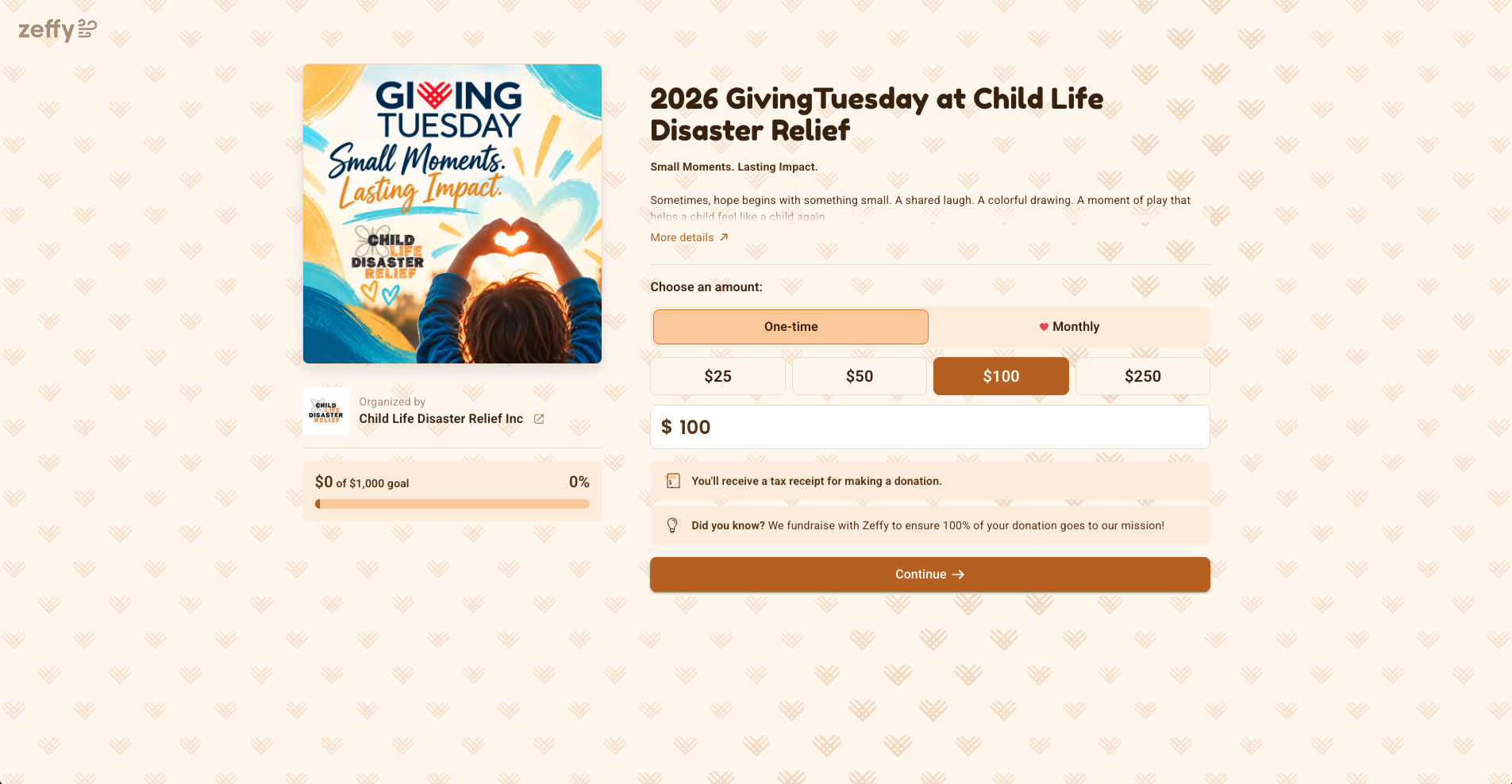
The campaigns above didn't win by doing more. They picked one need, set a visible goal or a match, and asked people to share. You can do the same in four weeks.
Giving Tuesday is your biggest giving day of the year. The platform you use shouldn't take a cut of it. On Zeffy, nonprofits pay no platform fees and no processing fees, so $100 given is $100 for your mission. Zeffy is funded by optional contributions from donors at checkout.
Three is plenty: one the week before, one on the day and one last call that evening. Send them to a focused audience, like lapsed donors, rather than your whole list. Sending more can cost you subscribers.
Yes. Keep it to one goal, one audience, one form and three emails. Small goals are real goals: one all-volunteer team we spoke with set a Giving Tuesday goal of about $1,100, a third of its yearly budget. Zeffy is the free all-in-one fundraising platform with a donor CRM built in, so the form, the emails and the supporter pages run from one account. Every gift lands on the same donor record, and each donor gets a receipt automatically.
One clear need, a visible goal or a match, and an ask to share. The 2025 campaigns above all did this, from $2,081 to $38,226. Telling donors exactly what their gift buys helps too.
Start with a dedicated Giving Tuesday form and three emails to lapsed donors. If you have a few eager supporters, add peer-to-peer pages. If one day feels too crowded, stretch your campaign into a giving week.


Giving Tuesday 2026 is Tuesday, December 1. What it is, how it works, what giving looked like in 2025, and how a small nonprofit can take part for free.


Three Giving Tuesday emails to copy, 15 subject lines, the best time to send, and a printed letter for donors who prefer mail. Built for small teams.

Copy-paste Giving Tuesday posts for Facebook, Instagram and LinkedIn, the hashtags to use, and when to post each one. Written for small nonprofits.


