How is Zeffy free?

How is Zeffy free?
Zeffy relies entirely on optional contributions from donors. At the payment confirmation step - we ask donors to leave an optional contribution to Zeffy.
Learn more >

Giving Tuesday 2026 is Tuesday, December 1, 2026. It is a global day of generosity, and nonprofits of every size take part.
Here is the honest part. The small nonprofits that do well on Giving Tuesday don't try to out-shout bigger organizations on a crowded day. They pick one audience, one goal and one dedicated form. They send three well-timed emails instead of ten. And they keep 100% of the gifts. This page covers the date, what the day is, how it works, what giving looked like last year, and a short plan with a link for every next step.
Giving Tuesday is always the Tuesday after US Thanksgiving, which is the fourth Thursday of November. In 2026, Thanksgiving is Thursday, November 26, so Giving Tuesday falls five days later.
It comes right after Black Friday and Cyber Monday, at the start of year-end giving. That timing is both the gift and the trap. Donors expect to be asked, but your team is also chasing its December goal. As one nonprofit leader put it: "I think it's just we're so distracted by trying to reach our end of year goal."
For a small nonprofit: put December 1 on the calendar now, and plan Giving Tuesday and your year-end appeal as two separate asks so one doesn't swallow the other.
Giving Tuesday is a global day of giving held the Tuesday after US Thanksgiving. It was created in 2012 as a counterweight to the shopping days around it: Black Friday and Cyber Monday celebrate spending, and Giving Tuesday celebrates giving back.
Today the movement is led by an independent organization called GivingTuesday, and it has grown to movements in 100+ countries. People share their gifts, volunteer stories and campaigns with the hashtag #GivingTuesday. You can learn more about the movement at givingtuesday.org.
For a small nonprofit: you don't have to invent the occasion. The day is already promoted for you. Your job is to show up with one clear ask.
Any nonprofit, school, church or community group can take part. There is no central pot of money and no single donation site. Each organization runs its own campaign, and donors give directly through that organization's own donation form or page. The money goes straight to you.
Most campaigns are simple: a goal, a donation form, a few emails and some social posts on the day. Some organizations also line up a local business, a board member or a major donor to match gifts for a few hours. That match is an agreement between you and your sponsor, and you announce it in your own emails and posts.
For a small nonprofit: you need a reason to give, a place to give and a few reminders. Everything else is optional.
We looked at every payment received by a nonprofit on Zeffy on Giving Tuesday 2025 (December 2, 2025, midnight to midnight Eastern time). Here is what stood out, with what each number means for your plan (Zeffy data, Giving Tuesday 2025).
For the full breakdown, see our Giving Tuesday trends.
For a small nonprofit: a $50 ask, a phone-friendly form and an email to past donors before noon covers most of what the data says.
This is the short version. Each step links to the page that covers it in depth.
1. Pick one goal and one audience. Tie a dollar goal to one outcome, and choose who you are asking. Small goals are real goals: one all-volunteer team we spoke with set a Giving Tuesday goal of about $1,100, a third of its yearly budget. For the full plan, read how to run a Giving Tuesday campaign.
2. Build a dedicated Giving Tuesday form. Give it a goal thermometer, its own link and a QR code you can print. Visible progress is the cheapest urgency lever you have. You can create a free Giving Tuesday donation form in a few minutes.
3. Send three emails, not ten. Send a preview a week out, a day-of email in the morning and a last call in the evening. Schedule all three in advance. One organization that sent up to five emails a day told us: "We lost probably about twenty five percent of our subscribers. They unsubscribed." Aim at the right people instead: you can segment lapsed donors in Zeffy's free donor CRM and keep them on a list separate from year-end. Grab wording from our Giving Tuesday email templates.
4. Post on the platforms you already use with #GivingTuesday. Post in the morning, share progress midday and post a last call in the evening. Ready-to-paste copy is in our Giving Tuesday social media posts.
5. Thank donors within two days and move into year-end. Giving Tuesday isn't the finish line. It's the starting gun for year-end giving.
For ideas and real campaigns from other nonprofits, browse these Giving Tuesday campaign ideas and examples.
For a small nonprofit: these five steps fit on one page. Do them in order and skip anything your team can't do well.
Writing every email and post from scratch is where small teams lose the most time. Zeffy has free Giving Tuesday templates written for each type of nonprofit, including animal rescues, schools, churches, food banks and more. Each set includes ready-to-send emails, social captions, campaign ideas and a real Giving Tuesday form to learn from. Find Giving Tuesday emails and posts written for your cause and adapt them in an afternoon.
For a small nonprofit: start from a template made for your cause, then add one real story from your own work.
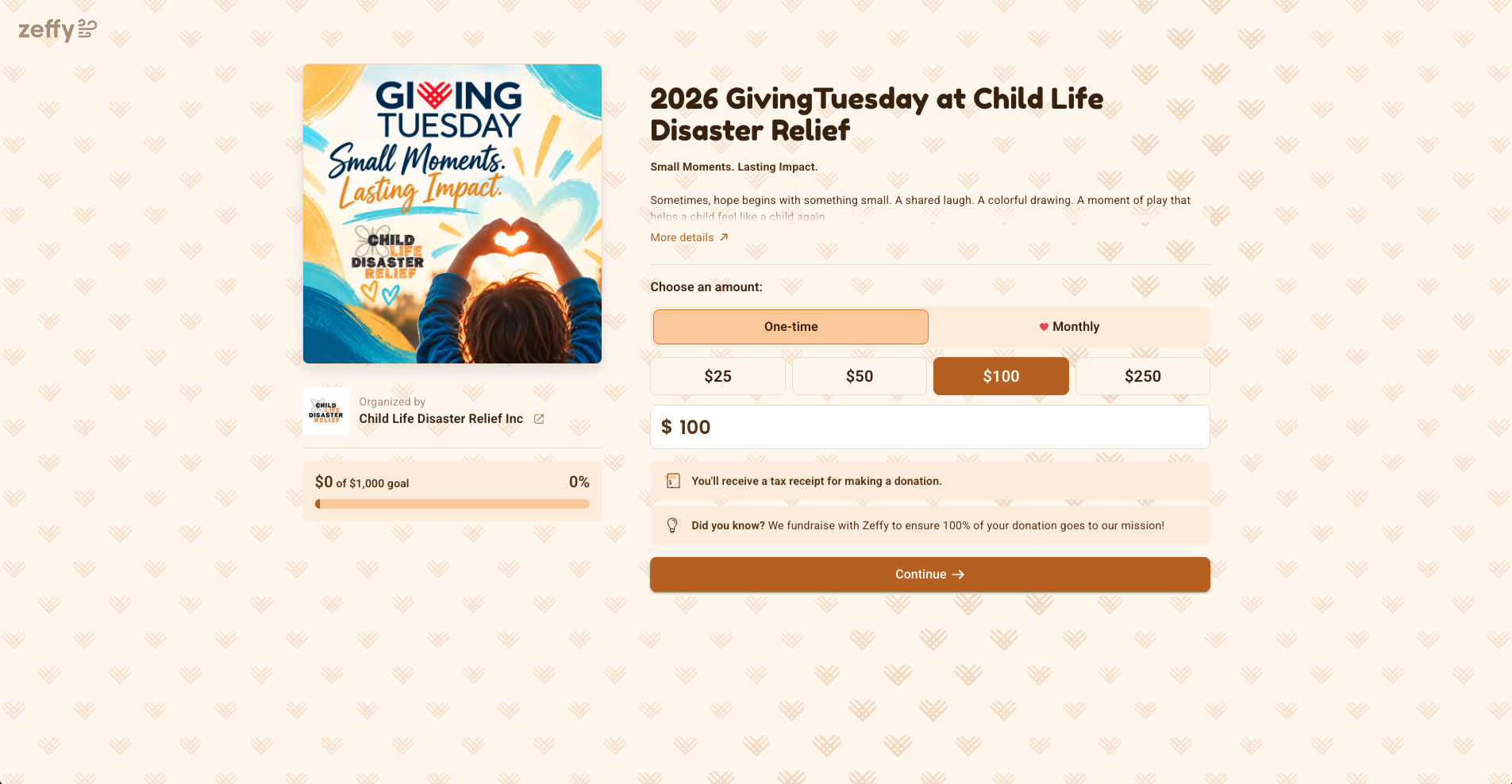
Giving Tuesday is your biggest giving day of the year. The platform you use shouldn't take a cut of it. On Zeffy, nonprofits pay no platform fees and no processing fees, so $100 given is $100 for your mission. Zeffy is funded by optional contributions from donors at checkout.
Giving Tuesday 2026 is Tuesday, December 1, 2026, the Tuesday after US Thanksgiving.
Giving Tuesday 2027 is Tuesday, November 30, 2027.
Yes. Giving Tuesday is always the Tuesday after US Thanksgiving, which is the fourth Thursday of November. That puts it in late November or the first days of December.
No. Giving Tuesday started in the US, but it is now celebrated around the world, with movements in 100+ countries.
Any nonprofit, school, church or community group can take part. You run your campaign through your own donation form or page, and donors give to you directly.
The official hashtag is #GivingTuesday. Use it on every post on the day. Our social media posts guide, linked in the 5 steps above, has ready-to-paste examples.
They follow the same rules as any other gift to the organization. US donors who itemize can deduct gifts to a 501(c)(3) nonprofit.


Real Giving Tuesday campaigns from small nonprofits on Zeffy, what each one did, and ideas you can launch in a week. Pick one and copy it.


Three Giving Tuesday emails to copy, 15 subject lines, the best time to send, and a printed letter for donors who prefer mail. Built for small teams.

A 4-week Giving Tuesday plan for small nonprofits: pick one goal, build a dedicated form, send three emails, post, and thank donors. Checklist included.


