We use cookies to improve your experience on our platform. By clicking “Accept all cookies”, you agree to the storing of cookies on your device to enhance site navigation, analyze site usage and assist in our marketing efforts.
Cookies required for basic website functionality.
Cookies used to deliver content most relevant to you and your needs.
Cookies used to deliver content most relevant to you and your needs.
Cookies that help understand the performance of the website, how users interact with it and to identify bugs.
How is Zeffy free?
How is Zeffy free?
Zeffy relies entirely on optional contributions from donors. At the payment confirmation step - we ask donors to leave an optional contribution to Zeffy.
Crowdfunding for Australian charities: the complete 2026 guide
July 30, 2026
⚡TL;DR — The Short Answer
Crowdfunding is one of the most accessible ways for AU charities to raise money online, but platform choice quietly decides how much of every gift reaches the cause.
Compare platforms on three things: fees, whether they handle DGR-compliant tax receipts natively, and where donor data is stored.
Donation-based platforms built for registered charities are the right category; reward-based platforms (Pozible, Kickstarter) don't issue DGR-compliant receipts.
EOFY (30 June) is the dominant AU fundraising peak; don't launch mid-June against every major charity's year-end appeal.
A specific dollar goal tied to a concrete outcome, a soft-launch list, and daily promotion for 2 to 4 weeks is the proven scaffold.
Zeffy is the only zero-fee option on this list, with DGR-compliant receipts built in and full support for AU registered charities.
At a typical grassroots charity crowdfunding raise, the platform you pick decides whether your community's generosity reaches your cause or your payment processor. A 2 to 5% platform fee stacked on card processing skims hundreds of dollars off a campaign before a single program dollar is spent. This guide leads with the platform comparison, then walks through the 9 steps, and lets the numbers do the persuading.
The 8 best crowdfunding platforms for AU charities in 2026
Most crowdfunding platforms take a cut of your donations. For a small charity or community group with no margin for waste, those fees decide what your campaign actually delivers. But fee rate is only one lever. Before choosing a platform, AU charities should also weigh:
DGR-compliant tax receipts. For a donor to claim a tax deduction, the receipt must include the charity's name, ABN, and a DGR statement (for example, "Donations of $2 or more are tax-deductible"). Not all platforms handle this natively for AU charities.
Where donor data is stored. AU-native rivals like GiveNow and TryBooking lead with "data stored in Australia." Zeffy is Canadian-owned and stores data offshore. That said, AU early adopters of Zeffy note that Canadian provenance actually reads as a positive, given mirrored legal and cultural systems. Address the question honestly with your board; don't let it be a surprise.
GST invoicing. If your charity is GST-registered and running ticketed events, confirm whether the platform issues GST tax invoices (showing price plus 10% GST separately) before committing.
Below are the 8 platforms an AU registered charity or NFP will most often consider, ranked by how much of a $100 gift reaches the cause. Re-verify every fee on the platform's live AU pricing page before launch, fees drift, and the numbers below reflect research to mid-2026.
Platform
Platform fee
Transaction fee
True net on $100
Funding model
Best for
Zeffy
$0
$0 (Zeffy covers processing)
$100
Keep what you raise
US/Canada 501(c)(3)s that want every dollar to reach the mission
Fundrazr
$0 (donor-tip funded)
~2.9% + $0.30 (passed to donor or nonprofit)
~$97 if nonprofit absorbs
Keep what you raise
Donation + P2P campaigns; broader on personal-cause use
GoFundMe Pro (Essentials)
Included
2.4% + $0.30 card / 2.5% PayPal-Venmo / +1% Amex
~$97.30
Keep what you raise
Mid-to-large nonprofits; Custom tier sized for $1M+ orgs
GoFundMe (verified 501(c)(3))
Included
2.2% + $0.30 per donation
~$97.50
Keep what you raise
One-off campaigns; no built-in donor CRM
Mightycause (Advanced)
1.2% + ~$79/mo subscription
~2.9% + $0.30
~$95.60
Keep what you raise
Nonprofits willing to pay subscription for branded campaigns
CauseVox (Starter)
$0 (donor-tip model)
~2.9% + $0.30
~$97 if donor tips
Keep what you raise
Design-forward branded pages (P2P gated to paid tiers)
Kickstarter
5%
~3 to 5%
~$90 to $92 (only if goal is hit)
All-or-nothing
Reward-based creative projects, not 501(c)(3) campaigns
Indiegogo
5%
Payment processing on top
~$92
Flexible or fixed
Reward-based product launches and creative projects
Platform
Platform fee
Card processing
True net on $100
AU-native?
Notes
Zeffy
0%
0% (covered)
$100.00
No (Canadian)
Zero-fee; DGR-compliant receipts with ABN + $2 statement; donations, ticketing, P2P, memberships, donor management
Arts/creative; all-or-nothing model; tiered to 3% at scale
MyCause
0%
~2.5% + GST
~$97
Yes (AU-owned)
Dual personal-cause + charity; optional donor tip
GiveNow
1.5 to 3.5%
0 to 1.43% (no fixed fee)
~$95 to $97
Yes (AU-owned)
Data stored in AU; 6,000+ charities; Our Community-owned since 2001
Raisely
0% (tip) or 4% flat
+1.4% + $0.30 (Stripe NFP)
~$94 to $96
Yes (Melbourne, Keela-owned)
Free tier with optional donor tip or flat 4%; roadmap slowed post-acquisition
GoFundMe AU
0 to 4.9%
2.0% + $0.30
~$92 to $98
No (US-owned)
Personal-cause dominant; charity product exists; no built-in DGR receipting
GoFundraise
0 to 6% + GST
1.1 to 2.1% + $0.20
~$91 to $97
Yes (AU)
Opaque per-campaign pricing; varies by campaign type
1. Zeffy: the only zero-fee option for AU charities
Zeffy is the only platform on this list that covers both the platform fee and the card processing fee. When a donor gives $100, your charity receives $100. On a typical grassroots raise, that means hundreds of dollars more reaching your cause than on any other platform here.
Zeffy is Canadian-owned, not Australian-owned. AU early adopters consistently describe that as a positive rather than a negative: Canada and Australia share mirrored legal systems, cultural values, and a similar relationship with charitable law. It is honest to note that donor data is not stored in Australia. Zeffy is funded by optional donor tips at checkout; your charity is never charged if a donor declines. It supports donations, peer-to-peer (P2P) campaigns, event ticketing, memberships, and donor management in one free platform, with DGR-compliant tax receipts that include the charity name, ABN, and the $2-or-more deductible statement. Zeffy does not offer raffles or lotteries in Australia. Trusted by 100,000+ not-for-profits worldwide, with over $2 billion raised.
2. Chuffed: for social-justice and community causes
Chuffed is a Sydney-founded, 0% platform-fee crowdfunding platform built for social-justice, environmental, community, and First Nations causes. Donors are asked to optionally cover the transaction fee (around 2 to 3%). Chuffed is eligibility-restricted: your cause must be social, environmental, political, community, or First Nations in nature. For campaigns that fit, the fee story is hard to beat and the platform's values alignment resonates strongly with progressive donor audiences.
3. Pozible: for arts and creative projects
Pozible is Melbourne-founded crowdfunding for arts, film, music, publishing, and design. It uses an all-or-nothing model: pledges are only processed if the campaign reaches its target. Platform fee is 5%, tiered down to 4% over $100,000 and 3% over $500,000, plus 2.4 to 3.4% card processing. Pozible is the right category for a charity running a specific creative project with a defined deliverable; it is not the right tool for ongoing donations or DGR-receipted giving where donors expect a tax-deductible receipt automatically.
4. MyCause: AU-owned, dual personal and charity
MyCause is a 100% Australian-owned crowdfunding platform operating since 2009. Platform fee is 0%; charities pay approximately 2.5% + GST in card processing fees, with an optional donor tip. The dual personal-cause and charity model means MyCause covers both registered charities and individuals fundraising for medical emergencies or memorials. For a charity that wants a simple, no-platform-fee donation page with strong AU brand recognition, MyCause is a reliable choice. The customisation ceiling is lower than Raisely, and the brand is more associated with individual campaigns than dedicated charity infrastructure.
5. GiveNow: AU-native donations default since 2001
GiveNow is Australia's original all-in-one fundraising platform, operating since 2001 and owned by Our Community Foundation (an NFP itself). Platform fees run 1.5 to 3.5% depending on plan; transaction fees range from 0 to 1.43% with no fixed fee per transaction. All data is stored in Australia. GiveNow is the default choice for AU charities that prioritise local ownership, data residency, and a long track record: over $230 million raised, 6,000+ charities. The visual design feels older than newer platforms and customisation is limited, but the local trust story and cumulative sector relationships are real differentiators.
6. Raisely: design-forward, Melbourne-born
Raisely is a modern fundraising platform built for charities, founded in Melbourne in 2016 and acquired by Keela (a Canadian NFP CRM company) in 2023. Two pricing models: a free tier funded by an optional donor tip at checkout (donor can opt out; the charity pays nothing), or a flat 4% transaction fee with no donor tip. Either way, Stripe or PayPal processing fees apply on top (approximately 1.4% + $0.30 at AU NFP Stripe rates). Raisely has strong design, a drag-and-drop website builder, and an AU-based support team. Note: since the 2023 Keela acquisition, some AU charities report the product roadmap has slowed and features are being pushed behind upsells (the Keela CRM and a Pro plan).
7. GoFundMe AU: personal-cause dominant
GoFundMe AU is the AU arm of the US-owned GoFundMe platform. Platform fee runs 0 to 4.9% depending on the pricing model, plus 2.0% + $0.30 processing. GoFundMe AU is built primarily for personal causes (medical emergencies, memorial funds, disaster recovery). A charity product exists, but AU not-for-profits generally prefer AU-native platforms for ongoing charity campaigns because GoFundMe lacks built-in DGR-compliant receipting native to its charity product and has no donor CRM or segmentation tools. It works well for a one-off urgent campaign where brand recognition and inbound search traffic matter more than charity-specific infrastructure.
8. GoFundraise: AU platform, opaque pricing
GoFundraise is an Australian fundraising platform that sits between a fully self-serve tool and a managed-services arrangement. Platform fees run 0 to 6% + GST, varying by campaign type; processing fees are approximately 1.1 to 2.1% + $0.20. The per-campaign pricing structure makes it harder for a small charity to forecast total costs. It is a more suitable fit if you want a platform that also supports digital fundraising program management alongside the technology.
The 3 types of crowdfunding (and which one charities should use)
Crowdfunding is a category, not a single product. Three models dominate, and only one is built for registered charities.
Donation-based crowdfunding
Donors give without expecting a tangible reward. The "reward" is the impact: a scholarship funded, a shelter restocked, a research grant launched. This is the model nearly every AU registered charity or DGR-endorsed not-for-profit should use. It supports DGR-compliant tax receipts, regular giving, and donor records. Most platforms in the comparison above (Zeffy, Chuffed, MyCause, GiveNow, Raisely, GoFundMe AU, GoFundraise) are donation-based.
Reward-based crowdfunding
Backers contribute in exchange for a product, perk, or experience. Pozible, Kickstarter, and Indiegogo operate in this category. For an Australian charity, the structural mismatches are significant: contributions are not tax-deductible donations (they are purchases), receipts are not DGR-compliant, donor history is not retained in a CRM, and the campaign mechanic rewards novelty over cause. Reward-based platforms do not issue DGR-compliant tax receipts, so donors cannot claim a deduction on their personal income tax return. Use a reward-based platform only if your campaign is genuinely a creative product launch (a benefit album, a book, branded merchandise) and even then, run the actual donation component on a donation-based platform.
Debt-based crowdfunding
Sometimes called peer-to-peer lending. Backers loan money expecting repayment with interest. This is almost never the right tool for a registered charity or NFP and is mainly used by small businesses and individuals. Skip it for a charitable campaign.
9 steps to launch a charity crowdfunding campaign
1. Set a goal and timeline
Pick a specific dollar figure and a 2 to 4-week window. Specific beats round: "$18,500 to hire one part-time counsellor for six months" outperforms "$20,000 for mental health." Campaigns that reach roughly 30% of their goal in the first few days are significantly more likely to finish at or above goal, which means your soft-launch list (board members, committee members, staff, long-term supporters) needs to be primed before the public launch. According to the ACNC Australian Charities Report, donations and bequests to AU charities totalled approximately $13.9 billion in the year to 30 June 2023, the sector is generous, and a specific, well-timed ask gets its share.
2. Pick the campaign structure
Three common structures for AU charities:
Donation-only: a single campaign page collecting one-time and regular gifts.
Peer-to-peer (P2P): supporters create their own sub-pages under your campaign and recruit friends and family. Multiplies reach without multiplying your committee's workload.
Event-tied: a gala, quiz night, or fun run with a crowdfunding page running alongside.
For most first campaigns, donation-only is the right starting point. Add peer-to-peer in year two once you know which supporters will champion your cause.
3. Choose your platform
This is the single biggest financial lever you control. The comparison table above sets out the true net on a $100 gift for each option. For a registered charity or NFP running its first or second campaign with no margin for waste, the numbers point to Zeffy: zero platform fee, zero processing fee, $100 in equals $100 out. Build a free crowdfunding donation page on Zeffy.
4. Write a specific story
Modern donors give to a face and a number, not a cause statement. Frame your campaign around one person, one project, or one measurable outcome:
One beneficiary, named (with permission) and pictured.
A unit of impact tied to a gift amount: "$25 covers one tutoring session," "$150 funds one scholarship application fee."
A short video or three to five real photos. Phone photos are fine.
A clear what-happens-if-we-hit-goal sentence.
5. Build the campaign page
Keep the donation form short. Every additional field reduces conversion. Include: the story, the goal, the unit-of-impact ladder, a single clear call to action, and a progress thermometer. Skip anything else. For tactical setup, see Zeffy's step-by-step P2P campaign setup guide.
6. Build momentum with social proof
The single biggest social-proof lever in small crowdfunding is a live progress thermometer. Donors give more when they can see other donors giving. Embed a thermometer on your campaign page and, if possible, on your homepage. Embed a live fundraising thermometer on your site. Layer in donor walls, milestone updates, and a public match if you can secure one.
7. Recruit a fundraising team
Five to fifteen committed champions will outraise a thousand passive social followers. Many AU charities are all-volunteer or board-run committees; your champion list might be board members, committee members, P&C or P&F parents, staff, or long-term supporters. Give them: a short script, three pre-written social posts, three sample emails, the campaign link, and a weekly leaderboard. Multiply your fundraisers, not your fees.
8. Promote daily, not occasionally
Plan to post or send something every day for the duration of the campaign. A workable rhythm:
Launch day: email blast, social announcement, thermometer share.
Days 2 to 5: beneficiary stories, behind-the-scenes content.
Midpoint: progress update, public thank-yous for top donors.
Final week: urgency, match announcements, daily countdowns.
Last 48 hours: hourly social pushes, personal text outreach from the team to lapsed donors.
9. Thank every donor, then keep the relationship
Automatic receipts are the baseline. The retention work is the personal follow-up: a thank-you email within 24 hours, a one-minute video from the founder or a beneficiary within a week, and an outcomes update within 30 days of campaign close. Timely outcomes communication is consistently one of the strongest predictors of repeat giving (Fundraising Effectiveness Project, AFP Global).
For regular givers, best practice in Australia is to send a consolidated giving statement before 30 June each financial year so they can include all their gifts on their personal income tax return. If your platform handles this automatically, confirm it with a test transaction before EOFY.
Three common crowdfunding pitfalls
1. You launched at the wrong time
EOFY (End of Financial Year, 30 June) is the dominant AU fundraising peak because donors maximise tax-deductible gifts before the financial year closes. If your campaign is not tied to EOFY, don't launch in mid-June: you will be competing for oxygen against every major AU charity's year-end appeal. GivingTuesday (the Tuesday after US Thanksgiving) is acknowledged in Australia but sits well behind EOFY and Christmas as a fundraising moment. Pick a quiet week, own it, and avoid the crowd.
2. You gave supporters nothing to share
"Please donate" is not shareable. A specific story, a public match, a competition, or a hashtag-driven challenge is. Build at least one shareable hook into the campaign before launch, not after.
3. Your donation form has too many fields
Every required field drops conversion. Ask for name, email, amount, payment. Everything else (phone, address, employer, how-did-you-hear-about-us) should be optional or moved to a post-donation survey.
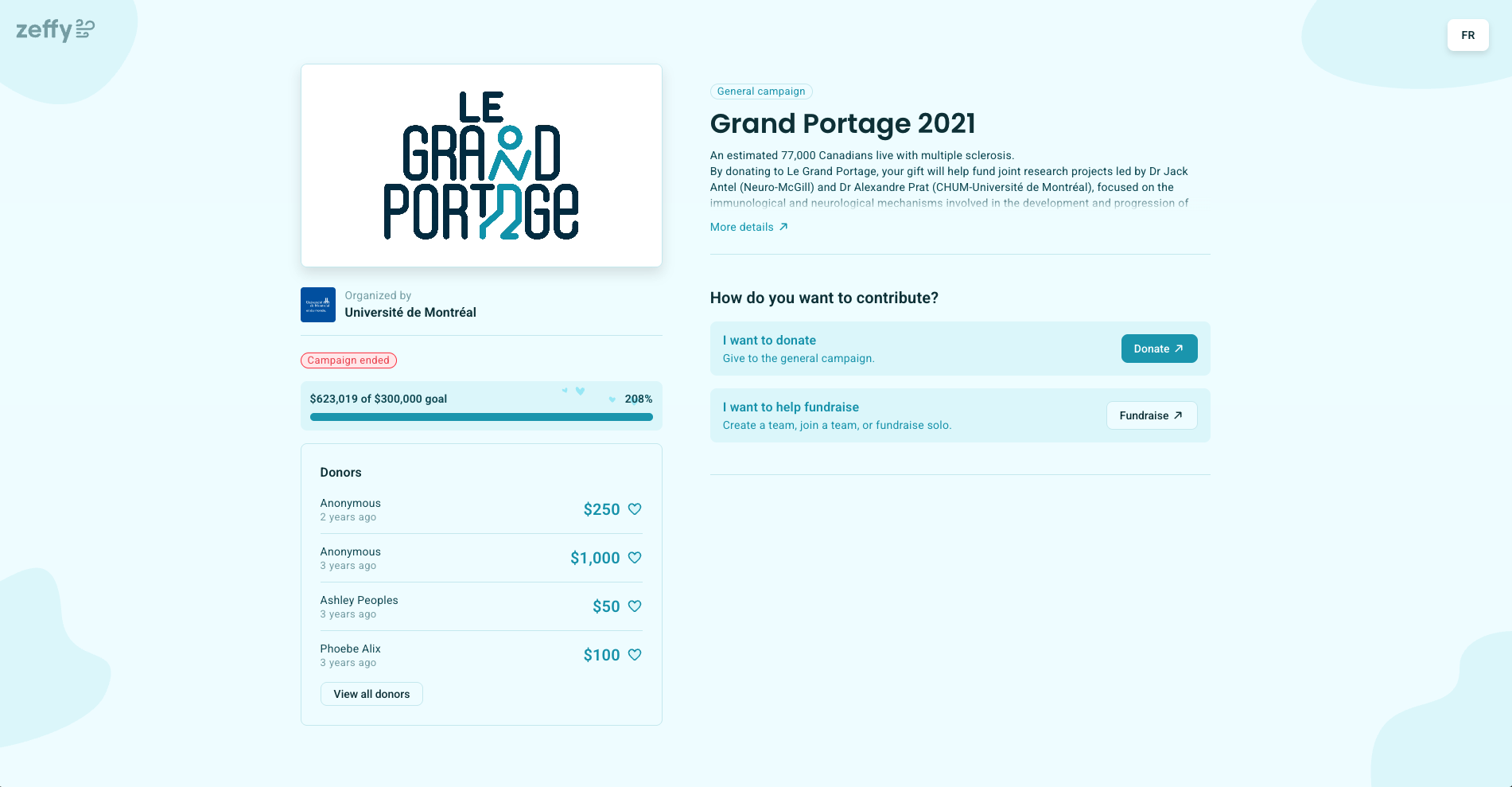
Since 2020, the University of Montreal's Faculty of Medicine has run the annual Grand Portage for MS peer-to-peer crowdfunding campaign on Zeffy to fund Multiple Sclerosis research. Across five editions and 1,174+ donors, the program has raised over $194,000 and saved roughly $5,600 in platform fees that would have gone to a competitor. The 2021 edition alone brought in $71,540 from 453 supporters. Multi-year P2P is what made the difference: each year's champions came back, and the donor list compounded. (This is a Canadian example; AU charities will recognise the same compounding principle at work.)
The Parlor Room: Revive The Iron Horse
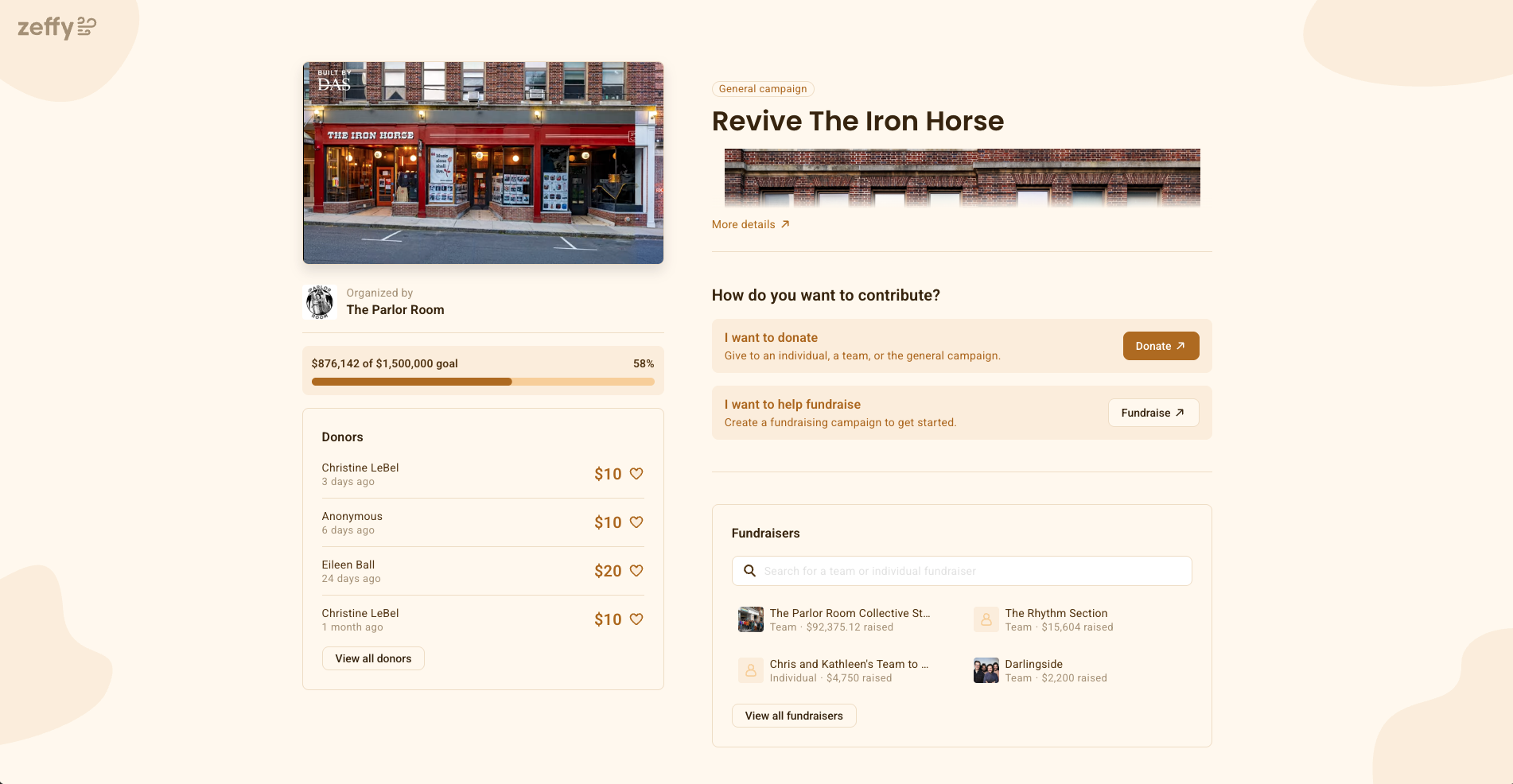
The Parlor Room, a music not-for-profit in Northampton, Massachusetts, used Zeffy's peer-to-peer crowdfunding to revive the beloved Iron Horse Music Hall in 2023. The Revive The Iron Horse campaign raised $74,296 from 619 supporters in a few months, with zero platform fees taken out. Average gift: $120. The takeaway: a clear, specific, locally-resonant ask plus a zero-fee platform plus daily promotion is enough. (This is a US example; the same approach translates directly to an AU community arts or music venue campaign.)
Legal and tax considerations for charity crowdfunding
Crowdfunding does not change your compliance obligations. Three areas every AU charity or NFP should check before launching.
ACNC registration and state or territory fundraising authorities
Fundraising is regulated state by state and territory in Australia, not federally. This means a charity fundraising online is technically soliciting donations from residents across multiple states and territories, each with its own rules.
VIC: Regulated by Consumer Affairs Victoria under the Fundraising Act 1998. ACNC-registered charities can notify CAV and are recognised without applying for a separate licence.
QLD: Regulated by the Office of Fair Trading under the Collections Act 1966. ACNC-registered charities can obtain a QLD fundraising authorisation via the cross-border recognition scheme.
WA, SA, TAS, ACT, NT: Each has its own regulator and thresholds. WA is moving to ACNC-recognition too. TAS adopted the National Fundraising Principles in 2025.
For an AU donor to claim a deduction on their personal income tax return, three conditions must be met: the organisation must be DGR-endorsed by the ATO, the gift must be $2 or more, and the receipt must include the charity's name, ABN, and a DGR statement (for example, "Donations of $2 or more are tax-deductible"). Approximately 41.5% of ACNC-registered charities have DGR endorsement, being registered with the ACNC does not automatically mean donations are tax-deductible. Donors can verify your DGR status on ABN Lookup.
What is NOT tax-deductible: raffle tickets, gala or dinner tickets where the donor receives a benefit, auction items, and volunteer time. If you are running ticketed events alongside your crowdfunding campaign, be clear in your donor communications about which contributions are tax-deductible and which are not. See the ACNC DGR fact sheet for a plain-English explanation.
Privacy Act 1988, data sovereignty, and platform terms of service
The Privacy Act 1988 applies to NFPs with annual turnover above $3 million (smaller ones can opt in to comply). The Notifiable Data Breaches scheme requires you to notify the OAIC and affected individuals if a data breach is likely to cause serious harm. Post-breach scrutiny in the AU sector has sharpened focus on collecting only what you need, storing data securely, and vetting third-party platforms carefully.
AU-native rivals lead with "data stored in Australia" as a trust signal. Address this honestly with your board: some platforms store data offshore. Before committing to any platform, also check its terms on payout schedules (some hold funds 7 to 14 days or longer), refund policy, and who owns your donor list after the campaign closes. If a platform's terms of service are unclear on data ownership, ask in writing before launch.
None of this is legal advice. For state or territory questions, speak to a nonprofit lawyer or contact Justice Connect / Not-for-profit Law for free legal resources, including plain-English guides to state fundraising authorities and DGR endorsement. Justice Connect runs the Fix Fundraising campaign, which is working to simplify the state-by-state compliance burden for AU charities.
Pre-launch checklist
Use this checklist as your final pre-flight before going live.
Strategy
Specific dollar goal and 2 to 4-week timeline locked in.
Campaign structure chosen (donation-only, P2P, or event-tied).
Soft-launch list built (board members, committee members, staff, top supporters) to hit approximately 30% of goal in week one.
Public match secured if possible.
Platform
Platform chosen and true-net-on-$100 calculation done.
State or territory fundraising authority confirmed (or ACNC deemed-authority status verified for NSW from 1 April 2026).
DGR-compliant tax receipt template tested with one live $2 donation (check that charity name, ABN, and DGR statement all appear correctly).
Payout schedule and bank account verified.
Content
One named beneficiary or specific project at the centre of the story.
Yes, and it is one of crowdfunding's most effective use cases. Disaster-relief campaigns typically have a clear, urgent, emotionally resonant ask that motivates fast giving. The key is having a donation-based platform set up in advance so you can launch quickly. Make sure your charity has current DGR endorsement (check via ABN Lookup) and that your platform issues DGR-compliant tax receipts automatically: donors giving to disaster appeals often give above the $2 threshold and will expect to claim on their personal tax return. GoFundMe AU is worth considering for pure reach on a one-off emergency appeal, but its charity product lacks built-in DGR receipting. Zeffy, GiveNow, and Raisely handle DGR-compliant receipts natively for AU registered charities.
Total raised is the headline number, but it rarely tells you whether the campaign built lasting capacity. Track alongside it: donor conversion rate (visits to campaign page vs donations made), average gift size, percentage of new donors vs returning donors, and retention rate (how many donors give again within 12 months). For P2P campaigns, also track the number of active fundraising pages and the share of total raised from supporter pages vs the charity's own page. Sending a 30-day outcomes update to donors and then tracking open rates gives you a leading indicator of repeat giving intent.
Crowdfunding is the broad category: a campaign page that collects donations from a wide audience. Peer-to-peer (P2P) fundraising is a specific model within it, where individual supporters create their own fundraising pages that sit under your main campaign, then recruit their personal networks. P2P multiplies reach without multiplying your committee's workload, because your champions do the asking on your behalf. The tradeoff is that P2P requires more coordination: you need to recruit, brief, and support each fundraiser, and keep a leaderboard running to maintain motivation. For a first campaign, donation-only is simpler. P2P tends to deliver its best results in year two or three, once you know which supporters will really go all-in for your cause.
Crowdfunding averages vary widely by cause type, audience size, and how long the campaign runs. Rather than citing a benchmark that may not reflect your organisation's context, focus on what you can control: set a specific, achievable goal based on your soft-launch list size and past fundraising history, and aim to reach approximately 30% of that goal in the first few days from your warmest contacts. According to the ACNC Australian Charities Report, donations and bequests to AU charities totalled approximately $13.9 billion in the year to 30 June 2023, which tells you the sector is generous. What converts is a specific ask, a face, and a clear unit of impact, not a platform-average statistic.
Yes. Zeffy charges $0 in platform fees and $0 in processing fees. When a donor gives $100, your charity receives $100. Zeffy is funded by optional donor tips at checkout: donors are asked if they want to leave a small contribution to Zeffy, and your charity is never charged if a donor declines or removes the tip. Zeffy has supported over 100,000 not-for-profits and helped raise over $2 billion globally. It supports AU registered charities with DGR-compliant tax receipts (charity name + ABN + $2-or-more deductible statement), donations, P2P campaigns, event ticketing, memberships, and donor management in a single free platform. Zeffy does not offer raffles or lotteries in Australia.
Get weekly fundraising tips from nonprofits experts
Thank you! Your submission has been received!
Oops! Something went wrong while submitting the form.
Keep reading :
Nonprofit guides
Peer-to-Peer Fundraising: A Complete Guide for Australian Charities (2026)
Everything Australian charities need to run a successful peer-to-peer fundraising campaign: how P2P works, top AU fundraising ideas, a step-by-step launch guide, the AU platform landscape, and best practices for recruiting and coaching fundraisers.
Look for people who attend related events, follow relevant Facebook groups, or subscribe to aligned newsletters.These aren’t just potential donors—they’re your future advocates.
Look for people who attend related events, follow relevant Facebook groups, or subscribe to aligned newsletters.These aren’t just potential donors—they’re your future advocates.






.webp)

