We use cookies to improve your experience on our platform. By clicking “Accept all cookies”, you agree to the storing of cookies on your device to enhance site navigation, analyze site usage and assist in our marketing efforts.
Cookies required for basic website functionality.
Cookies used to deliver content most relevant to you and your needs.
Cookies used to deliver content most relevant to you and your needs.
Cookies that help understand the performance of the website, how users interact with it and to identify bugs.
How is Zeffy free?
How is Zeffy free?
Zeffy relies entirely on optional contributions from donors. At the payment confirmation step - we ask donors to leave an optional contribution to Zeffy.
Best Ecommerce Platforms for Nonprofits in 2026: Complete Comparison Guide
June 17, 2026
⚡TL;DR, The Short Answer
Verdict: Most small nonprofits already sell online, the real question is which tool runs the store, the donations, and the tax receipts from one dashboard a volunteer can manage without losing 3% of every sale to fees.
What works: Zeffy is the only platform that charges $0 in platform and processor fees, consolidates the store with donor records and automatic tax receipts, and works for any all-volunteer org in the US or Canada.
What doesn't: Every other platform on this list charges a per-sale processor fee (2.9% to 3.3% + $0.30), a monthly subscription, or both, and none of them issue nonprofit tax receipts without a third-party add-on.
Best for: A PTA, youth sports league, animal rescue, booster club, or community program already selling spirit wear, calendars, or event merch and tired of reconciling Square plus a spreadsheet plus a donation tool.
Worth considering if: Your org has $50K+ in annual merch revenue, dedicated ecommerce staff, and complex shipping rules, at that scale, Shopify's feature depth may justify the monthly cost.
Why small nonprofits are already selling online (and losing 3% of every sale)
If you searched for an ecommerce platform, you already sell something. Maybe it is spirit wear at the football game. Maybe it is calendars at the rescue's open house. Maybe it is a bake-sale tin next to a donation jar. The decision was made a long time ago.
The problem is the stack. A typical small nonprofit runs three tools that do not talk to each other: Square at the game-day table, a Facebook post for online orders, and a spreadsheet to reconcile the mess. None of them were built for nonprofits. All of them take about 2.4% to 3.3% plus $0.30 off every sale.
Here is the math on a worked example, not an industry benchmark. If your org sells $50,000 of merchandise in a year and the processor takes roughly 3%, that is about $1,500 lost to fees before anyone sees a dollar. At $100,000 it is closer to $3,000. Your supporters thought they were giving to the cause. A chunk went to a payment processor instead.
That is the fee problem. The other problem is the patchwork: store on one tool, donations on another, donor record nowhere, tax receipts sent by hand. The right ecommerce platform for a small nonprofit solves both at once. How Zeffy stays 100% free explains the model, and the comparison below ranks each option by what you actually keep after fees and whether it consolidates the stack into one dashboard.
Three quick use cases this comparison is written for:
Youth sports and booster clubs selling spirit wear, team gear, and concession-stand pre-orders.
Animal rescues and shelters selling calendars, pet supplies, branded merch, and adoption-event extras.
PTAs and school groups selling school merch, yearbooks, fun-run shirts, and event tickets alongside the store.
What to look for in a nonprofit ecommerce platform
Generic "ease of use" checklists do not help here. Five things actually matter when a volunteer is running the store:
1.Total cost, fees included. Look at the monthly plan, the processor fee per sale, any platform transaction fee, and the cost of add-on apps you will need. A $0/month plan with a 3.3% processor fee can cost more than a $29/month plan with a 2.25% rate, depending on volume.
2.Setup time for a non-technical volunteer. If launch needs a developer, hosting, or theme code, the tool is effectively unavailable to your org. Aim for live in an afternoon.
3.Consolidation. Does the store live in the same tool as donations, donor records, and tax receipts? Or is it a fourth tool you have to reconcile against the other three? This is the difference between one dashboard and a spreadsheet at 11 p.m.
4.Payment flexibility. Credit cards are table stakes. You also want Apple Pay and Google Pay (mobile checkout converts higher), ACH or PAD for larger gifts, and a way to take payments in person without buying a card reader.
5.Reporting and tax receipt automation. A US 501(c)(3) or Canadian registered charity needs a receipt that holds up. If the platform does not issue one, you will write them by hand or pay for another tool.
For a small nonprofit: the platforms that win on these five almost always lose on feature depth. That is fine. You do not need a multi-warehouse inventory system. You need to sell 40 t-shirts, take a few donations alongside them, and get the receipts out automatically.
Best ecommerce platforms for nonprofits: full comparison
Ranked by what a small all-volunteer nonprofit actually keeps after fees and whether the tool consolidates the stack. Pricing verified against vendor sources in June 2026; confirm current pricing on each vendor's site before signup.
Platform
Monthly cost
Transaction fees
Nonprofit discount
Key limitation
Small-NPO fit
Zeffy
$0
$0 (platform and processor)
Built for nonprofits; free for registered nonprofits in the US, Canada, UK, and Australia
Not a standalone Shopify-style storefront (no print-on-demand or carrier-calculated shipping)
✅
Shopify
From $29/mo (Basic); NPO Lite/Full pricing not published, contact Shopify
2.25% to 2.9% + $0.30 per sale
NPO Lite and NPO Full exist; pricing on request
Monthly cost plus processor fees erase small-store margin
Enterprise-grade complexity; built for ecommerce teams
❌
Ecwid by Lightspeed
Free up to 10 products; paid tiers from $19/mo
Processor pass-through ~2.9% + $0.30
None specific
10-product cap on free tier; no nonprofit receipts
⚠️
For a small nonprofit: only one row keeps 100% of the sale. The rest either charge a monthly fee, a per-sale fee, or both. That does not make them wrong tools. It makes them the wrong tools for an org where every dollar is supposed to fund the program.
1. Zeffy: the free nonprofit store that consolidates sales, donations, and receipts
Small-NPO fit: ✅ Realistic for an all-volunteer org with zero technical staff and any budget, including $0.
Zeffy is the only entry on this list built specifically for registered nonprofits in the US, Canada, UK, and Australia. More than 100K+ nonprofits use Zeffy to raise $2B+ and counting. The pricing is the headline: No platform fee, no transaction fee, no credit card fee. Ever. Zeffy covers the processor fee that every other platform passes through to you. A $25 spirit-shirt sale puts $25 in the org's account.
The other half of the story is consolidation. Most ecommerce tools sell you a store. Zeffy gives you the store, the donation form, the donor record, and the tax receipt in one dashboard. A volunteer who sets up the store does not also need to set up a separate receipting tool and a reconciliation spreadsheet.
What you can do with the store
Build the store in minutes. List products with images and descriptions, customize the logo, colors, and banner to match your branding. No code, no theme files, no hosting decisions.
Product variants and inventory. Set size and color options, cap stock so a shirt does not oversell, and run pre-sale pricing for fundraising drops.
Discount codes and a donation add-on at checkout. Every buyer is asked if they want to add a donation when they check out, which lifts revenue per order on top of merch sales.
Automatic receipts and thank-you emails. Every sale triggers a branded thank-you, and donation add-ons get a compliant tax receipt. No manual sending. See how Zeffy's receipt automation works.
Every payment method, including in-person. Credit cards, Apple Pay and Google Pay, ACH and PAD, and cheques on the online side. For the game-day table, accept in-person payments with Tap to Pay (no card reader) straight from an iPhone or Android.
Honest scope
Zeffy is a free store and fundraising hub. It is built for selling, not a standalone Shopify-style storefront, so if you want a fully branded shop on its own domain, you will pair the Zeffy store with a separate site or embed it into the site you already have. Zeffy does not do print-on-demand or shipping-rate integrations either, you produce and ship the merch yourselves, the same way you do at the volunteer table today.
Eligibility is registered nonprofits in the US, Canada, UK, and Australia. If you qualify, the math is hard to argue with.
For a small nonprofit: this is the rare case where the free option is also the right option. The fee savings compound every month, and you get to retire the spreadsheet.
What nonprofits actually sell through Zeffy
This isn't theoretical. Nonprofits have sold more than 2.8 million items through Zeffy stores, over $78 million in total sales, at a typical price around $20 an item. Here's what's actually moving:
Branded merch and apparel. T-shirts are the single most popular item by a wide margin, followed by hoodies, totes, mugs, and stickers, roughly $11 million in merch and apparel sales in all.
Event concessions. Booster clubs and schools run the snack table through Zeffy: soda, water, candy, popcorn, hot dogs, pizza, and nachos. Small $1 to $5 items that add up fast over a season.
Classic product fundraisers. The tried-and-true sellers live here too: mulch is one of the highest-grossing categories, alongside popcorn.
School and community stores. Yearbooks, holiday "Santa Shop" credits, and "Boo Grams," the small seasonal sales that used to run on paper and a cash box.
Whatever you are selling, a merch drop, a concessions stand, or a spring mulch fundraiser, it runs through the same free store with no platform fee, no transaction fee, no credit card fee. The markup stays with your mission.
2. Shopify: features, pricing, and limitations for nonprofits
Small-NPO fit: ❌ Skip unless you already have $50K+ in annual merch revenue, dedicated ecommerce staff, and complex shipping rules.
Shopify is the category default for ecommerce businesses. The feature set is robust, the theme library is large, the app store covers nearly every edge case, and the platform scales from one product to a million. None of that is in dispute.
What is in dispute for a small nonprofit is the math. Shopify's standard plans start at $29/month for Basic and go up from there. Transaction fees on Shopify Payments run 2.25% to 2.9% + $0.30 per sale, with 2.9% on Basic and 2.25% on Plus (source: shopify.com/pricing). On a $25 spirit-shirt sale, that is roughly $1.03 in processor fees, or about 4.1% effective, on top of the monthly subscription.
Shopify does run a nonprofit program called NPO Lite and NPO Full. Pricing is not published on shopify.com/nonprofits, Shopify directs interested orgs to contact support. Ask for current pricing directly rather than relying on numbers that float around old blog posts.
The other gap is the stack. Shopify is a store. It does not issue IRS-compliant donation receipts, it does not maintain a donor record, and it does not add a donation step at checkout without a third-party app. For a small nonprofit, that means Shopify does not consolidate the stack, it becomes the fourth tool, not the one tool.
For a small nonprofit: Shopify is the right pick when feature depth pays for itself. Below about $50K of annual merch revenue, the subscription plus the per-sale fees usually cost more than the value you get back.
3. Square Online: the in-person and online hybrid pick
Small-NPO fit: ⚠️ Worth it when in-person sales are the main channel and the online store is a sideline; otherwise the fees stack up.
Square Online is the ecommerce side of Square's POS business. If you already run a Square reader at the game-day table or the gift shop, Square Online plugs into the same dashboard for online orders.
Pricing changed in January 2026. The free tier now charges 3.3% + $0.30 per online transaction, up from 2.9% + $0.30 (source: posusa.com/square-fees-pricing). The 2.9% + $0.30 rate now only applies on the paid Plus ($49/mo) and Premium ($149/mo) tiers. There is no nonprofit-specific discount on the plan.
On a $25 sale on the free tier, that is roughly $1.13 in processor fees, or about 4.5% effective. Across $50,000 of merch a year, the difference between Square's 3.3% and Zeffy's 0% is roughly $1,650 in mission dollars.
Square does not issue tax receipts, maintain a donor CRM, or offer a donation flow at checkout. It is genuinely good at one thing: unified online and in-person sales for a business that does not need any of that.
For a small nonprofit: if in-person sales are your bread and butter, run Square at the table and pair it with Zeffy for the donation side, the donor record, and the receipts. That keeps the in-person workflow you know and consolidates the rest.
4. Wix: drag-and-drop with a nonprofit discount window
Small-NPO fit: ⚠️ Year 1 to 2 with the nonprofit discount; ❌ at full pricing.
Wix is a drag-and-drop website builder that added ecommerce features. The site editor is fast and friendly, the templates look modern, and the learning curve is one of the gentlest in the category.
Pricing is straightforward. Wix's ecommerce plans (billed annually) are Core $29/mo, Business $39/mo, and Business Elite $159/mo (source: wix.com/upgrade/website). Wix itself charges 0% platform transaction fees, the 2.9% you see quoted in other roundups is the payment processor's per-sale charge, not a Wix charge. The distinction matters: Wix is not skimming a platform fee on top.
Wix publishes a 70% nonprofit discount on premium plans for the first two years. After the discount window closes, you are paying full rate.
The gap is the same as Wix's neighbors here: no donation receipts, no donor CRM, no native nonprofit POS path. You will pair Wix with a second tool for the fundraising side.
For a small nonprofit: Wix earns the discount-window ⚠️ when your org also needs a full marketing site and you have someone willing to set it up. Once the discount expires, the math gets harder.
5. WooCommerce: the WordPress option
Small-NPO fit: ❌ unless you already run WordPress and have someone who maintains the site.
WooCommerce is a free WordPress plugin. The plugin itself charges 0% platform fee. If your nonprofit already has a WordPress site and someone technical on the team, this can be the cheapest line item in the category.
The fee that matters is the processor. WooPayments charges 2.9% + $0.30 per US domestic transaction (source: woocommerce.com WooPayments fees page). The $0.30 is mandatory and routinely gets dropped in pricing comparisons. On a $25 sale, that is roughly $1.03 in fees, the same effective rate as Shopify Basic.
The cost the spreadsheet does not capture: WordPress hosting ($5 to $50/month depending on plan and host), a theme, security maintenance, and the time of whoever keeps the plugin stack updated. Donation receipts and donor CRM require additional paid plugins that add monthly cost.
For a small nonprofit: WooCommerce is the right answer when WordPress is already a sunk cost and you have a volunteer or staffer who genuinely enjoys maintaining it. Otherwise, the cheapest line item hides the most reconciliation work.
6. Squarespace: a website builder that happens to sell
Small-NPO fit: ❌ Pick Squarespace for the site, not the store.
Squarespace makes some of the prettiest templates in the category. The editor is guided and forgiving, and the marketing site you build looks polished by default.
The ecommerce side is the bolt-on, not the headline. Plans run roughly $25 to $72/month, and lower tiers add a Squarespace transaction fee on top of the payment processor fee. Stack the subscription, the platform transaction fee, and the processor pass-through, and small sales can run 5%+ effective.
There are no native donation receipts, no donor CRM, and no nonprofit POS story.
For a small nonprofit: pick Squarespace when the marketing site is the priority and you can run the store and donations elsewhere. Treating it as your primary ecommerce tool will cost more than it earns at low volume.
7. BigCommerce: enterprise omnichannel
Small-NPO fit: ❌ Skip unless you have an ecommerce team.
BigCommerce is built for ecommerce businesses scaling into multi-channel sales (web, Amazon, Google Shopping, social). The platform charges no transaction fee on top of plans, which start at about $29/month billed annually. The processor pass-through still runs about 2.9% + $0.30.
The complexity is built for ecommerce teams, not a solo volunteer. The features a PTA selling spirit wear actually uses are a fraction of what BigCommerce charges for.
For a small nonprofit: BigCommerce is doing work you will never use. Pick it only if your org is genuinely running omnichannel ecommerce at scale.
8. Ecwid by Lightspeed: embed-into-your-site widget
Small-NPO fit: ⚠️ Free tier fits very small SKU sets; processor fees still apply.
Ecwid (now part of Lightspeed) is an ecommerce widget you embed into an existing site. If your nonprofit already has a marketing site and you only need to add a small product list, the embed approach is fast and code-light.
The free tier covers up to 10 products (source: ecwid.com/pricing), which genuinely fits a calendar fundraiser, a small spirit-wear lineup, or a handful of program-tied SKUs. Paid tiers run from $19 to $99/month if you scale beyond 10 products.
The processor pass-through is roughly 2.9% + $0.30 per sale. Lightspeed has been rebranding portions of Ecwid; confirm the current product name and free-tier limits at lightspeedhq.com before you sign up.
For a small nonprofit: ⚠️ Worth a look when you have a working website, fewer than 10 products, and no need for donation receipts or a donor record.
How to set up your nonprofit online store in 7 steps
1.Define what you will sell. Pick 3 to 8 starting products. Spirit wear, calendars, branded merch, event extras. Set retail prices that cover production cost, give the supporter a fair price, and leave a margin for the mission. Do not start with 40 SKUs.
2.Choose your platform from the comparison above. Match the platform to your fee tolerance, your technical capacity, and whether you need the store consolidated with donations and receipts. Most small nonprofits land on a free, nonprofit-native tool.
3.Set up payment processing. Connect your bank account, verify your nonprofit status, and turn on the payment methods your supporters actually use (credit cards, Apple Pay, Google Pay). For hybrid sellers, set up Tap to Pay on the volunteer's phone so the game-day table does not need a card reader.
4.Add products with real photos and clear descriptions. One clean photo on a plain background beats five blurry ones. Descriptions name the size, the fabric or material, and what the purchase funds ("each shirt funds one classroom snack pack for a week").
5.Configure shipping or pickup. Most small-nonprofit stores do pickup at events or a flat-rate shipping fee, not live carrier rates. Pick one and write it on the product page so nobody is surprised at checkout.
6.Test the full checkout. Buy something yourself with a real card. Confirm the receipt arrived, the thank-you email looks right, the funds hit the bank account, and the order shows up in your dashboard. Fix anything that did not.
7.Promote it. Email your existing list, post on the social channels your supporters actually use, and tell the board. Add the store link to your email signature and the donation page. The store does nothing if nobody knows it exists.
For a small nonprofit: most volunteers can clear steps 1 through 7 in a single weekend if the platform is set up right.
Real nonprofits using ecommerce successfully
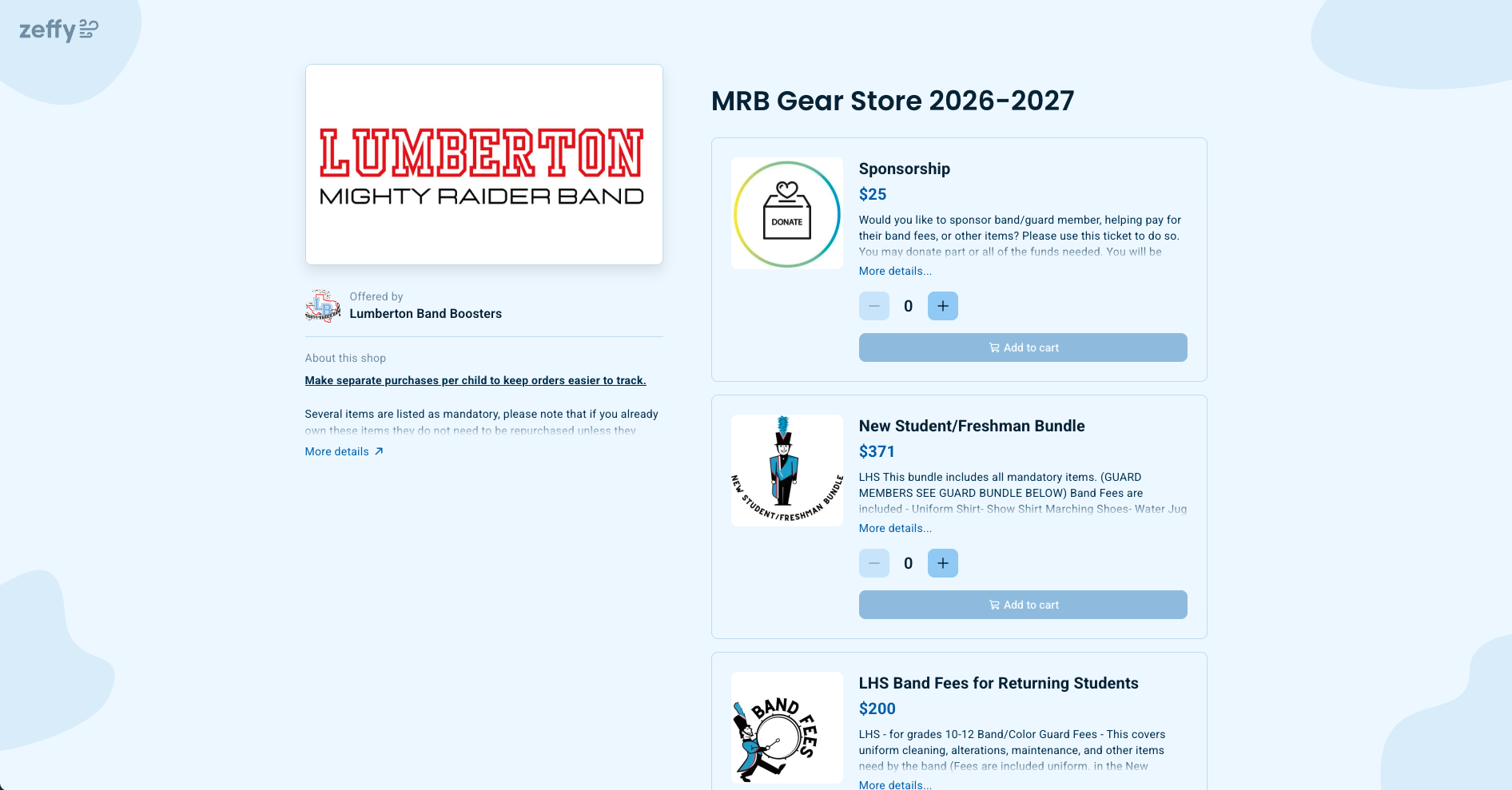
Lumberton Band Boosters runs a combined store for the High School band, Color Guard, and Middle School band on Zeffy. Before Zeffy, the booster club was reconciling spirit-wear orders, concession-stand pre-sales, and donations across separate tools. On Zeffy, the store, the donations, and the receipts live in one dashboard a parent volunteer can run. The fee savings come from the model: every dollar a parent pays for a t-shirt or a band fee is a dollar the program receives, instead of a chunk going to a processor.
The pattern is what to take from the example, not the dollar amount. A small all-volunteer org consolidated three tools into one and stopped losing percentage points on every sale. That is the consolidation wedge in practice.
If you already sell merch, calendars, or event extras, the question is not "should we have an online store?" It is "which tool lets a volunteer run the store, the donations, and the receipts without 3% leaking out of every sale?" One tool on this list answers yes to all three. The rest either charge a monthly fee, a per-sale fee, or both, and leave you to bolt on a second tool for the fundraising side.
Zeffy is the only platform on this list that is genuinely free for nonprofits, with no platform fee and no transaction fee. Other platforms with a free tier (Square Online, Ecwid, WooCommerce as a plugin) still pass a payment processor fee of roughly 2.9% to 3.3% + $0.30 through to the nonprofit on every sale. Zeffy covers that processor fee, which is why $100 in equals $100 out. Eligibility is registered nonprofits in the US, Canada, UK, and Australia.
Yes. Shopify's standard plans charge 2.25% to 2.9% + $0.30 per sale on Shopify Payments, 2.9% on Basic, lower rates on higher tiers (source: shopify.com/pricing). Shopify also runs a nonprofit program called NPO Lite and NPO Full, but pricing on those plans is not published on shopify.com/nonprofits, contact Shopify support for current rates.
Yes, on Zeffy. The store, the donation form, the donor record, and the tax receipt all live in one dashboard, and supporters can add a donation at checkout when they buy merch. Most ecommerce-first platforms treat donations as an afterthought that requires a third-party app, which means a second tool to reconcile and pay for.
No, not for any platform on this list. Modern store builders use drag-and-drop editors that a volunteer with no coding or design experience can use. The technical bar is higher for WooCommerce (which assumes a working WordPress site) and BigCommerce (which is built for ecommerce teams). For Zeffy, Square Online, Wix, Squarespace, Shopify, and Ecwid, a volunteer can launch a basic store in an afternoon.
Setup on Zeffy is $0. Setup on Shopify, BigCommerce, and Wix's ecommerce plans starts at $29 to $39/month before any sales. WooCommerce is a free plugin but requires WordPress hosting ($5 to $50/month) and any paid plugins you need. Every platform except Zeffy also charges a per-sale payment processor fee of roughly 2.25% to 3.3% + $0.30.
Yes. Zeffy's Tap to Pay lets a volunteer accept credit cards, Apple Pay, and Google Pay straight from an iPhone or Android, with no card reader purchase required. The in-person sales flow into the same dashboard as the online store, so the game-day table and the website pull from the same inventory and report to the same donor record.
Look for people who attend related events, follow relevant Facebook groups, or subscribe to aligned newsletters.These aren’t just potential donors—they’re your future advocates.
Look for people who attend related events, follow relevant Facebook groups, or subscribe to aligned newsletters.These aren’t just potential donors—they’re your future advocates.







.webp)

