We use cookies to improve your experience on our platform. By clicking “Accept all cookies”, you agree to the storing of cookies on your device to enhance site navigation, analyze site usage and assist in our marketing efforts.
Cookies required for basic website functionality.
Cookies used to deliver content most relevant to you and your needs.
Cookies used to deliver content most relevant to you and your needs.
Cookies that help understand the performance of the website, how users interact with it and to identify bugs.
How is Zeffy free?
How is Zeffy free?
Zeffy relies entirely on optional contributions from donors. At the payment confirmation step - we ask donors to leave an optional contribution to Zeffy.
How to Celebrate National Volunteer Week 2026: 10 Ideas Your Volunteers Will Love
June 18, 2026
National Volunteer Week is the one week of the year when small nonprofits actually pause to thank the people who run them. The temptation, every year, is to over-engineer it: a themed five-day curriculum, a $300 swag bag, a comms calendar that the same three volunteers also have to staff.
The honest read for a 5-person org: volunteers do not need a themed week. They need to feel seen. The highest-ROI plan is a handful of specific, personal acts of recognition built around one zero-cost in-person moment, with every dollar landing on the volunteers instead of on platform fees.
This guide gives you the 2026 dates and theme up top, then 10 celebration ideas tagged by effort (👍 do this / ⏭️ skip unless you have a paid staffer with bandwidth), a "pick 2 to 3 days, not 5" calendar template, budget-friendly recognition tactics, and copy-paste social media posts.
When is National Volunteer Week 2026?
National Volunteer Week 2026 runs April 19 to 25, 2026, the third full week of April, per Points of Light, the U.S. organizing body.
The official 2026 Points of Light theme is: "Shining a Light on the People and Causes That Inspire Us to Serve."
In Canada, Volunteer Canada uses the same April 19 to 25, 2026 dates with its own theme, "Ignite Volunteerism." If your org operates in both countries, you do not need two plans. One week, two themes you can borrow language from.
For a small nonprofit: mark the calendar now and decide which 2 to 3 days you will actually do something. Aiming for "all five days, every channel" is the planning trap.
What is National Volunteer Week?
National Volunteer Week (NVW) is an annual observance in the U.S. and Canada when nonprofits, schools, governments, and community groups recognize the people who give their time. Points of Light coordinates the week in the United States. Volunteer Canada coordinates the Canadian counterpart.
The week matters for nonprofits because it is a formal, externally-recognized moment to thank volunteers, boost morale, recognize service publicly, and strengthen the community ties that keep your program running the other 51 weeks.
Why Volunteer Week matters more for volunteer-run orgs
If you are reading this, the people planning National Volunteer Week at your org are often the same people you are trying to thank. Recognition is one of the highest-leverage retention levers you have, and your realistic budget is somewhere between $0 and a few hundred dollars. For more on keeping volunteers long-term, see our volunteer retention strategies guide.
The most significant way to show people how much you appreciate their time is to respect it. That means a Volunteer Week plan that fits inside your team's actual capacity, not one that adds another RSVP, another comms deliverable, and another Friday-night setup to the same five volunteers' plates.
This guide is built for that reality. The 10 ideas below are tagged by effort, the calendar tells you to pick 2 to 3 days (not 5), and the budget section assumes you have $0 to start with. If you want a deeper look at the year-round picture, our volunteer management guide covers scheduling, onboarding, and communication in one place.
10 ways to celebrate National Volunteer Week
Each idea has an effort tag (Quick Win = under 1 hour, Medium = half-day, Bigger = week-long planning) and a small-nonprofit verdict: 👍 do this, or ⏭️ skip unless you have a paid staffer with bandwidth.
1. Social media spotlight series (Quick Win, 👍 do this)
Pick 3 to 5 volunteers. For each, post a short photo + 2 to 3 sentences naming one specific thing they did this year ("Maria drove the food bank van every Saturday in February when we lost two drivers"). Stagger the posts across the week.
Why it works: public, free, and scales to your team size. A small nonprofit can do five posts in an hour with a phone and a Google Doc.
Cost: $0. Time: about 1 hour to draft all five.
2. Personalized thank-you letters (Quick Win, 👍 do this)
A 90-second handwritten note that names one specific thing the volunteer did beats a templated certificate every time. A thank-you only feels personal when it goes beyond polite protocol. For a full bank of volunteer appreciation ideas beyond Volunteer Week, that guide is worth bookmarking.
Here is a sample you can adapt. Write it by hand if you can:
Dear Sam,
I wanted to take a moment, during National Volunteer Week, to thank you for the Tuesday-night intake shifts you covered all spring. When Jenna went on leave in March, you stepped in without us even asking, and the front desk never missed a night.
People we never see thanked you in our exit surveys this quarter. I wanted you to hear it from me too.
With gratitude,
Alex
Keep your volunteer contact list somewhere you can actually use it. Zeffy's free donor and contact management holds your volunteer records and lets you email them from the same dashboard, so the list is not stranded in a spreadsheet on someone's laptop.
Cost: postage. Time: about 15 minutes per note.
3. Virtual appreciation event (Medium, 👍 do this if your volunteers are remote)
A 45-minute virtual coffee or recognition call on Zoom, with a short slide of impact numbers and a round-robin where each volunteer is thanked by name. Send the link a week ahead and a reminder the morning of.
Why it works: low cost, low logistics, accessible to volunteers who cannot travel.
Cost: $0 with the Zoom free tier (40-minute limit) or your existing nonprofit plan. Time: 2 hours of prep.
4. In-person celebration gathering (Bigger, 👍 do this, make it your anchor)
If you do one thing, do this. One evening, one room, food, a few short speeches, and time for volunteers to actually talk to each other. It does not need to be fancy. It needs to happen.
Use a free event ticketing platform so RSVPs and reminder emails run themselves. Zeffy's free event ticketing system handles RSVPs, e-tickets, QR check-in, and reminder emails from one dashboard. At the door, use Tap to Pay for any day-of donations or last-minute ticket sales. No card terminal to rent, just your phone. For a broader look at pulling the event together, our nonprofit event planning guide walks through each step.
Cost: venue (often free at a community space) + food. Time: half-day of planning, plus event night.
5. Award ceremony (Medium, ⏭️ skip unless you have a paid staffer with bandwidth)
A formal awards format, with custom categories, printed certificates, and scripted remarks, is great when it lands. For a 5-person team, it often becomes a second full event to plan on top of #4. If you have the bandwidth, fold short, named awards into the in-person gathering instead of running a separate ceremony.
Cost: $50 to $200 in printing and small awards. Time: half-day of writing remarks + venue.
6. Skill-building workshop (Bigger, ⏭️ skip unless you have a paid staffer with bandwidth)
Volunteer-led or expert-led workshops (leadership, project management, a creative skill) are a real perk, but they are a real project. A survey, a curriculum, an instructor, a venue. Worth doing once a year if someone owns it. Not worth bolting onto Volunteer Week if no one does.
7. Gift bags or tokens of appreciation (Quick Win to Medium, 👍 do this at low cost)
The sentiment counts, not the price tag. Good low-cost options:
A handwritten card paired with a $5 coffee gift card
A small plant or seed packet
Branded merch only if a board member is sponsoring it (otherwise skip the custom hoodies)
Homemade baked goods if someone on your team will actually bake them
Cost: $0 to $10 per volunteer. Time: 2 to 3 hours of assembly.
8. Volunteer wall of fame (Quick Win, 👍 do this)
A printed or digital "wall" with photos, first names, and one-line contributions, posted in your office, on your website, or in your newsletter. Keep it up year-round, not just during Volunteer Week.
Cost: $0 to $20 for printing. Time: 1 hour.
9. Day-by-day themed activities (Bigger, ⏭️ skip unless you have a paid staffer with bandwidth)
A different activity every weekday is the format that competitor listicles push hardest, and the format that exhausts small teams fastest. See the next section for a realistic "pick 2 to 3 days" version.
10. Community service project together (Medium, 👍 do this if it fits your mission)
Spend a few hours doing service together: a park cleanup, a meal pack, a build day. The theme of being seen is "we showed up alongside you," not "we put you on a stage." Pair it with a casual meal afterward.
Cost: $0 to project supplies. Time: half-day.
For a small nonprofit: the strongest plan from this list is #4 as the anchor, #2 for every active volunteer, and #1 across the week. The other seven are bonuses, not requirements.
Sample week-long celebration calendar: pick 2 to 3 days, not 5
Here is a full Monday-to-Friday menu. Do not try to run all five. Pick the 2 to 3 your team can actually execute in about 6 hours of total planning. The rest are good ideas for next year.
Day
Activity
Effort
Small-NPO verdict
Monday
Social media launch with volunteer spotlights (idea #1)
About 1 hour
👍 Always include
Tuesday
Send personalized thank-you emails or handwritten notes (idea #2)
About 15 min per note
👍 Always include
Wednesday
Host a virtual coffee chat (idea #3)
2 hours prep
👍 If volunteers are remote
Thursday
Share impact stories from beneficiaries (newsletter or social)
1 hour
👍 Reuses existing content
Friday
In-person celebration or gift distribution (idea #4)
Half-day + event
👍 Make this your anchor
For a small nonprofit: if you only do two days, do Tuesday (notes) and Friday (anchor gathering). If you can stretch to three, add Monday (social posts). That is a complete, respectable Volunteer Week.
Budget-friendly recognition ideas
None of the ideas below require a budget. Every dollar you save on platform fees is a dollar you can spend on volunteers instead.
Handwritten notes that name a specific thing. Generic mass-emails underperform. A note that says "you covered the Tuesday intake shift in March" lands.
Social media shoutouts with a photo and a short story (see the templates below).
A printed certificate made in a free tool, signed by hand.
Extra PTO for volunteers who are also staff. A Friday off is free for you and meaningful for them.
Public recognition at a board meeting with the volunteer present, on the agenda by name.
A volunteer feature in your newsletter: one paragraph, one photo, one quote.
A short thank-you video from a beneficiary recorded on a phone. Two minutes is plenty.
For a small nonprofit: appreciation does not require a budget. It requires specificity. The volunteer who hears their name and one specific contribution will remember it longer than the one who got a generic mug.
Social media templates for Volunteer Week
Use these as starting points. Replace the bracketed bits with real details. Tag your volunteers if they consent.
Instagram / Facebook post (volunteer spotlight)
It is National Volunteer Week, and we want you to meet [Volunteer Name]. 🧡
[Volunteer Name] has been with us for [X years/months] and is the reason [specific thing, "our Saturday food pickups happen every week" / "every new volunteer gets a welcome call within 48 hours"].
Instagram / Facebook post (organization-wide thank you)
This week is National Volunteer Week (April 19 to 25). To the [number] volunteers who gave [number] hours to [your mission] this year: every shift, every drive, every late-night email reply: thank you.
You are the reason we exist.
#NationalVolunteerWeek #VolunteerAppreciation
LinkedIn post (impact framing)
National Volunteer Week is April 19 to 25, 2026. At [Org Name], our volunteers contributed [specific outcome: "1,200 hours of tutoring" / "every meal we served this year"].
Recognition is a retention strategy. If your team relies on volunteers, this is the week to say so out loud.
To [Volunteer Names] and everyone who showed up this year: thank you.
Day [N] of National Volunteer Week. Today we are thanking [Name] for [specific thing]. 🧡 #ThankAVolunteer
Build the graphics in Canva using their free nonprofit account. They have NVW templates you can adapt in 10 minutes.
For a small nonprofit: one post a day, drafted in a single sitting on Sunday evening, gets you through the week without a content calendar.
How to turn Volunteer Week into a recruitment opportunity
Appreciation content is the best recruitment content you will publish all year. People reading about real volunteers having real impact are exactly the people who join.
A few moves that pair recognition with recruitment:
Invite potential volunteers to the in-person gathering. Let them see what the room feels like.
End every spotlight post with one sentence on how to get involved and a link to your volunteer signup.
Run a "bring a friend" promotion. Current volunteers who refer a friend during NVW get a small thank-you.
Post one volunteer opportunity alongside the appreciation content, not separately.
You can also pair the week with a "donate in honor of a volunteer" option using free donation forms. Donors who are already moved by your appreciation content get a frictionless, zero-fee way to act on that.
For a small nonprofit: the right framing is "here is what our volunteers do, and here is how to join them." Both halves in the same post.
Free tools to plan your Volunteer Week events
Keep this part of the plan tight. You need a way to take RSVPs for the gathering, a way to talk to your volunteers, a way to run a virtual session, and a way to make graphics. Almost all of it can be free.
Zeffy: free event ticketing for the appreciation event
Use Zeffy's free event ticketing system for the in-person gathering or award ceremony. RSVPs, e-tickets, QR check-in, and reminder emails all run from one dashboard. No platform fee, no transaction fee, no credit card fee. Ever. Used and loved by 100K+ nonprofits, $2B+ raised, $0 fees.
Bloomerang Volunteer: volunteer management system (separate category)
If you need to track volunteer hours, schedule shifts, or run skill-based matching, a dedicated volunteer management system handles that. Bloomerang Volunteer is one option in this category. This is a different tool than your event platform; do not expect one product to do both.
Zoom: virtual events
For the virtual coffee chat or remote award call, Zoom's free tier is fine for short sessions. Many nonprofits qualify for discounted paid tiers if you need longer meetings or larger rooms.
Canva: graphics and certificates
Canva's free Nonprofit plan covers social media posts, certificate templates, and event signage. You can build the whole week's visual kit in an afternoon.
For a small nonprofit: you can run a strong Volunteer Week on a free ticketing tool, a free Zoom tier, a Canva nonprofit account, and one shared Google Doc for thank-you note drafts. That is the entire stack.
Case study: how VIQ raised $1,731 at their Volunteer Week event
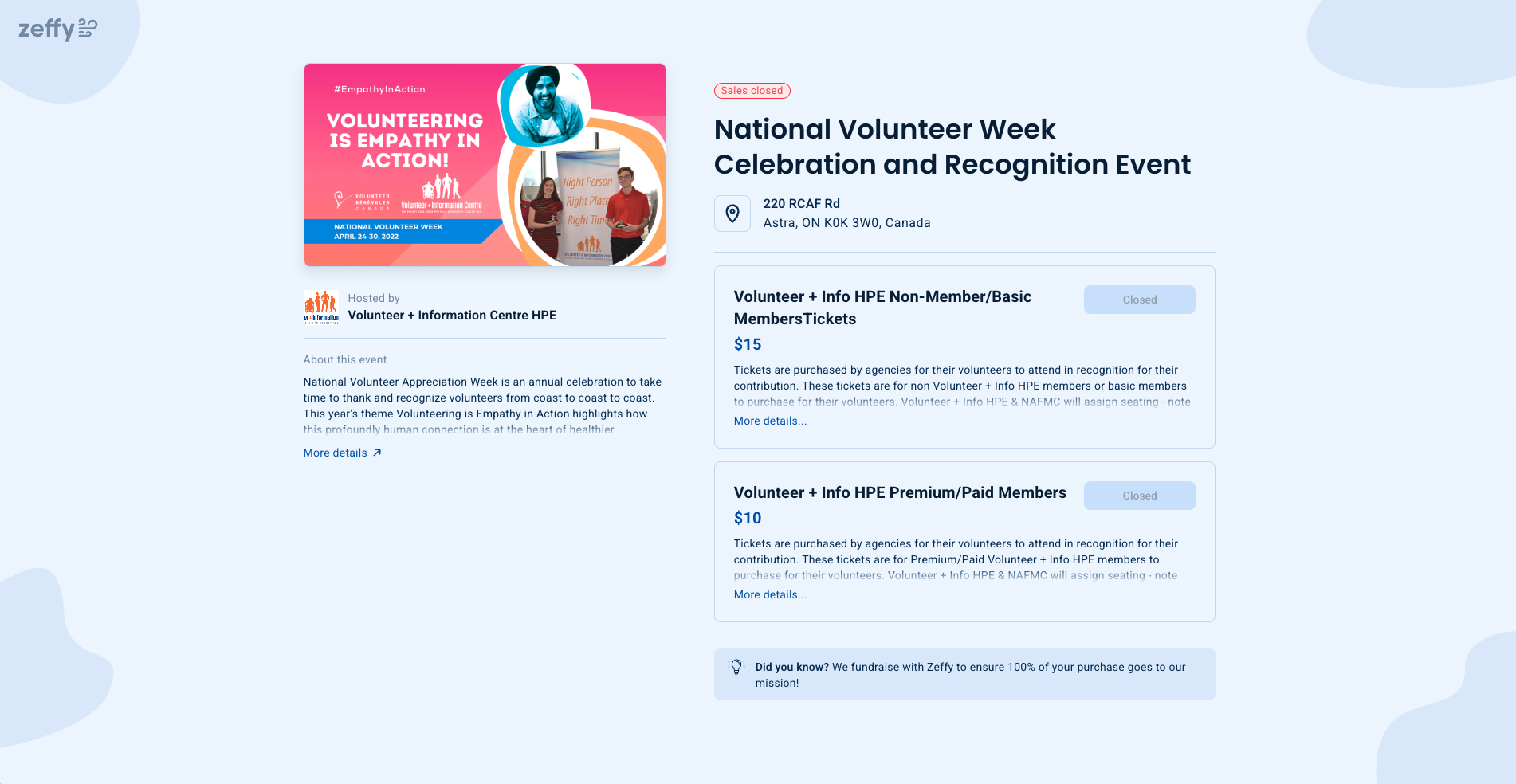
Volunteer + Information Center (VIQ) used Zeffy to organize their National Volunteer Week Celebration and Recognition Event. The event, themed "Volunteering is Empathy in Action," highlighted the human connection at the heart of volunteerism.
Using Zeffy's free event ticketing platform, VIQ offered tiered ticket options for different member types. They raised $1,731 while saving $86 in fees, and that $86 went straight back into their volunteer recognition budget instead of to a platform.
VIQ's example shows the math for a small nonprofit: a free ticketing platform turns Volunteer Week into a moment that funds itself, with every dollar landing on the mission.
The official 2026 theme is "Shining a Light on the People and Causes That Inspire Us to Serve" (Points of Light). Volunteer Canada's 2026 theme is "Ignite Volunteerism."
The highest-impact moves cost nothing: handwritten notes that name a specific contribution, social media spotlights with a photo and a short story, public recognition at a board meeting, and one in-person gathering at a free venue. Skip custom merch and elaborate themed weeks unless a sponsor is covering them.
The sentiment matters more than the price tag. Strong low-cost options include a handwritten card paired with a $5 coffee gift card, a small plant, a printed certificate, or homemade baked goods. Skip branded merch unless a board member is sponsoring it.
Run one post a day with a photo and a specific story (see the templates in the social section above). Use #NationalVolunteerWeek, #VolunteerAppreciation, and #ThankAVolunteer. End every post with one sentence on how to get involved.
Points of Light coordinates National Volunteer Week in the United States. Volunteer Canada coordinates the Canadian observance. Many schools, community groups, and nonprofits also organize their own local events.
Pick 2 to 3 days, not 5. Build the week around one in-person or virtual anchor gathering, send 5 to 10 personal thank-you notes, and run a daily volunteer spotlight on social media. That is a complete Volunteer Week in about 6 hours of planning.
A Guide to Recruiting Volunteers for your Nonprofit
Whether your nonprofit organization is looking to streamline its volunteer network, bring on new volunteers, or is simply weighing the pros and cons of volunteer versus paid staff, this guide will help you discover the best practices to follow when implementing a volunteer strategy.
Learn how to manage volunteers with our guide. Discover volunteer management training, best practices, and tips on how to manage volunteers for successful programs.
Look for people who attend related events, follow relevant Facebook groups, or subscribe to aligned newsletters.These aren’t just potential donors—they’re your future advocates.
Look for people who attend related events, follow relevant Facebook groups, or subscribe to aligned newsletters.These aren’t just potential donors—they’re your future advocates.





.webp)

