We use cookies to improve your experience on our platform. By clicking “Accept all cookies”, you agree to the storing of cookies on your device to enhance site navigation, analyze site usage and assist in our marketing efforts.
Cookies required for basic website functionality.
Cookies used to deliver content most relevant to you and your needs.
Cookies used to deliver content most relevant to you and your needs.
Cookies that help understand the performance of the website, how users interact with it and to identify bugs.
How is Zeffy free?
How is Zeffy free?
Zeffy relies entirely on optional contributions from donors. At the payment confirmation step - we ask donors to leave an optional contribution to Zeffy.
20+ Thanksgiving Fundraising Ideas Small Nonprofits Can Actually Run (2026)
June 24, 2026
⚡TL;DR — The Short Answer
Verdict: Thanksgiving is the best time to fundraise if you pick ideas matched to your actual capacity. Most small nonprofits should run one digital ask and one low-ops in-person or pre-order idea — not a big event.
What works: Gratitude campaigns, pie pre-orders, sponsor-a-family programs, and Stuff-the-Turkey challenges. All low-lift, no permits, runnable in 2-4 weeks by 1-2 volunteers.
What doesn't: Turkey Trots, sit-down dinners, and in-person fitness events for orgs without permits, insurance, and a dedicated ops volunteer already in place.
Best for: 1-3 person all-volunteer nonprofits who want a clean Q4 ask that keeps 100% of every dollar raised.
Worth considering if: You have a community venue, a school partner, or a local business relationship — those unlock the medium-effort ideas (talent show, read-a-thon, silent auction) and push the ceiling to $15K+.
If you run a 1-3 person nonprofit, the problem with most Thanksgiving fundraising listicles isn't a shortage of ideas. It's that none of them filter for what you can actually pull off in six weeks with two volunteers and no events team.
This guide does. Below are 20+ Thanksgiving fundraising ideas, sorted roughly by effort, with a ✅ or ❌ small-nonprofit fit verdict on every one. ✅ means a small all-volunteer org can realistically run it in 4-6 weeks. ❌ means it needs permits, a longer lead time, paid staff, or insurance, so it only works if you already have dedicated ops capacity.
Thanksgiving's real edge for a tiny nonprofit isn't novelty. It's that gratitude reframes the "begging" feeling that keeps founders from ever sending the ask. Pick one or two ideas you can run on a stack that keeps 100% of every dollar you raise, and you'll be in good shape by the last week of November. Over 100K+ nonprofits trust Zeffy to do exactly that, having raised $2B+ combined with no platform fees, no transaction fees, and no credit card fees.
Why Thanksgiving is prime time for nonprofit fundraising
Q4 carries more weight than any other quarter for donations. Research from Blackbaud Institute consistently shows roughly 30% or more of annual charitable giving lands in Q4, with the heaviest concentration between Thanksgiving and December 31. For the most current figure, see the Blackbaud Institute Charitable Giving Report.
For a small nonprofit, the takeaway isn't "run a big event." It's that donors are already in a giving frame of mind, so a simple, gratitude-led ask outperforms a frantic one. Lead with thank-yous to last year's supporters, then make the ask. The same season that makes outreach feel awkward is the season that makes it work.
For a small nonprofit: you don't need to invent demand in Q4. You need a clean, runnable ask aimed at people who already want to give before December 31.
The 20+ ideas, sorted by effort
1. Gratitude campaign ✅
Fit: ✅ A 2-week digital campaign you can run from email and social with no staff and no permits. Highest small-nonprofit fit on this list.
A gratitude campaign is a simple two-week ask that leads with thank-yous to last year's donors and then invites this year's gift. It closes the stewardship gap (the thing most small orgs skip) at the same time as it raises money.
How to run it:
Week 1: gratitude. Three social posts and one email naming what last year's donors made possible. Specific outcomes, not vague thanks. "Your 2025 gift funded 412 meals" beats "thank you for your support."
Week 2: invite. One email and two social posts asking supporters to share what they're thankful for and add a gift. Pin a single hashtag.
Donor wall. A simple page or social highlight reel where donors' names and thank-you messages appear as gifts come in. Public recognition lifts average gift size.
Goal visual. A live fundraising thermometer at the top of the donation page so each gift visibly moves the bar.
Run the ask on a free donation form, use a fundraising thermometer for the goal visual, and use free donor management to segment first-time vs. repeat donors and send personalized thank-yous from one dashboard. The same tool that takes the gift sends the receipt and the thank-you, and segments the list for next year.
Common range, depending on scale: $1,000-$8,000.
For a small nonprofit: if you only do one thing this Thanksgiving, do this. It's the lowest-lift and the highest-leverage idea on the list.
2. Thanksgiving giveaway on social media ✅
Fit: ✅ Runs from a phone in 1-2 weeks. Watch contest-compliance rules per platform.
An online giveaway asks supporters to donate or share to enter for a prize. It's a low-cost awareness lever, especially if the prize is a donated item (gift basket, holiday feast box, local-business gift card).
Sample contest mechanics you can copy:
Rules: One entry per donation of any amount; bonus entry for sharing the post and tagging two people. Open to US residents 18+. No purchase necessary where required by law.
Hashtag: One short branded tag, used everywhere. Example pattern: #[YourOrg]Thanks.
Prize tiers: One grand-prize basket plus two or three smaller runner-up prizes so multiple people win.
Disclosure: Name the sponsoring org clearly. Most platforms require this; check each platform's current promotion rules before launch.
Lead on TikTok, Instagram, and Facebook. X is fine as a secondary channel. Keep your mechanics generic enough to work across platforms instead of leaning on any single platform's contest features, which change often.
Common range, depending on scale: $500-$5,000.
For a small nonprofit: worth running once a year for the awareness and email-list lift, even if the dollar total is modest.
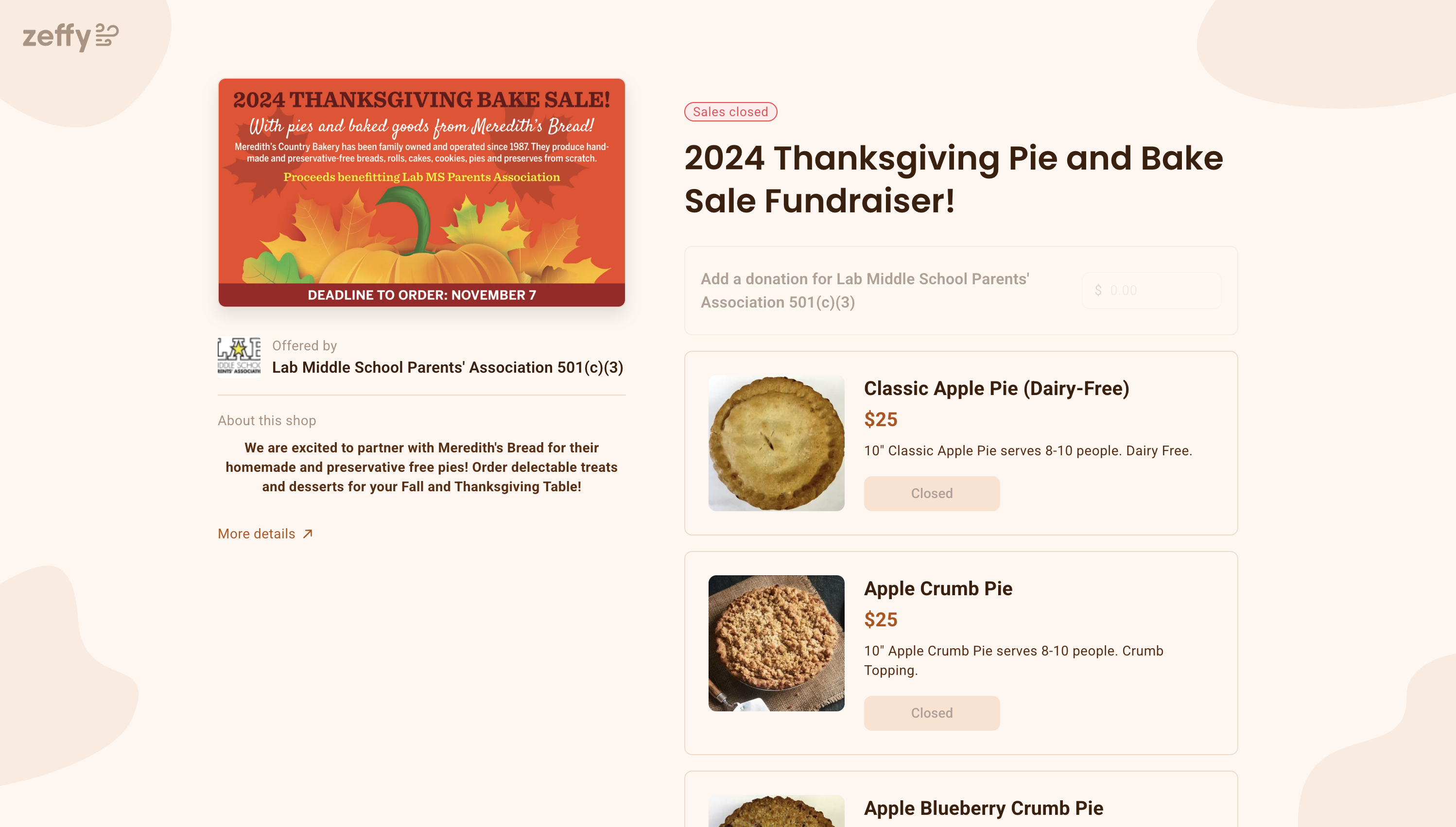
3. Pie sale (pre-order) ✅
Fit: ✅ High-margin, low-effort. Pre-orders mean you only bake (or buy wholesale) what's already sold.
A pie sale is a bake sale's smarter cousin. Pre-orders eliminate guesswork and waste; you collect payment before you bake or buy.
How to set it up:
Price: $15-$25 per pie (illustrative). Aim for 2-3x your ingredient or wholesale cost.
Wholesale partner: ask a local bakery for a wholesale rate in exchange for visibility on your order page and at pickup.
Pre-order window: open three weeks before Thanksgiving; close five days before so partners can fulfill.
Pickup, not delivery. One pickup window at one location keeps logistics sane. Save delivery for next year.
Use a free online store to take pre-orders (with variants for flavor and quantity), and use free Tap to Pay on a volunteer's phone for any walk-up pickups that want to pay by card.
Common range, depending on scale: $800-$4,000.
For a small nonprofit: the cleanest in-person idea on the list. Two volunteers, one pickup day, no permits if you're partnering with a licensed bakery.
Fit: ✅ Slightly more effort than a pie pre-order because of day-of logistics and food-handling rules.
If you'd rather sell a wider mix of baked goods (cookies, breads, brownies, sweet potato pies), run a bake sale instead of (or alongside) a pie pre-order.
Pricing strategy:
Mark up 2-3x ingredient cost. Individual cookies at $2-$3, small loaves at $8-$12, whole pies at $15-$25 (illustrative).
Lean on high-margin items: pies, specialty breads, and "kits" (a bag of cookies plus hot cocoa) beat single cookies on profit-per-square-foot of table.
Bundle. A "Thanksgiving dessert trio" at $30 sells better than three things at $10.
Check local cottage-food rules before you sell, secure any required permits, and ask a local bakery to donate or wholesale items in exchange for booth signage. Use free Tap to Pay on a phone to take card payments at the table; expect 30-50% of buyers to want to pay by card.
Common range, depending on scale: $500-$3,000.
For a small nonprofit: good for a parent group, faith community, or volunteer chapter with an existing event to piggyback on. Standalone, it's a lot of baking for a modest return.
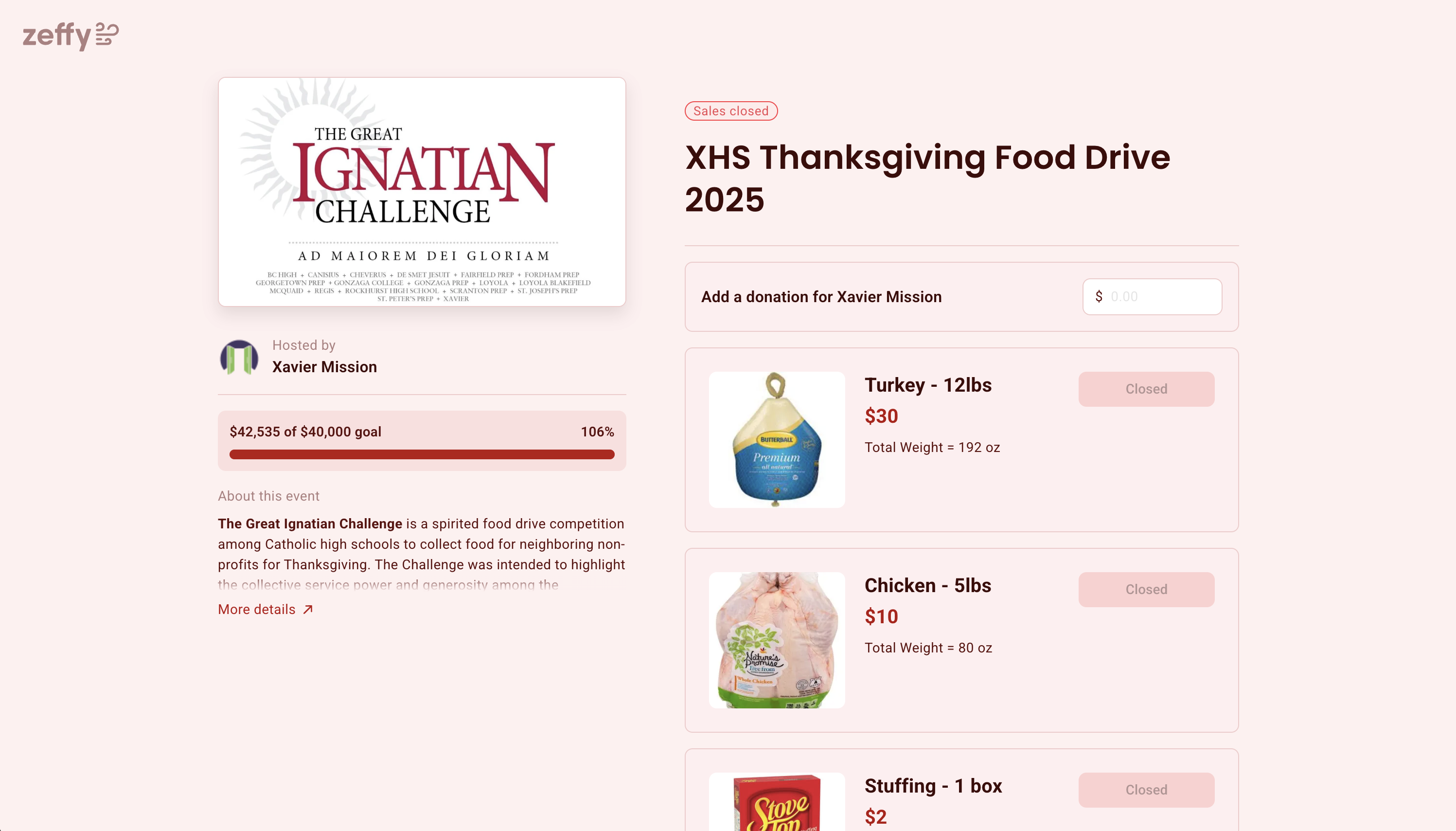
5. Thanksgiving food drive ✅
Fit: ✅ Low cost, high community engagement. Plan three weeks out so partners have time to confirm.
A food drive collects shelf-stable items for a local food bank or community-services agency. It's not the highest-dollar idea here, but it converts volunteers and first-time supporters into donors better than almost anything else.
How to run it:
Partner first. Confirm a local food bank or community-services agency as the recipient before you announce anything. Ask them for their most-needed items list.
Drop-off sites. Two or three is plenty. A partnering local grocery store often works well; ask early.
Volunteer slots. Sort, pack, and deliver in one or two scheduled shifts. Capture names and emails of every volunteer.
Conversion. Send a follow-up email to every volunteer and drop-off donor with a thank-you, an impact number ("we delivered X meals"), and one soft ask. This is where the actual revenue comes from.
Common range, depending on scale: $500-$3,000 in cash (the in-kind value is usually much higher, but cash is what funds payroll).
For a small nonprofit: worth it for the donor-acquisition lift, not the in-kind value. The email list you build is the asset.
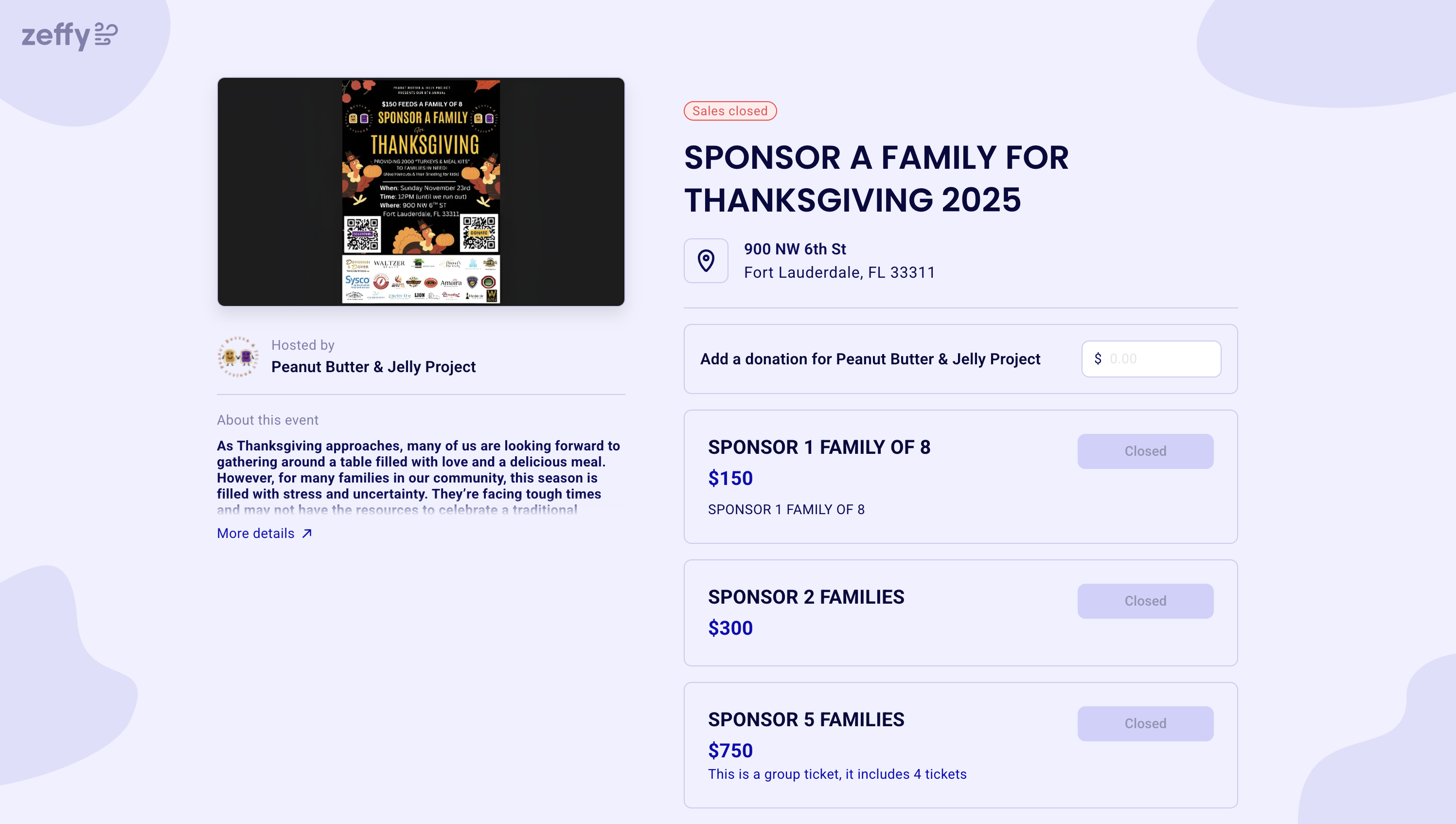
Fit: ✅ Translates well to a small org because the unit of donation is concrete and shareable.
Donors sponsor complete Thanksgiving meals for families in need. The clearer your cost-per-family number, the better this performs.
How to set it up:
Cost-per-family. Build a transparent number (groceries, paper goods, delivery if any). Round to a clean ask: $50, $75, $100 per family.
Partner. A local food bank or community-services agency identifies recipient families. Don't try to source families yourself.
Recognition tiers. "Sponsor a family" ($75), "Sponsor a table" ($300, four families), "Sponsor the block" ($1,000, twelve families). Same idea, different commitment levels.
Impact report. Within two weeks of Thanksgiving, send every sponsor a number ("you funded X families") plus one photo or anonymized story from your partner.
Run the ask on a free donation form with preset amounts that match the tiers.
Common range, depending on scale: $2,000-$15,000.
For a small nonprofit: one of the best fits on the list. Concrete, shareable, and the partner does the heavy lift on family selection.
Fit: ✅ A gamified version of your gratitude campaign. Same lift, more visual.
A virtual progress visual: as donations come in, the turkey "fills up." Pair with social-share mechanics and a stretch goal.
Goal thermometer or progress bar on the donation page and in every email.
Share mechanics: a pre-written share image or video that auto-updates as the bar climbs.
Prize tiers: at 25%, 50%, 75%, and 100%, unlock something small (a bonus social shout-out, a behind-the-scenes video, a board-member match).
Common range, depending on scale: $1,000-$6,000.
For a small nonprofit: a strong companion to the gratitude campaign if you want a visual hook. Don't run both standalone; pick one frame.
8. Thankful read-a-thon ✅
Fit: ✅ Easiest if you already have a school or youth-group partner. Otherwise, ❌.
Students or participants get pledges for books read during Thanksgiving week. Works best with a school, library, or youth-group partner who handles the logistics.
Pledge sheet: a simple form (paper or digital) with reader name, sponsor name, and pledge-per-book.
Book selection: let kids pick; don't curate. Engagement matters more than the reading list.
Tracking: a parent or teacher signs off on totals at the end.
Common range, depending on scale: $1,500-$8,000.
For a small nonprofit: only worth it with a real school partner already on board. Cold-pitching schools in October will eat your runway.
9. Thanksgiving talent show ✅
Fit: ✅ if you already have a venue (church hall, school auditorium, community center). ❌ if you're sourcing one from scratch.
Solo or group performances, dance, magic, lip-sync battles. Family-friendly, easy to staff with volunteers.
Revenue mechanics:
Admission ticket: $10-$20 (illustrative).
Performer entry fee: $5-$15.
Audience-vote donations (donate to vote for your favorite act). This usually outperforms ticket revenue.
Concessions and program ads from local businesses.
Common range, depending on scale: $1,500-$6,000.
For a small nonprofit: good fit if a community venue is already friendly to you. The audience vote is what makes it work financially.
10. Community event booth ✅
Fit: ✅ Lowest-effort in-person idea on the list. Piggybacks on someone else's event.
A booth at a fall festival, holiday market, or town Thanksgiving event. You're renting reach, not building it.
Booth fee: $50-$300 depending on the event (illustrative). Confirm before you commit.
Inventory: a Gratitude Wall (free engagement), one or two small saleable items (cards, ornaments), a tablet or phone for digital donations.
Lead capture: the real point. Collect emails for a "we'll send you our year-end impact report" sign-up.
Use free Tap to Pay to accept card donations on a phone with no terminal.
Common range, depending on scale: $300-$2,000 in same-day revenue (more in follow-up).
For a small nonprofit: worth it mainly for the email list, not the booth-day total.
11. Pumpkin painting contest ✅
Fit: ✅ Family-friendly, easy to host outdoors or in a community room.
Participants decorate pumpkins and a panel of judges (or audience votes) picks winners by age category. Charge entry, sell concessions, auction the painted pumpkins at the end.
Entry fee: $10-$20 per pumpkin, includes a pumpkin and basic supplies.
Age categories: under 8, 8-12, 13-17, adult. Keeps it fair.
People's choice: donation-weighted voting raises more than ticket revenue.
End-of-event auction: sell the painted pumpkins.
Common range, depending on scale: $500-$2,500.
For a small nonprofit: a clean family-engagement fundraiser. Modest dollars, real community lift.
12. Thanksgiving silent auction or raffle ✅
Fit: ✅ if you can source 10-20 items from local businesses. ❌ if you can't.
A virtual or hybrid Thanksgiving-themed silent auction or raffle. The whole game is item sourcing.
Item-sourcing checklist:
10-20 items minimum for a virtual auction to feel populated. Mix gift baskets, experiences, services, and one or two higher-value items.
Local business asks: aim for 30 outreach emails to land 10-15 yeses. Lead with the deductibility and the audience exposure.
Minimum bids: 30-40% of fair-market value, so the room never feels empty.
Bid timeline: open the auction one week out; close on Thanksgiving evening or the Friday after.
For raffles, a single high-value prize (catered Thanksgiving dinner, weekend getaway) outsells a stack of small prizes. Check your state's raffle/charitable-gaming rules before selling tickets.
For a small nonprofit: worth it only if you have an item-sourcer on your team. Without one, this is a black hole.
13. Give-and-Get holiday shop ✅
Fit: ✅ if you're using donated or consigned product. ❌ if you're sourcing and storing inventory yourself.
An online store of Thanksgiving and holiday items where proceeds go to your nonprofit. Cranberry sauce, candles, table centerpieces, branded merch.
Source via partnership. Local artisans consign product; you take a margin. Avoid buying inventory up front.
Markup: 30-50% on partner product; 2-3x cost on merch you produce.
Bundles outsell singles. A "Thanksgiving Host Package" beats six separate items.
Shipping vs. pickup. Pickup is simpler and avoids fulfillment costs. Save shipping for a year you have a fulfillment partner.
Use a free online store with variants and inventory limits.
Common range, depending on scale: $1,000-$8,000.
For a small nonprofit: the operational risk is inventory. Consign, don't buy.
14. Virtual Thanksgiving cooking class ✅
Fit: ✅ if you have a chef partner who'll volunteer. ❌ if you're hiring one.
Pay-to-attend online cooking class, hosted by a volunteer chef partner. Send participants the ingredient list a week ahead and record the session for replay sales.
Ticket price: $25-$50 (illustrative).
Replay sale: $15-$20 for non-attendees after the live event.
Class size: cap at 30-50 live participants for Q the replay is unlimited.
Platform: any video tool you already use (Zoom, Google Meet, etc.).
Use free event ticketing for the live class and the replay.
Common range, depending on scale: $1,000-$5,000.
For a small nonprofit: only worth it if the chef is already in your network. Cold outreach to chefs in October rarely lands.
15. Thanksgiving fitness challenge ✅/❌
Fit: ✅ as a virtual pledge-per-mile challenge (low ops). ❌ as an in-person event (permits, insurance, staffing).
Reframed from a single fitness class to a broader fitness challenge that can run virtually or in-person.
Two ways to run it:
Virtual pledge-per-mile. Participants log miles (running, walking, cycling) during Thanksgiving week and collect pledges from sponsors. Lowest-lift version.
In-person clinic or class. Higher revenue but more ops (venue, insurance, instructor).
Corporate wellness angle. Local employers sponsor employee teams. Asks for one outreach call, but a single yes can fund the whole challenge.
Example: The LAB. The LAB (Las Vegas Athletics of Basketball) sold tickets to its Thanksgiving Elite Skills Clinic, a two-day basketball training workshop. Using Zeffy's free event ticketing, the LAB raised $3,730 and saved $186 in fees.
For the virtual pledge model, use free peer-to-peer fundraising so each participant gets a personal page their sponsors can pledge against. For the in-person clinic model, use free event ticketing as The LAB did.
Common range, depending on scale: $1,500-$8,000.
For a small nonprofit: the virtual pledge-per-mile version is ✅. The in-person event is ❌ unless you already have insurance and a venue.
16. Classic Thanksgiving dinner fundraiser ❌
Fit: ❌ for a 1-3 person org running this from scratch this year. ✅ only if you have a venue, a kitchen partner, and an ops volunteer.
A sit-down Thanksgiving dinner for the community. High-ceiling fundraiser, real operational lift.
Ticket tier examples:
Individual seat: $25-$50.
Family of four: $100.
Sponsor table (seats 8): $500-$1,000, includes signage and program recognition.
"Sponsor a family" add-on: $75 per family for community members who can't pay.
Sponsorship package template (offer 3-4 levels): Title Sponsor ($2,500+, naming rights and top-of-program), Table Sponsor ($1,000, branded table and signage), Supporting Sponsor ($500, program listing and social shout-out), In-Kind Partner (food or services in exchange for listing).
Cost-reduction tactics:
Food donations. One scripted ask to local restaurants and grocers: "We're feeding [N] community members on [date]. Would you donate [item] in exchange for listing in our program and on our social channels?"
Decoration. One volunteer with a Pinterest board and $100 in supplies. Don't hire a decorator.
Atmosphere. Long tables, candles, a single shared centerpiece. Family-style beats plated for cost and warmth.
Use free event ticketing with tiers, group tickets, and QR check-in. Use free Tap to Pay on a phone for door sales and walk-up donations.
Example: The Papillion Center.The Papillion Center, a faith-based counseling and therapy center, ran its 2023 Thanksgiving Dinner with tiered sponsorship packages, from event sponsorships down to supporting-sponsor roles. Using Zeffy's free event ticketing, The Papillion Center raised $18,000 for its mission and saved $900 in fees that would otherwise have left the org.
Common range, depending on scale: $5,000-$25,000.
For a small nonprofit: the highest-ceiling idea on the list and the riskiest if you don't have the ops in place. If you can't name today who's running food, who's running the floor, and who's running ticketing, pick a lower-effort idea this year and build the dinner for 2027.
17. Turkey Trot fun run or walk ❌
Fit: ❌ for most small all-volunteer orgs. Permits, insurance, an 8-week lead, and route safety make this a real event-production lift.
Turkey Trots are everywhere on Thanksgiving morning, and that's the problem: yours has to be permitted, insured, and routed safely.
If you do run one:
Start 8 weeks out. Permits and route approval take time.
Registration tiers: early bird ($25), regular ($35), family of four ($100), with-shirt ($45) (all illustrative).
Swag: a race t-shirt and bib bump registration but eat margin. Order based on registrations one week before, not on hope.
Permit and insurance checklist: municipal permit, event liability insurance, medical personnel on standby, water and first-aid stations, marshaled course.
Promotion timeline: announce 8 weeks out; open registration 6 weeks out; final push 2 weeks out; race-week reminders daily.
Layer in peer-to-peer pledges so each runner raises beyond their registration fee: use free event ticketing for registration tiers and free peer-to-peer fundraising for pledge-per-runner pages.
Common range, depending on scale: $3,000-$15,000.
For a small nonprofit: ❌ unless you already have a volunteer running ops. The first-year permit-and-insurance lift will eat your team. Consider partnering with an existing Trot instead of starting one.
How to choose the right Thanksgiving fundraiser
If you're trying to decide which one (or two) to actually run, use the table below. Effort, timeline, and fit line up exactly with the per-section ✅/❌ verdicts above. Pick by attainability, not novelty.
Idea
Effort
Timeline to plan
Common revenue range (illustrative)
Ideal for (org size)
1. Gratitude campaign ✅
Low
2 weeks
$1,000-$8,000
1-3 person all-volunteer
2. Social media giveaway ✅
Low
1-2 weeks
$500-$5,000
1-3 person all-volunteer
3. Pie sale (pre-order) ✅
Low
3 weeks
$800-$4,000
1-3 person all-volunteer
4. Bake sale ✅
Low-Med
3-4 weeks
$500-$3,000
Volunteer chapter or parent group
5. Food drive ✅
Low-Med
3 weeks
$500-$3,000 cash
1-3 person all-volunteer with a food-bank partner
6. Sponsor a family ✅
Low-Med
3-4 weeks
$2,000-$15,000
1-3 person all-volunteer with a community partner
7. Stuff-the-Turkey ✅
Low
2-3 weeks
$1,000-$6,000
1-3 person all-volunteer
8. Thankful read-a-thon ✅
Med
4 weeks
$1,500-$8,000
Org with a school or youth-group partner
9. Talent show ✅
Med
4-6 weeks
$1,500-$6,000
Org with a community venue
10. Community event booth ✅
Low
2-3 weeks
$300-$2,000
1-3 person all-volunteer
11. Pumpkin painting contest ✅
Low-Med
3-4 weeks
$500-$2,500
Family-focused org or chapter
12. Silent auction or raffle ✅
Med
4-6 weeks
$2,500-$15,000
Org with an item-sourcer on the team
13. Give-and-Get holiday shop ✅
Med
4-6 weeks
$1,000-$8,000
Org with artisan or consignment partners
14. Virtual cooking class ✅
Low-Med
3-4 weeks
$1,000-$5,000
Org with a volunteer chef partner
15. Fitness challenge (virtual) ✅
Low-Med
3-4 weeks
$1,500-$8,000
1-3 person all-volunteer (virtual pledge model)
15. Fitness challenge (in-person) ❌
High
6-8 weeks
$2,000-$10,000
Org with venue and insurance
16. Thanksgiving dinner ❌
High
6-8 weeks
$5,000-$25,000
Org with venue, kitchen partner, ops volunteer
17. Turkey Trot ❌
High
8 weeks
$3,000-$15,000
Org with permits, insurance, ops capacity
For a small nonprofit: if it's already October and you're a team of one or two, stop reading the ❌ rows. Pick a gratitude campaign and a pie sale, or a sponsor-a-family and a community booth. Two ideas, four to six weeks, no permits.
How The Papillion Center raised $18,000 with a Thanksgiving dinner
The Papillion Center, a faith-based counseling and therapy center, used its 2023 Thanksgiving Dinner to layer tiered sponsorships on top of meal tickets, from full event sponsors down to supporting-sponsor roles. The result: $18,000 raised for its mission and $900 in fees saved by running everything on Zeffy's free event ticketing instead of a paid platform.
The takeaway for a small nonprofit isn't "run a $25,000 dinner." It's that the cleanest path to four or five figures in Q4 is one focused idea with tiered ways to give, run on a stack that keeps 100% of every dollar you raise.
For a low-effort idea (gratitude campaign, social giveaway, pie pre-order), 2-4 weeks is plenty. For medium-effort ideas (silent auction, talent show, sponsor-a-family), 4-6 weeks. For a Turkey Trot or a sit-down dinner, 6-8 weeks minimum, and only if you already have permits, insurance, or a venue lined up.
Yes, and for small nonprofits this is usually the right move. A common pairing: one digital ask (gratitude campaign or Stuff-the-Turkey) layered with one in-person or pre-order idea (pie sale, community booth, sponsor-a-family). Two ideas, one runway, one donor list. Avoid stacking three or more; the third idea always gets neglected.
The gratitude campaign, the Stuff-the-Turkey challenge, a virtual cooking class, a virtual silent auction or raffle, and the virtual version of a fitness challenge (pledge-per-mile). All of them run from a phone and an email list; none of them require permits.
Lead every email and social post with a specific thank-you to last year's donors before you ask for this year's gift. Add a public donor wall or a "Gratitude Grams" mechanic where supporters can send thank-you notes to others. Close every campaign with an impact number to the people who gave. Gratitude isn't a section of the campaign; it's the frame.
Yes, for two reasons. First, Q4 is where a significant share of annual giving lands, so the audience is already in giving mode. Second, the gratitude frame reduces the "begging" feeling that stops most small-org founders from asking. Even a two-week gratitude campaign with no events outperforms staying quiet through November.
Look for people who attend related events, follow relevant Facebook groups, or subscribe to aligned newsletters.These aren’t just potential donors—they’re your future advocates.
Look for people who attend related events, follow relevant Facebook groups, or subscribe to aligned newsletters.These aren’t just potential donors—they’re your future advocates.





.webp)

