We use cookies to improve your experience on our platform. By clicking “Accept all cookies”, you agree to the storing of cookies on your device to enhance site navigation, analyze site usage and assist in our marketing efforts.
Cookies required for basic website functionality.
Cookies used to deliver content most relevant to you and your needs.
Cookies used to deliver content most relevant to you and your needs.
Cookies that help understand the performance of the website, how users interact with it and to identify bugs.
How is Zeffy free?
How is Zeffy free?
Zeffy relies entirely on optional contributions from donors. At the payment confirmation step - we ask donors to leave an optional contribution to Zeffy.
If you came here for a donation tracker template, this page leads with it: a free spreadsheet you can open in Excel or copy in Google Sheets, no email gate, no login. It is the right tool for a brand-new or volunteer-run charity with one giving channel and a few hundred donors a year. It works whether you are a registered charity, a PTA, a village hall committee, a CIC, or an unincorporated community group that hasn't decided yet.
Further down, we name the exact moment a spreadsheet stops working, in the words real charities use, so you know when to move to something built for the job.
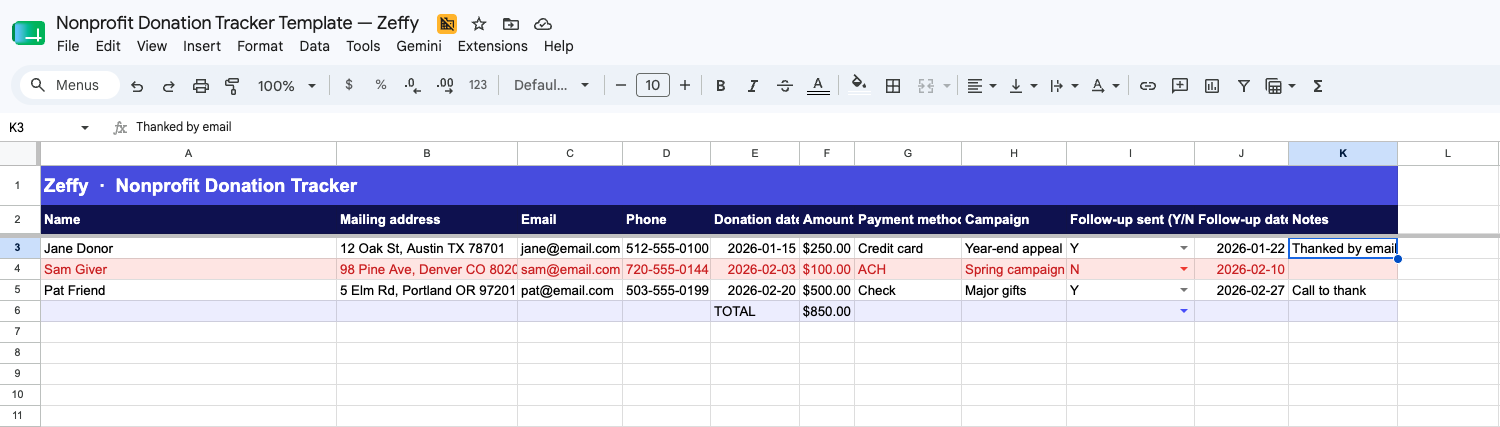
Gift details: date, amount, payment method, campaign
Follow-up tracking: yes or no, follow-up date, notes
Auto-sum for total raised by campaign and by donor
Colour-coded formatting that flags overdue follow-ups in red
No login or email signup required, just open and use it, completely free.
For a small charity: if you have one giving channel and one person entering data, this template will carry you through your first year. The ceiling shows up the moment a second channel does, and we cover that below.
What is included in this template
Eleven columns, grouped so you can scan a donor record in one glance.
Donor details. Name, postal address, email, and phone. Email is the column that earns its keep: email is where most donors want to hear from you, and it is the fastest route to a personal thank-you.
Gift details. Donation date, amount, payment method, and campaign name. The amount column auto-sums at the bottom and by campaign.
Follow-up tracking. A yes or no flag, a follow-up date, and a free-text notes column. Overdue follow-ups highlight red automatically.
For a small charity: the eleven columns are the floor, not the ceiling. Resist the urge to add more, because every new column becomes a field someone has to fill in by hand on every gift.
How to use the donation tracker template
Eight steps. One sentence each. You can have a working tracker in under an hour.
1. Enter the donor's name and postal address in the first two columns.
2. Add the donor's email, since most donors prefer to hear from you there.
3. Add a phone number if you call or text donors, or leave it blank.
4. Log the donation date so you can sort gifts in order.
5. Enter the amount, and the Funds Donated total at the bottom updates on its own.
6. Tag the campaign that drove the gift so you can compare what worked.
7. Record the payment method (online, cheque, cash, in-kind) for your records.
8. Mark yes or no in the Follow-up column and set a date, and the row turns red when the date passes.
Pro tip: use a filter on the Campaign column to see one campaign at a time, and a filter on Amount to surface your major gifts. The template's auto-sum and follow-up columns also exist natively in Zeffy's free donor management software, where new donations write themselves into the record.
For a small charity: the spreadsheet works as long as one person owns it. Two people typing into the same Google Sheet is where the typos and duplicate rows start.
Why track donations with a spreadsheet at all
A tracker earns its keep four ways.
Gift Aid claim readiness. HMRC lets a UK charity reclaim 25p for every £1 a UK taxpayer gives, provided you hold a valid Gift Aid declaration and keep the records for at least six years after the last donation covered. A clean tracker turns your quarterly Charities Online submission from a scramble into a copy-paste. (HMRC Gift Aid guidance)
UK GDPR record-keeping. Donor names, postal addresses and email addresses are personal data under the Data Protection Act 2018. Your tracker needs a lawful basis for holding that data (usually consent or legitimate interest) and a clear plan for how long you keep it. The ICO publishes plain-English guidance for charities on this.
Budgeting. When you can see what came in last month and last quarter, you can plan what to spend next month with more than a guess.
Donor relationships. Knowing who gave, when, and to what campaign is the foundation for genuine stewardship. Without it, every thank-you is generic. See our donor retention guide for the next steps.
Campaign analysis. Tagging gifts by campaign tells you which appeal earned its keep and which one to retire.
For a small charity: these are the reasons you track at all. They are not reasons to stay on a spreadsheet forever. The next section is the honest part.
When to upgrade from a spreadsheet to donor management software
A donation tracker template is a fine starting point for week one, and a slow leak the moment donations start arriving from more than one place. Every transaction becomes a hand-keyed entry, and the spreadsheet stops being a record. It becomes a reconciliation chore.
A UK volunteer fundraiser told us: 'We have, like, a million Google Sheets, and it's just trying to get it all together in one place.'
If any one of these is true for you, the spreadsheet is past its useful life:
Donations are arriving from more than one source (an online form, a Direct Debit or bank transfer, employer matching or Payroll Giving, a sponsored fundraising page).
You are copying contacts into Gmail or a newsletter tool to send updates.
You started a second sheet because the first one got messy.
You are tracking 100 or more donors, running more than one campaign at a time, or losing more than two hours a week to manual entry.
You are about to file your first Gift Aid claim and cannot tell which gifts have a valid declaration on file.
A trustee or a donor has asked whether your data handling meets UK GDPR, and you cannot easily answer.
The migration concern is fair: you already have a spreadsheet, and you do not want to start over. You do not have to. You can import your existing spreadsheet (up to 10,000 contacts per file) directly, past gifts included. More than 100,000 charities have raised billions on Zeffy with zero platform fees.
One more honest note: Zeffy is built for simplicity, not scale. It is not a moves-management or wealth-screening tool, and it does not have custom contact fields (you use Notes and Tags instead). If you are a one-to-three-person team or an all-volunteer organisation, that is the point. It is the system that fits the actual job.
No platform fee, no transaction fee, no credit card fee. Ever.
For a small charity: the upgrade is worth it the day the second giving channel shows up, and not really before. If you only have one channel, stay on the template.
Donation tracking is the habit of recording every gift your charity receives, along with who gave it, when, how much, and through which channel. A simple spreadsheet handles this well when you are starting out. The goal is to have a clean, searchable record you can use for Gift Aid claims, donor thank-yous, campaign analysis, and annual reporting to your trustees.
Give each gift its own row and keep the columns consistent: donor name, postal address, email, donation date, amount, payment method, campaign, and whether a Gift Aid declaration is on file. Use a filter on the Campaign column to compare appeals side by side, and a filter on Amount to find your major gifts quickly. Avoid merging cells or colour-coding by hand, as those break when you sort. Let the template's conditional formatting do that work automatically.
Log every gift on the day it arrives with the donor's name, amount, date, payment method, and a note of whether a valid Gift Aid declaration is on file. Gift Aid declarations must be kept for at least six years after the last donation they cover, and the claim window is four years from the end of the financial period. Note that Gift Aid does not apply to raffle ticket purchases, event ticket payments, auction lots at fair value, or donations from companies. (HMRC Gift Aid guidance; Charity Tax Group for eligible-gift boundaries.)
Yes, as a record of which gifts are Gift Aid eligible. The template captures the donor name, gift amount, date, and payment method that HMRC needs. You still need a signed Gift Aid declaration on file per donor (paper, digital, or oral) before you can reclaim the 25p per £1. For higher-rate (40%) or additional-rate (45%) taxpayers, the donor claims the difference themselves through Self Assessment. Keep declarations for at least six years after the last donation they cover. (HMRC Gift Aid guidance)
Switch when the spreadsheet creates more work than it saves. Common trigger points: donations arriving from more than one source, copy-pasting contacts into a newsletter tool, starting a second sheet because the first became unmanageable, tracking more than 100 donors across multiple campaigns, or approaching your first Gift Aid submission and realising you cannot confirm which gifts have a declaration on file. Zeffy's free donor management software connects your donation forms directly to your donor records, so new gifts write themselves in without manual entry.
Get weekly fundraising tips from nonprofits experts
Thank you! Your submission has been received!
Oops! Something went wrong while submitting the form.
Keep reading :
Tips & best practices
Choose a donation form your UK charity can actually afford (2026)
Compare the best donation forms for UK charities in 2026. Learn 10 tips to optimise your form for more gifts, understand Gift Aid mechanics, and see how Zeffy, JustGiving, CAF Donate and Enthuse compare on fees and features.
UK Donation Acknowledgements and Gift Aid: Free Template and Guide (2026)
UK charities do not issue tax receipts the way US organisations do. The mechanism here is Gift Aid: the charity reclaims 25p for every £1 a UK taxpayer donates from HMRC, on the strength of a Gift Aid declaration the donor signs. This guide explains what UK charities actually need to keep on file, what a good donation acknowledgement should contain, and how to handle year-end statements for higher-rate donors. It also covers the Gift Aid Small Donations Scheme (GASDS) for cash and contactless collections, and explains where Gift Aid does not apply (event tickets, raffle entries, auction lots). The free tool below generates a UK-format donation acknowledgement template; Zeffy handles the paperwork automatically, at no cost to your charity.
Recurring Donations for UK Charities: A Complete Guide to Regular Giving (2026)
Regular giving is the backbone of sustainable charity income in the UK. This guide explains the benefits of recurring donations for UK charities, how Gift Aid multiplies every regular gift, and how to set up a monthly giving programme on Zeffy's free platform. Practical tips cover converting one-off donors into regular supporters, staying compliant with the Fundraising Regulator's Code, and acknowledging donors in line with UK norms.
Look for people who attend related events, follow relevant Facebook groups, or subscribe to aligned newsletters.These aren’t just potential donors—they’re your future advocates.
Look for people who attend related events, follow relevant Facebook groups, or subscribe to aligned newsletters.These aren’t just potential donors—they’re your future advocates.





.webp)

