We use cookies to improve your experience on our platform. By clicking “Accept all cookies”, you agree to the storing of cookies on your device to enhance site navigation, analyze site usage and assist in our marketing efforts.
Cookies required for basic website functionality.
Cookies used to deliver content most relevant to you and your needs.
Cookies used to deliver content most relevant to you and your needs.
Cookies that help understand the performance of the website, how users interact with it and to identify bugs.
How is Zeffy free?
How is Zeffy free?
Zeffy relies entirely on optional contributions from donors. At the payment confirmation step - we ask donors to leave an optional contribution to Zeffy.
UK Donation Acknowledgements and Gift Aid: Free Template and Guide (2026)
July 7, 2026
UK charities do not issue "tax receipts" in the way US organisations do. The central mechanism is Gift Aid: your charity reclaims 25p for every £1 a UK taxpayer donates directly from HM Revenue & Customs (HMRC), on the strength of a Gift Aid declaration the donor signs. What charities send to donors is a voluntary donation acknowledgement -- a warm, record-keeping thank-you, not a statutory document a donor must hold to claim relief at the basic rate.
This guide covers what UK charities need to keep on file, what belongs in a donation acknowledgement, when higher-rate donors need supporting paperwork, and how the Gift Aid Small Donations Scheme (GASDS) works for cash and contactless collections. The free generator below produces a UK-format acknowledgement template you can use straight away.
Your Charity Commission, OSCR or CCNI registration number
✨With Zeffy, your charity details are saved once and auto-fill every acknowledgement. Set it up once
Needed if you include a Gift Aid declaration (HMRC uses it to identify a UK taxpayer)
✨Zeffy sends acknowledgements to donors the moment they give. No manual entry needed.
ℹGift Aid lets your charity reclaim 25p from HMRC for every £1 a UK taxpayer donates, at no extra cost to the donor. The declaration must be made by the donor. This adds HMRC's model declaration to the document, with the donor's details pre-filled, ready for them to tick and sign.
Live Preview
What changes when you automate acknowledgements with Zeffy
Doing it by hand
✗ Write each acknowledgement one at a time
✗ Chase Gift Aid declarations separately
✗ Email or post each letter individually
✗ Track donations in a spreadsheet
✗ Build year-end statements by hand
With Zeffy (100% free)
✓ Auto-sent for every donation
✓ Built-in Gift Aid handling for UK charities
✓ Sent automatically with the confirmation email
✓ Searchable donation dashboard + CSV export
✓ Year-end summaries for regular donors
Every hour spent on admin is an hour away from your cause. Zeffy handles donor acknowledgements for you, 100% free.
This tool creates a donation acknowledgement and, optionally, HMRC's model Gift Aid declaration for your records. A donation acknowledgement is a thank-you and record of the gift; it is not a tax receipt, as UK individual donors do not claim tax relief on donations in the way US or Canadian donors do. Gift Aid is claimed by the charity, not the donor. The Gift Aid declaration wording is HMRC's published model text. This is general information, not tax or legal advice. Check current requirements with HMRC (gov.uk) or a qualified adviser.
The tool below generates a donation acknowledgement template suitable for UK charities. It is an acknowledgement, not a Gift Aid declaration. See the sections below for exactly what a Gift Aid declaration must include.
How Zeffy handles donation acknowledgements for UK charities
The generator above works well for one-off acknowledgements. If your charity processes dozens (or hundreds) of donations each month, producing acknowledgements manually is not a good use of your time. Zeffy automates the entire acknowledgement workflow for every donation, at zero cost to your charity. Here is how it works.
Automatic acknowledgements for every donation
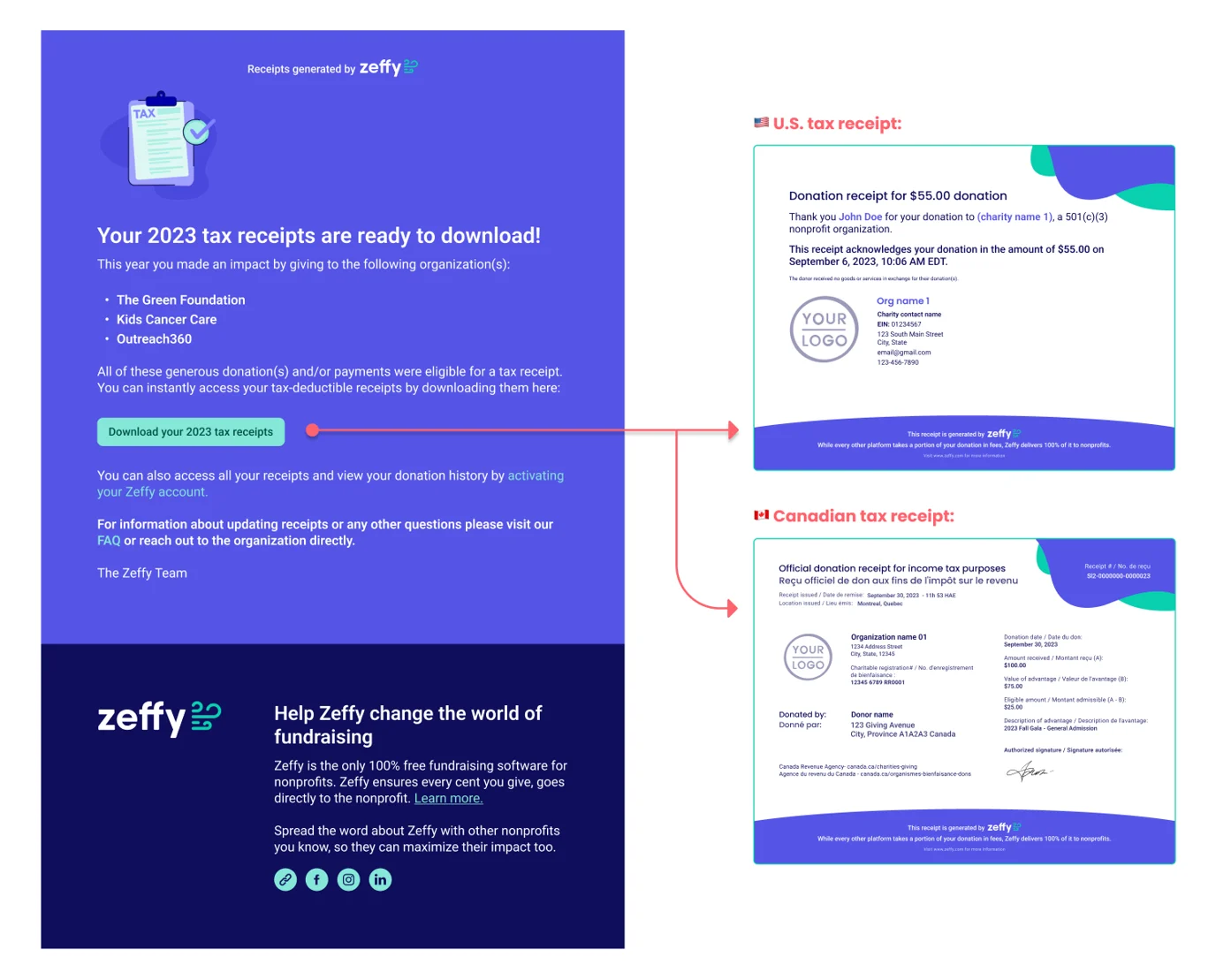
Every time someone donates through Zeffy, they receive an acknowledgement with their confirmation email. No extra steps needed on your end.
To set it up, go to your campaign settings and enable automatic receipt sending. For events, memberships, and raffles you can specify the portion of the payment that is a genuine donation (Gift Aid does not apply to the ticket or entry price itself -- see below). Zeffy handles the rest.
Donors can also access their acknowledgements at any time by logging into their Zeffy account and viewing their transaction history.
Works for cash and in-person donations too
Cash and cheque donations do not have to live in a separate system. Log them directly in your Zeffy dashboard and generate an acknowledgement on the spot from the donor's contact page.
For gifts in kind, your acknowledgement should include a description of the donated items but not a monetary value -- the donor is responsible for determining fair market value themselves. The Charity Tax Group is the authoritative UK reference for the tax treatment of gifts in kind and other complex giving scenarios.
Note: Gift Aid does not apply to gifts of goods. A donor may be able to claim income tax relief on gifts of assets to charities through Self Assessment, but this is a matter for their own tax return.
Year-end and tax-year summaries, handled
For UK higher-rate (40%) and additional-rate (45%) taxpayers, a year-end summary of their donations is genuinely useful: they reclaim the difference between basic rate and their rate via their Self Assessment return (covering the tax year 6 April to 5 April, with an online filing deadline of 31 January the following year). Sending a giving summary ahead of that deadline is good stewardship.
Zeffy sends every donor who has received an acknowledgement that year a giving recap with all their records in one place, including a total giving summary. Monthly donors receive a single cumulative record covering all recurring gifts. You do not need to compile or send anything manually.
Your only task is to make sure automatic acknowledgements are enabled on your forms before the end of the calendar year.
Cancel, replace, or resend in a few clicks
Mistakes happen. If you need to correct an acknowledgement, open the donor's profile, cancel the original (the donor is notified automatically and the record is marked as cancelled), and generate a replacement. You can add a note referencing the original acknowledgement number.
Need to resend? Go to the payment in your dashboard and select resend. You can update the email address if the donor had a typo.
Export everything for your records
Go to Finances, then Tax Receipts in your Zeffy dashboard. You will see every acknowledgement your organisation has generated, filterable by date range. Export the full list as a CSV that includes donor name, amount, acknowledgement number, status, and a direct URL to each record.
This makes trustee reporting, annual-return preparation, and Gift Aid claim reconciliation straightforward.
Doing it manually
With Zeffy
Create each receipt individually
Auto-generated for every donation
Research HMRC and Gift Aid compliance rules
Compliance built in and kept up to date
Email receipts to each donor
Sent automatically with confirmation emails
Track receipts in spreadsheets
Searchable dashboard with CSV export
Build year-end summaries by hand
Auto-sent to every donor before January 31
Calculate partial deductions for events
Split receipts for ticketed events, automated
Every hour spent on paperwork is an hour away from your mission. Zeffy automates it all, 100% free.
What is a donation acknowledgement in the UK?
A donation acknowledgement is formal documentation from a charity confirming a donor's contribution. It typically includes the donation amount, date, and donor details.
Both parties benefit. Donors use acknowledgements as a record of their giving, particularly if they are higher or additional-rate taxpayers claiming the difference through Self Assessment. Charities use them for stewardship, bookkeeping, and to demonstrate good practice to their regulators.
Crucially, a donation acknowledgement is distinct from a Gift Aid declaration. The declaration is the legal document that authorises the charity to reclaim tax from HMRC. The acknowledgement is the voluntary thank-you the charity sends in return.
Gift Aid: what it is and why it matters
Gift Aid is the central UK mechanism for boosting the value of charitable donations. When a UK taxpayer donates and signs a Gift Aid declaration, your charity can reclaim 25p from HMRC for every £1 donated -- so a £100 gift becomes £125 at no extra cost to the donor (HMRC Gift Aid guidance).
To claim Gift Aid your charity must be HMRC-recognised -- a separate registration from your Charity Commission, OSCR, or CCNI registration. This yields an HMRC Charities Reference Number. You then submit claims through HMRC Charities Online.
What a valid Gift Aid declaration must include (HMRC requirements):
The donor's full name
The donor's home address (at minimum house number or name, and postcode)
The charity's name
A description of the donation(s) to which the declaration applies
A statement that the donor wants the donation treated as Gift Aid
Confirmation that the donor has paid enough UK Income Tax and/or Capital Gains Tax in the year to cover the amount the charity will reclaim
Declarations can be made in writing, digitally, or orally (with a written record kept by the charity). Keep declarations for at least 6 years after the last donation they cover. Claims must be made within 4 years of the end of the financial period in which the donation was received.
Gift Aid does not apply to:
Payment for event tickets, raffle entries, or auction lots at fair value
Membership fees that confer tangible benefits
Company donations (different rules apply)
Donors who have not paid enough UK Income or Capital Gains Tax in the year
For complex cases -- gifts in kind, split payments, events where only part of the fee is a donation -- the Charity Tax Group is the definitive UK reference.
GASDS: the top-up scheme for small cash and contactless donations
The Gift Aid Small Donations Scheme (GASDS) lets charities claim a 25% top-up on small cash and contactless donations of £30 or less, without needing a written declaration from the donor.
Key rules:
Annual cap: £8,000 in eligible small donations per tax year (yielding up to £2,000 top-up)
Your charity must have been HMRC-recognised for at least 2 complete tax years
Claims are matched to your Gift Aid claim history
GASDS is directly relevant to UK charity events: fêtes, quiz nights, sponsored walks, and church collections where donors tap a card reader or drop cash in a bucket. As UK VoC research consistently shows, cash is in decline but contactless giving at community events is growing -- and GASDS means those small contactless donations can still generate meaningful Gift Aid-style uplift (HMRC Gift Aid guidance).
When do UK charities need to keep donation records?
UK basic-rate donors do not need a receipt or acknowledgement from a charity to benefit from Gift Aid. The charity does the claiming, not the donor. What matters is that your charity holds a valid Gift Aid declaration on file for each donor whose donations you are claiming on.
For higher-rate (40%) and additional-rate (45%) taxpayers, the donor reclaims the difference between basic rate and their higher rate through their own Self Assessment return. An acknowledgement from your charity helps them prepare that return, but they are ultimately responsible for keeping their own records.
What your charity needs to keep:
Signed (or digital/oral) Gift Aid declarations, retained for 6 years after the last covered donation
Records of all Gift Aid claims submitted to HMRC via Charities Online
For GASDS: records of the small cash and contactless donations claimed (no individual declarations needed, but aggregate records are required)
Good record-keeping is also a requirement under the Code of Fundraising Practice (effective 1 November 2025), which covers online fundraising platforms and donor-facing practice across England, Wales, and Northern Ireland.
What to include on a UK donation acknowledgement
A donation acknowledgement is voluntary, but a well-constructed one serves multiple purposes: it thanks the donor warmly, gives them the records they need, and signals that your charity operates to professional standards.
Recommended elements for a UK donation acknowledgement:
Your charity's full name and registered charity number (prefixed as appropriate: Charity Commission for England and Wales, OSCR for Scotland, CCNI for Northern Ireland)
Your HMRC Charities Reference Number (if you are HMRC-recognised and claiming Gift Aid)
Donor's full name
Donation amount and date
Payment method
A clear statement of whether any goods or services were provided in return (relevant for event tickets, gala dinners, auctions -- this affects Gift Aid eligibility)
A warm thank-you sentence that reflects your charity's voice
If your charity is a member of the Fundraising Regulator, including your membership statement is good practice and builds donor confidence.
A note on events, raffles, and auctions: Gift Aid cannot be claimed on the ticket or entry price when the donor receives something in return (a seat at a dinner, a raffle entry, a bid on an auction lot). If a donation is made separately on top of the ticket price, only that additional amount qualifies. For raffles specifically, note that they operate under the Gambling Act 2005 as small society lotteries, registered with your local licensing authority -- not with HMRC. See our guide to running a charity raffle in the UK for the full licensing picture.
Best formats for sending donation acknowledgements
How you deliver acknowledgements depends on your donors and your workflow. Here are the most common options for UK charities:
Email is the standard for most charities. It is fast, free, and easy to automate. Attach a PDF or link directly to the acknowledgement.
Platform-based acknowledgements are generated and sent automatically through your fundraising software. This is the most efficient option if your platform supports it (Zeffy does, at no cost to your charity).
PDF works well as an email attachment or a downloadable file. It is the standard format for records that donors may need to print.
Direct post is the traditional route. Some donors, particularly older supporters, prefer a physical copy. It takes more time and costs more, but it can serve as both an acknowledgement and a thank-you letter for significant gifts or legacies.
Most charities use a combination: an automated email acknowledgement immediately after the donation, and a posted letter for major gifts or legacy pledges.
Year-end and tax-year statements for UK donors
Why send year-end statements?
The UK tax year runs from 6 April to 5 April. For higher-rate and additional-rate taxpayers who reclaim the difference via Self Assessment, a giving summary ahead of the 31 January online filing deadline (covering the prior tax year) is genuinely useful. Sending it proactively is good stewardship and strengthens the donor relationship.
Even for basic-rate donors who do not file Self Assessment, a calendar-year giving summary is a warm touchpoint -- particularly for recurring donors who may not realise the cumulative value of their giving.
December is also a major fundraising moment in the UK calendar (The Big Give Christmas Challenge runs annually; Giving Tuesday is growing). A timely statement in January reinforces your relationship at a natural moment.
What to include
A year-end statement should summarise all donations from that calendar year. Include each gift date, amount, and a cumulative total. For recurring donors, a single consolidated statement is cleaner than 12 individual acknowledgements.
If your charity has submitted Gift Aid claims for a donor's donations, noting the total Gift Aid reclaimed on their behalf is a powerful demonstration of impact: "Your £500 in donations generated an additional £125 for our work through Gift Aid."
How Zeffy handles it
If you use Zeffy, year-end summaries are sent automatically. Every donor who has received an acknowledgement that year gets a giving recap with all their records in one place. Monthly donors receive a single cumulative record covering all recurring gifts. You do not need to compile or send anything yourself.
Your only task is to confirm that automatic acknowledgements are enabled on your forms.
How is Zeffy free?
Zeffy is funded entirely by optional contributions from donors. At the payment confirmation step, donors may choose to add a small optional contribution to support the platform. This is never required, and your charity always keeps 100% of what it raises. No platform fee, no transaction fee, no credit card fee.
This model has kept Zeffy fully independent since 2023. More than 100,000 organisations have raised over £2 billion through the platform without losing a pound to fees.
UK charities are understandably sensitive to platform costs. Most tools charge a per-transaction fee, a monthly subscription, or present donors with a prominently placed tip prompt at checkout -- a pattern that has attracted significant criticism in the UK fundraising press. Zeffy's 100%-free promise is unconditional: the platform is free regardless of whether any donor adds an optional contribution.
This tool generates a donation acknowledgement template for record-keeping purposes. It is not a Gift Aid declaration. Consult a qualified adviser or the Charity Tax Group for specific compliance questions. Zeffy automatically sends donation acknowledgements for every gift, including year-end cumulative records for recurring donors and split treatment for ticketed events, raffles, and other transactions where Gift Aid does not apply to the full payment.
Look for people who attend related events, follow relevant Facebook groups, or subscribe to aligned newsletters.These aren’t just potential donors—they’re your future advocates.
Look for people who attend related events, follow relevant Facebook groups, or subscribe to aligned newsletters.These aren’t just potential donors—they’re your future advocates.







.webp)

