We use cookies to improve your experience on our platform. By clicking “Accept all cookies”, you agree to the storing of cookies on your device to enhance site navigation, analyze site usage and assist in our marketing efforts.
Cookies required for basic website functionality.
Cookies used to deliver content most relevant to you and your needs.
Cookies used to deliver content most relevant to you and your needs.
Cookies that help understand the performance of the website, how users interact with it and to identify bugs.
How is Zeffy free?
How is Zeffy free?
Zeffy relies entirely on optional contributions from donors. At the payment confirmation step - we ask donors to leave an optional contribution to Zeffy.
A wine fundraiser is one of the few formats where a small nonprofit can credibly charge $50 to $100 a ticket, draw a higher-giving crowd, and graduate from the $20 spaghetti dinner. The catch: most small orgs pick the wrong format for the committee they actually have. A full wine-tasting gala asks a lot of six volunteers in eight weeks. A wine pull bolted onto an event you already run gets you most of the revenue with a fraction of the work.
Below are 15 ideas, each with a one-line fit verdict for a small, all-volunteer team. Then a tighter planning guide for the format most worth the effort, and a real case study from a Zeffy nonprofit that raised $26,527 on a single 2025 event.
15 wine fundraiser ideas, with a fit verdict on each
The list is grouped by format. Each entry carries a one-line verdict for a small, all-volunteer team: ✅ realistic, ⚠️ doable but heavy lift, ❌ skip unless you already have the pieces.
Wine pulls (lowest lift, best margins)
1.Classic blind wine pull. Guests pay $20 to $25 to pick a wrapped bottle at random. ✅ Lowest committee load on this list. Realistic to clear $2,000 to $5,000 on 50 to 100 donated bottles in one evening.
2.Cork pull. Numbered corks in a bowl match numbered bottles on display. Same mechanic, more visual. ✅ Great as an add-on to an event you already run.
3.Mystery wine grab. Bottles wrapped so the label is hidden until checkout. Slight premium feel. ✅ Pair with one or two "grand prize" bottles to drive volume.
4.Lucky bottles game. Every pull wins, but one in ten bottles is a premium label. ✅ Strong conversion because there are no losers.
Wine walls and games
1.Wine wall. A display of 50 to 100 bottles with numbered tags or keys. Guests buy a tag for $25 to $50 and unlock a bottle. ✅ Visually striking and self-serve once set up.
2.Wine pull ring toss. Carnival-style toss onto bottle necks. ⚠️ Works at picnics and family events, but you need floor space and a volunteer running it.
3.Seasonal or themed wine pull. Holiday wrap, Valentine's reds, summer ross. ✅ Easy seasonal refresh of an idea you already know how to run.
Wine tasting events
1.Classic wine tasting gala. 5 to 7 wines, sommelier or volunteer pourer, full venue. ⚠️ Real revenue ceiling, but you need a committee that can survive the $40-versus-$75 ticket-price fight and book a venue 8 to 12 weeks out.
2.Vertical tasting. Same vineyard, different years. ⚠️ Niche audience, requires a wine partner who will donate or discount rare vintages.
3.Wine and food pairing dinner. Multi-course with a wine paired to each course. ⚠️ Catering risk is the killer here. Pre-paid tickets are non-negotiable so you can forecast headcount.
Art and wine combinations
1.Wine and canvas night. Guided painting plus tastings. ✅ Local artists often teach for a share of ticket revenue. Doable for a first-time committee.
2.Gallery wine walk. Tickets get guests into multiple participating galleries or shops, each pouring a wine. ⚠️ Logistics-heavy partnerships but low venue cost.
3.Sip, sketch, and bid. Quick-sketch session followed by a silent auction of the finished pieces. ✅ Dual revenue stream and ends with a clear ask.
Virtual options
1.Virtual tasting with shipped kits. Wine and a tasting card shipped to ticket buyers, live-streamed tasting. ❌ Skip unless you already have a vineyard or distributor partner handling the fulfillment. Shipping logistics eat the margin for an all-volunteer team.
2.Online wine auction. Premium donated bottles sold via an online silent auction during a hybrid event. ✅ Pairs cleanly with any of the in-person formats above.
Small-nonprofit verdict on the list: if you have never run a wine event, start with a wine pull or wine wall at an event you already run. Save the tasting gala for year two, when you know your committee can hold a venue, a caterer, and 100 pre-paid tickets at once.
Wine pulls are the single best entry point for a small nonprofit. Donated bottles mean the margin is effectively 100% on whatever you sell. The mechanic is simple enough that two volunteers can run the table.
Here is how the six common formats compare for a small, volunteer-run team.
Type
How it works
Typical price point
Effort level
Revenue potential
Right fit when
Blind wine pull
Guests pay a flat fee to pick a wrapped, unlabeled bottle at random
$20 to $25 per pull
Low
$2,000 to $5,000 on 50 to 100 donated bottles
First-time committee; add-on to an existing event
Cork pull
Numbered corks in a bowl match numbered bottles on display
$20 to $25 per pull
Low
$2,000 to $5,000
You want a more visual table than a blind pull
Mystery wine grab
Bottles wrapped in paper or bags so labels are hidden until checkout
$25 per pull
Low
$2,500 to $5,000
You want a slightly more premium feel without changing the mechanic
Lucky bottles game
Every pull wins; one in ten bottles is a premium label as the hook
$25 per pull
Low
$2,500 to $6,000
You want stronger conversion because no one walks away empty-handed
Wine pull ring toss
Carnival-style ring toss onto bottle necks
$5 to $10 per toss, often 3 for $20
Medium
$1,000 to $3,000
Outdoor or family event with floor space and a dedicated volunteer
Seasonal or themed pull
Same mechanic with holiday wrap, Valentine reds, summer ross
$20 to $25 per pull
Low
$2,000 to $5,000
Holiday timing or a themed gala you already run
How to collect the money cleanly. The friction with pulls is not the pull, it is the payment. Cash creates reconciliation work for a volunteer at 10 p.m. "I'll pay you online later" usually means the donor never does. Set up tap-to-pay on a phone, no terminal required so a volunteer can take the $25 in five seconds, and print a QR code on the table that opens your Zeffy form as a fallback when the volunteer phone is in use.
Small-nonprofit verdict on wine pulls: if you can source 50 donated bottles and one tap-to-pay-capable phone, you can clear $2,000 in one evening. That is the highest dollars-per-volunteer-hour format on this list.
How to set up a wine wall
A wine wall is a wine pull with a better display. Bottles are arranged on a tall wooden frame, pegboard, or shelving unit, each with a numbered tag, key, or cork. Guests buy a tag and unlock the matching bottle. Because the wall is visible from across the room, it pulls foot traffic in a way a quiet pull table cannot.
Setup basics
Plan for 50 to 100 bottles. Below 50 the wall looks thin; above 100 the volunteer running it gets overwhelmed.
Source bottles through a "donate a bottle worth at least $15" ask to your board, sponsors, and a local wine shop. Donated bottles keep your margin at effectively 100%.
Price tags typically run $25 to $75 per pull, depending on the floor of the donated bottle values. Confirm your floor before setting the price.
Mix everyday bottles with a handful of higher-value bottles to drive volume. Guests will buy more tags when they can see a few standout labels on the wall.
Collect payment the same way as the pull. A phone with tap-to-pay handles the $25 sale in seconds, and a printed QR code that opens your ticketing or donation form gives a second checkout lane when the wall is busy.
Small-nonprofit verdict on wine walls: worth the extra build time only if you already have a donated-bottle pipeline. If you are starting from zero on bottles, a plain pull table gets you the same revenue with less furniture.
Art and wine fundraiser ideas
Pairing art with wine gives you two revenue streams: ticket sales and an art auction or sale. It also widens the audience to people who would not buy a wine-only ticket.
Wine and canvas night. A local artist leads a 90-minute guided painting session while guests sip two or three pours. Tickets at $45 to $65, plus an optional add-on auction of the artist's own work. The artist often teaches for a flat fee or a share of ticket revenue, which keeps your fixed cost predictable.
Gallery wine walk. Three to six local galleries or shops each pour a wine and host a featured artist. Guests buy a passport ticket at $35 to $50. You handle the ticketing and split the gate; partners absorb the venue cost. Best in a walkable downtown.
Sip, sketch, and bid. Guests do a quick 30-minute sketch session, then the finished pieces go into a silent auction at the end of the night. The auction closes the room with a clear ask instead of a slow fade.
Featured-artist tasting. One artist's work is hung in the tasting venue with prices and a bid sheet. Lower lift than a full gallery walk.
Small-nonprofit verdict on art and wine: the canvas night is the right entry point. Gallery walks need partner coordination 8 to 12 weeks out and are not a first-time committee project.
Virtual wine fundraiser options
Virtual wine fundraisers look attractive on paper because they remove the venue cost. In practice, the shipping logistics break the format for most small nonprofits.
Shipped tasting kits with a live stream. You ship two or three small bottles plus a tasting card to every ticket buyer, then host a live tasting on Zoom. Shipping costs, alcohol-shipping permits that vary by state, and lost or delayed packages eat the margin.
Online wine auction. A standalone online silent auction of donated bottles, running for a week. This works on its own but pairs better with an in-person event.
Wine club partnership. A wine club donates a share of subscriptions referred by your supporters. Steady but small. Useful as a year-round trickle, not as your main event.
Small-nonprofit verdict on virtual: skip the shipped-kit format unless you already have a vineyard or distributor partner handling fulfillment. A pure online wine auction during an in-person event is the only virtual format that consistently makes sense.
Creative add-ons that boost wine fundraiser revenue
The point of an add-on is to lift the per-guest dollar amount without adding new volunteers. These work alongside any of the formats above.
Silent auction of premium bottles. Bottles too valuable for a $25 pull go into a silent auction instead. A signed Bordeaux or a vertical of one vineyard's reserves can clear several hundred dollars on its own. Use Zeffy's free auction tool so bidding keeps running after guests leave the room.
Wine basket raffle. A themed basket (six wines, glasses, opener, charcuterie board) at $10 a ticket or 3 for $25. Easy second sale at the same volunteer table. Set it up with Zeffy's free raffle tool.
VIP ticket tier. A $150 ticket that includes an early pour with the sommelier or a take-home bottle. Two or three tickets sold here often equal ten general-admission sales.
Wine-blending station. Guests blend two or three base wines into a custom bottle for an extra $20. Memorable, sharable on social, and the cost is just the empty bottle and a label.
Wine quiz competition. Team tables compete in a five-round trivia for a wine prize. Sell tables, not seats; raises the per-head revenue and turns the room into something that feels like a night out.
Donation kiosk at checkout. A round-up or add-a-donation prompt at ticket checkout and again at the pull table. A small ask in the right moment lifts the night's total noticeably.
Small-nonprofit verdict on add-ons: pick two, not five. The basket raffle plus the round-up prompt is the highest-return pair for the least extra committee load.
Wine tasting fundraiser: complete planning guide
If you have committed to a full wine-tasting event, here is the tighter planning sequence. The biggest hidden risk is not the wine selection; it is the ticket-pricing fight inside your own committee and the cash-to-card transition on event night.
1. Set the goal and the ticket price together
Pick a revenue target first, then work backward. If you want $10,000 with a 100-guest cap, you need an average ticket plus add-on of $100 per guest. That is the conversation that decides everything else. Expect the committee to push back on a $75 ticket and argue for $40. The $40 ticket rarely clears the venue and catering bill on a 100-person event. Hold the price.
2. Choose the venue
A boutique hotel, a community hall, a vineyard, or a member's restaurant during off-hours. Confirm capacity, parking, and whether the venue requires you to use its alcohol license. Book 8 to 12 weeks out.
3. Pull permits and check your state's rules
Alcohol permit rules vary significantly by state. Check your state's Alcoholic Beverage Control (ABC) board for the specific permit your event needs and how far in advance to file. Do not skip this; a missing one-day permit can close the event the morning of.
4. Curate the wines
Five to seven wines is the sweet spot. Build them into a theme: Old World versus New World, a single region, or a vertical from one vineyard. Approach local wine shops and small importers for donations or steep discounts in exchange for visibility at the event.
5. Sell pre-paid tickets online
Pre-paid online tickets are the operational backbone of the event. They give you a hard headcount for catering, cut day-of cash handling, and reduce no-shows. Sell them through free event ticketing built for small nonprofits with two or three tiers: general admission, VIP, and a sponsor table.
6. Set up cashless payment for the door and the pull table
Older donors who came expecting to pay cash, and younger donors who came with only a phone, both need a clean path. A phone running Tap to Pay handles both. Print a QR code on every table that opens your ticketing or donation form as a backup when the volunteer phone is in use.
7. Run the math on add-ons before the night
A simple worked example: 100 guests at a $75 ticket = $7,500. Add a wine pull with 60 donated bottles at $25 each, assume 80% sell-through, and you add roughly $1,200 in donated-margin revenue. A basket raffle at $10 a ticket selling 80 tickets adds another $800. That is $9,500 from one event with two add-ons. Plug your real numbers in and decide which add-ons are worth the volunteer time before you commit.
8. Design the atmosphere
Tasting stations with clear signage and tasting notes. Glassware, water, and palate cleansers stocked at each station. Soft background music. A welcome desk that checks IDs and hands out tasting cards.
9. Verify legal drinking age
Collect date of birth at registration, state the 21-and-over requirement on the ticket page, and do a quick ID check at entry. This stops most age issues before they happen.
10. Plan for safe rides home
Partner with a rideshare promo code, recruit a few designated drivers, or budget for a shuttle for larger events. Mention it in the confirmation email so guests know before they arrive.
11. Follow up within 72 hours
Send a thank-you email with a one-paragraph recap, the total raised, and how the funds will be used. Invite attendees to your next event or to set up a monthly gift. This is the moment a one-time ticket buyer becomes a recurring donor.
Small-nonprofit verdict on the full tasting: only run this format if your committee can hold the $75 ticket price and you can sell 60+ pre-paid tickets two weeks out. If you cannot, switch to a wine pull at an event you already run.
Wine fundraiser planning checklist
A scannable version you can screenshot or print.
8 to 12 weeks out: set goal, choose format, lock venue, file alcohol permit application.
6 to 8 weeks out: open online ticket sales, start donated-bottle drive, line up sponsors, draft the wine list.
4 to 6 weeks out: first email and social push, confirm caterer headcount minimums, finalize add-ons (pull, wall, basket raffle).
2 to 3 weeks out: second email push, VIP-tier upsell email, confirm volunteer roles (door, pull table, payment, ID check).
1 week out: walk the venue, test Tap to Pay on the volunteer phones, print QR-code fallback cards for every table.
Day of: set up wall or pull table, brief volunteers on the payment flow, confirm rideshare or designated-driver plan.
Within 72 hours after: thank-you email with the total raised, recurring-gift ask, save-the-date for next year.
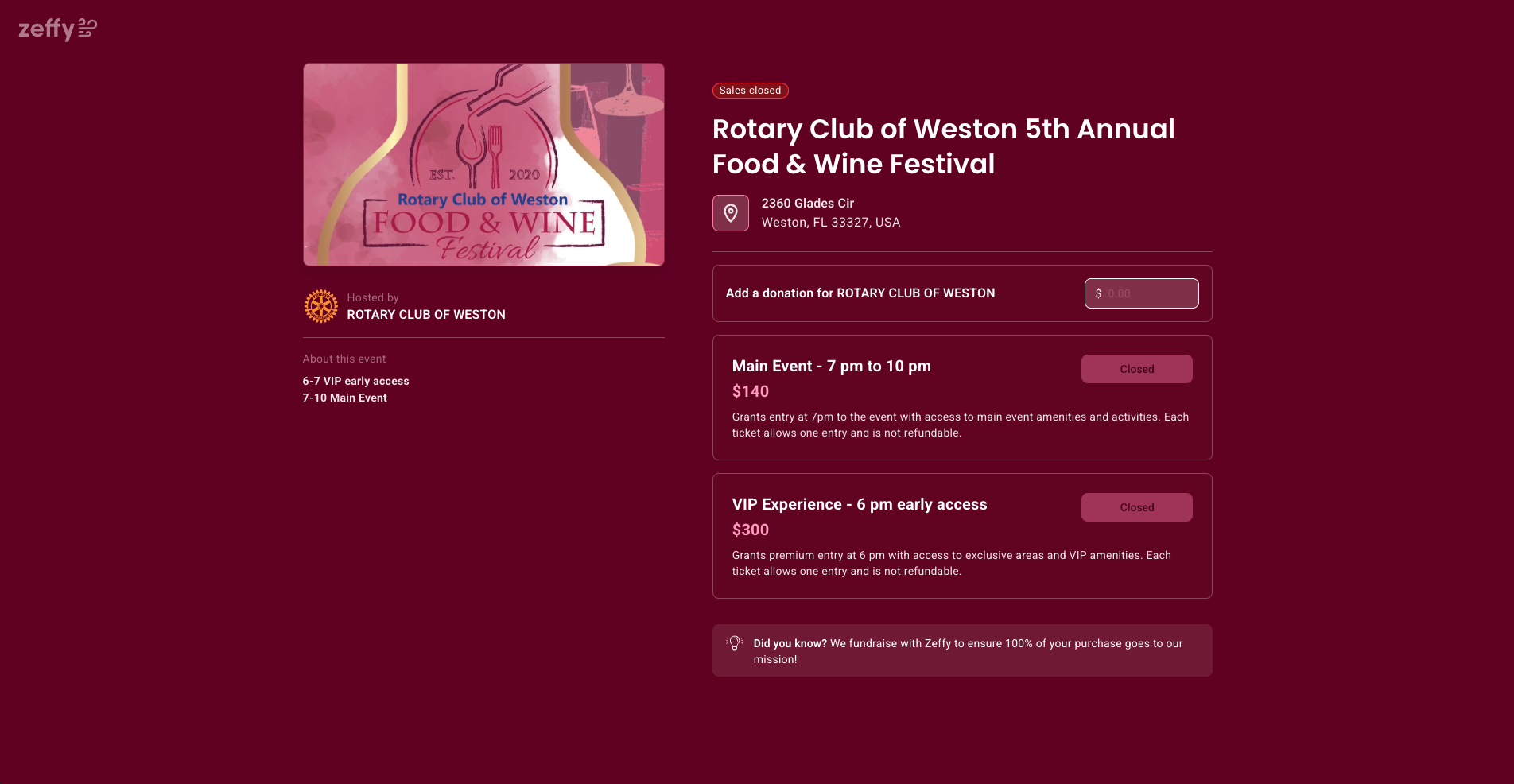
How the Rotary Club of Weston raised $26,527 with their Food & Wine Festival
The Rotary Club of Weston runs the Weston Food & Wine Festival every fall in Weston, Florida. The 2025 edition brought together 25-plus chefs and vintners and roughly 400 attendees for a wine-tasting and food-pairing event. Proceeds support the Boys & Girls Clubs of Broward, Lifenet4Families, the UHI CommunityCare Clinic, and the Rotary Foundation.
They sold tickets on Zeffy from July 3 through September 18, 2025, and raised $26,527 on the single event. The 2026 sixth-annual form is already live on Zeffy, so the team is running the same playbook again this year.
The fee math matters here. Zeffy charges nonprofits $0: no platform fee, no transaction fee, no credit card fee. Ever. At a typical 3 to 5% all-in fee on a fee-charging event platform, the Rotary Club of Weston would have paid roughly $800 to $1,300 in fees on $26,527. That is the kind of money a small committee usually only gets back by selling another 15 to 20 tickets.
On 50 to 100 donated bottles at $20 to $25 per pull, a wine pull can clear $2,000 to $5,000 in a single evening when bottles sell through. Because the bottles are donated, your margin is effectively 100% on whatever you sell.
It depends on your state and the format of the event. Some states allow nonprofits to run a one-day special event under the venue's existing license; others require a separate temporary nonprofit alcohol permit. Check your state's Alcoholic Beverage Control board for the rules that apply to your event and your venue.
Plan for 50 to 100 bottles. Fewer than 50 and the wall looks thin and stops drawing attention; more than 100 and a single volunteer cannot keep up with the sales. 75 is a comfortable target for a 100- to 150-guest event.
A wine pull is a tabletop game: guests pay a flat fee to pick a wrapped bottle at random. A wine wall is the same mechanic with a different display: bottles are mounted on a tall frame or shelving unit and guests buy a numbered tag or key that unlocks one. The wall pulls more foot traffic; the table is faster to set up.
Five to seven wines is the standard. Group them into a theme like Old World versus New World, a single region, or a vertical from one vineyard. Offer a non-alcoholic option for guests who want one.
Plan 1.5 to 2 hours for a focused tasting. If you add a silent auction, a live auction, or a paired dinner, plan 3 to 4 hours and vary the schedule so the energy does not flag.
A few that have held up well: Corks and Contributions, Decanting for a Difference, Cheers to Change, The Giving Vineyard, A Pour with Purpose, Sips for Smiles, Grapes of Gratitude, The Philanthropic Pour.
A blind wine pull on donated bottles, bolted onto an event your nonprofit already runs. Sourcing 50 bottles from board members and sponsors is the only meaningful lift. Two volunteers and one tap-to-pay-capable phone can run the table for a whole evening.
Get weekly fundraising tips from nonprofits experts
Thank you! Your submission has been received!
Oops! Something went wrong while submitting the form.
Keep reading :
Nonprofit guides
25+ Golf Fundraiser Ideas That Actually Make Money (Plus a 10-Step Planning Guide)
First golf fundraiser? No problem. Learn how to plan a charity golf tournament in 10 simple steps, add 25+ revenue ideas, and run it all on a zero-fee platform—no golf experience needed.
Look for people who attend related events, follow relevant Facebook groups, or subscribe to aligned newsletters.These aren’t just potential donors—they’re your future advocates.
Look for people who attend related events, follow relevant Facebook groups, or subscribe to aligned newsletters.These aren’t just potential donors—they’re your future advocates.





.webp)

