We use cookies to improve your experience on our platform. By clicking “Accept all cookies”, you agree to the storing of cookies on your device to enhance site navigation, analyze site usage and assist in our marketing efforts.
Cookies required for basic website functionality.
Cookies used to deliver content most relevant to you and your needs.
Cookies used to deliver content most relevant to you and your needs.
Cookies that help understand the performance of the website, how users interact with it and to identify bugs.
How is Zeffy free?
How is Zeffy free?
Zeffy relies entirely on optional contributions from donors. At the payment confirmation step - we ask donors to leave an optional contribution to Zeffy.
Crisis Communication Plan for Small UK Charities (2026)
July 2, 2026
For small charities, a crisis does not always make headlines but it can still shake donor trust, stall fundraising, or damage your mission.
You do not need a PR crisis or serious incident to find yourself in crisis mode. It can happen on an ordinary Tuesday, with no warning and no roadmap.
In moments like these, silence is risky, and scrambling makes things worse. You need a plan that is fast, flexible, and realistic, especially if your 'communications team' is just you and a part-time volunteer.
This guide fixes that. In the next few minutes, you will:
Build a one-page crisis plan you can launch in under an hour.
Download a free, easy-to-fill template.
Learn micro-team tactics, like 60-second drills and copy-and-paste holding statements, that keep your donors calm and your mission on track.
Every tactic here assumes you do not have spare staff or a crisis budget. It is designed for founders who juggle many hats.
A crisis communication plan is a one-page cheat sheet that tells your team who says what, when, and through which channel, the minute something goes wrong.
It covers four basics:
Roles, who drafts, who approves, who sends.
Contact list, donors, partners, media, landlord, grant officer.
Pre-written messages, email, social post, three-line holding statement.
Legal or money triggers, who calls the bank, insurer, or pro bono solicitor.
Think of it as the fire-exit map for your reputation: simple, visible, and ready before the smoke appears.
Some real-life crisis examples small charities commonly face include:
A prominent donor publicly withdrawing support
Accusations of financial mismanagement spreading on social media
Sudden departure or controversy involving a key staff member
Technical failures preventing online donations during a critical campaign
Public confusion caused by misinformation or incorrect media reports
Anticipating these realistic scenarios helps your team respond quickly and confidently.
Why small charities need a crisis communication plan
When something goes wrong, your supporters will hear about it through social media, word of mouth, or community gossip. A 60-second holding statement posted within the first hour stops rumours and shows your charity is on top of the facts, even if those facts are still arriving.
Keep the story straight
With a two-person staff, one off-script reply can spark confusion amongst your supporters fast. Store a shared script in a Zeffy email template or Google Docs so every direct message, email, and phone call repeats the same clear message.
Protect every donated pound
A defensive or vague post can trigger refund requests you cannot cover. Using pre-approved language and a quick check with a solicitor keeps funders calm and income intact.
Lower founder stress
Crises strike at midnight and during school runs. Knowing exactly who calls partners, who updates the site, and who checks comments frees the founder to fix the root problem instead of crafting copy on zero sleep.
Meet your UK reporting duties
UK registered charities have statutory reporting obligations that make a crisis communication plan legally material, not just a nice-to-have. Registered charities in England and Wales must report 'serious incidents' to the Charity Commission for England and Wales; equivalent duties apply at OSCR for Scotland and at the Charity Commission for Northern Ireland. Fundraising complaints route through the Fundraising Regulator under the Code of Fundraising Practice (current version effective 1 November 2025, with a new Section 9 covering online platforms). Any incident involving donor personal data triggers a 72-hour breach notification duty to the ICO under UK GDPR. These are the three regulators most likely to want to hear from you first, and each has its own deadline.
5 key components of a crisis communication plan for small charities
For small charities, your crisis team might just be you and two trusted people, and that is fine. The key is deciding in advance who handles what.
Your basic team should include:
Decision maker and communicator (usually the founder or chief executive)
Sounding board (trusted adviser, could be a trustee, mentor, or partner organisation lead)
Running a one-person operation? Assign at least one trusted friend or colleague who can help you think through responses and share the communication load.
2. Sticky-note risk list
A charity crisis communication plan should identify potential threats, such as financial mismanagement, data breaches, or public backlash. Analysing these risks means assessing how likely each crisis is, its possible impact, and how it could affect donors.
Planning allows charities to create clear response strategies for different situations. Here is something you can try to make a list and predict risks:
1. Get some sticky notes.
2. Jot your top five 'likely hits' on them. For UK charities, good examples include: lost grant (National Lottery Community Fund, local authority), safeguarding incident, data breach requiring ICO notification, social media backlash on Gift Aid or platform fees, or a small society lottery return missed with the licensing authority.
3. Mark each H = hurts mission, £ = costs money, ! = time-sensitive.
4. Put these up in a visible spot for everyone to see daily.
5. Snap a photo so remote volunteers see the same risk wall.
3. Copy-and-paste holding statements
Draft a three-line template: what happened, what we are doing, next update time. Store it as a pinned Google Doc, and when trouble hits, fill in the blanks and publish within 60 minutes.
If the incident involves donor data, personal information, or a safeguarding matter, draft a separate internal note for the trustees before publishing anything public. Trustees may need to file a serious incident report with your charity regulator or notify the ICO within statutory deadlines.
4. One-click contact list
Keep donors, volunteers, media contacts, and your site host details to hand. In a crunch you can send segmented emails on Zeffy without exporting lists or juggling multiple platforms.
With Zeffy, you can:
Instantly email segmented lists of donors, volunteers, or event attendees
Add a banner or update to your event registration or donation form in seconds
Pre-schedule a response sequence so you are not writing from scratch in panic mode
5. 15-minute quarterly drills
Pick one sticky-note crisis each quarter, run through the first three steps, and note gaps. Log fixes in your plan immediately. These mini drills build muscle memory without burning staff hours.
During your drill, ask:
Who would we call first?
What would we say to donors?
How would we update our website?
Who speaks to the press (if needed)?
This 15-minute exercise keeps your plan fresh without overwhelming your small team.
5 crisis communication plan examples to strengthen your strategy
1. Oxfam: own the issue fast
In 2018, Oxfam faced misconduct allegations involving staff in Haiti. Public trust was at stake, and silence would have allowed misinformation to spread, so Oxfam implemented a frank and decisive crisis communication plan.
They issued a formal statement acknowledging the issue, outlined immediate corrective actions, and strengthened internal safeguarding policies. Regular updates on their safeguarding efforts reassured donors and partners of their commitment to ethical standards.
What can small charities learn?
Pre-draft a three-line holding statement ('what happened / what we are doing / when the next update lands') and save it as a Zeffy email template so you can send it within an hour.
2. Publish the numbers: financial transparency in UK charities
When questions arise about how donated funds are used, the UK charity sector has a clear expectation: openness. Registered charities are required to publish their Trustees' Annual Report and Accounts (TAR) on the Charity Commission register, where donors can check them before giving. Larger charities must disclose salaries above £60,000 in £10,000 bands in their TAR, a statutory requirement under the Charity SORP.
Beyond statutory disclosure, charities that proactively communicate how funds are used, rather than waiting for questions to arise, build stronger, lasting donor relationships.
What can small charities learn?
Make financial transparency part of your normal communications, not just your crisis response. Show supporters how their donations are put to work. One specific message that resonates with UK donors: 'With Gift Aid, we reclaim 25p for every £1 you give from HMRC, at no extra cost to you.' That kind of concrete detail builds confidence in your stewardship. Zeffy is 100% free for UK charities, which means every pound donated goes directly to your cause.
3. Save the Children UK: answer the hard question
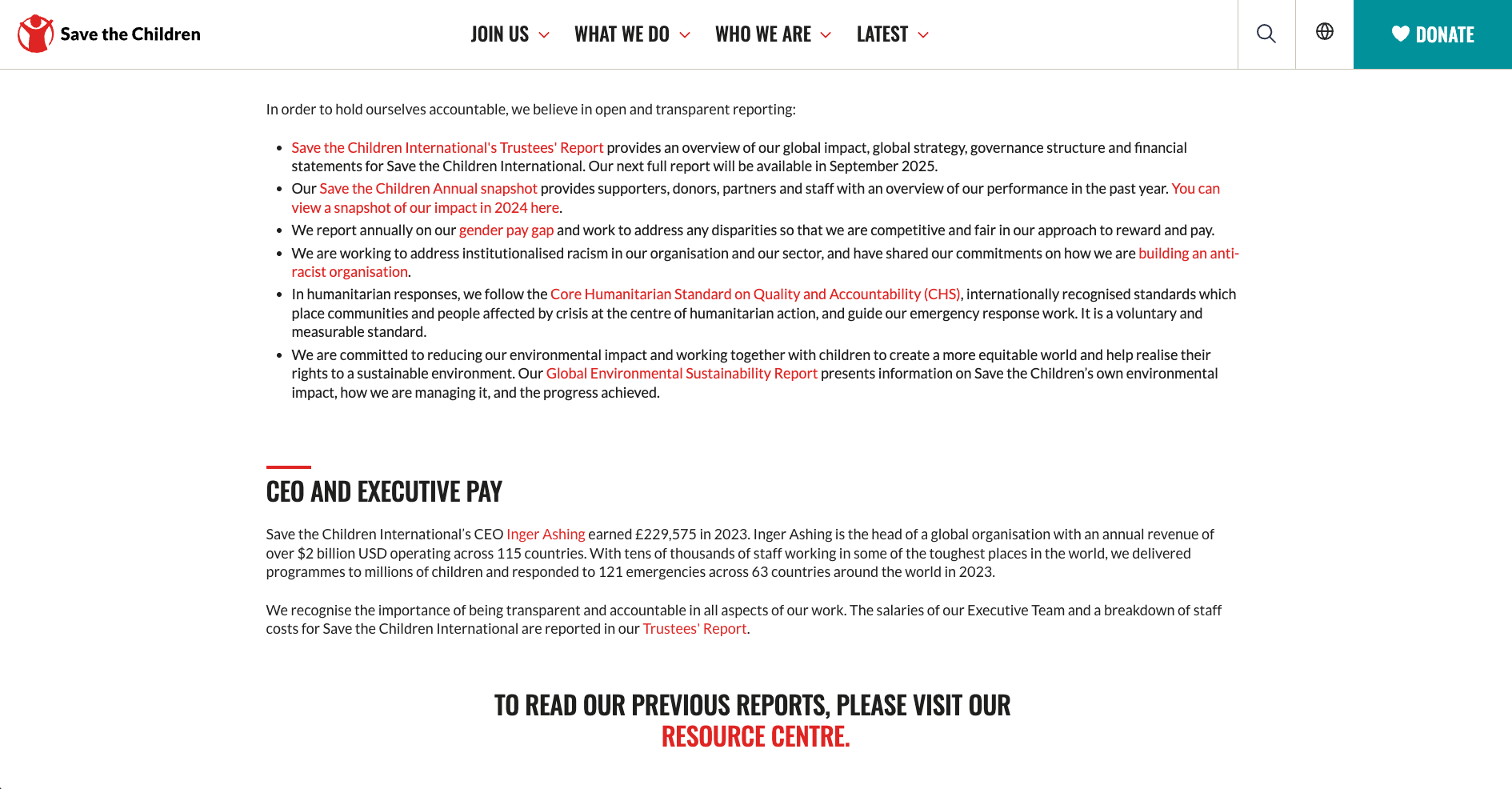
Save the Children faced public scrutiny over leadership salaries, raising questions about how donor funds were being managed. Without a clear response, the charity risked losing donor support and facing regulator complaints. It needed a crisis communication plan to clarify financial policies and maintain compliance.
The organisation released a public statement explaining that leadership salaries were in line with sector standards. They improved financial transparency by making their reports more accessible and held Q&A sessions with donors to address concerns directly.
What can small charities learn?
Create an accessible impact report that addresses sensitive topics like overhead and salaries proactively. Donors are concerned about executive pay, even though fair compensation helps your charity grow. Here are some quick wins to include:
Clearly explaining why specific expenditures matter and how they support your mission.
Reminding supporters that salaries above £60,000 are disclosed by law in your Trustees' Annual Report, which is publicly searchable on the Charity Commission register.
Highlighting financial efficiencies: 'We use Zeffy's free fundraising platform, so every pound donated supports our cause directly rather than covering platform costs.'
4. Médecins Sans Frontières: counter misinformation with facts
During the 2014 Ebola outbreak in West Africa, Médecins Sans Frontières (MSF) faced not only a public health emergency but also widespread misinformation and fear. Many communities believed that Ebola treatment centres were making the crisis worse, leading to distrust and resistance against healthcare workers.
To counter misinformation, MSF launched an intensive public education campaign using local radio, community leaders, and printed materials. They also provided real-time updates on case numbers, treatment success rates, and safety protocols to address public fear directly. This approach helped MSF gain community trust, stop misinformation, and ensure more people sought medical care.
What can small charities learn?
Choose at least one trusted local channel where your supporters regularly get community updates. It might be your local authority's community newsletter, a widely-read church bulletin, or a neighbourhood Facebook group. Prioritise based on audience reach and existing trust.
5. British Red Cross: own the mistake
In 2011, a social media account mix-up led to a personal message being published from a charity's official account. The situation could have damaged credibility, but the response turned it into a positive moment of engagement.
Rather than ignoring the mistake, the charity deleted the post and immediately acknowledged the error with a straightforward, good-humoured message. By staying transparent and approachable, they reassured supporters and turned the situation into a moment of genuine connection with their audience.
What can small charities learn?
If you slip on social media or say the wrong thing during a campaign, own it in plain language. A quick apology with a light touch often wins more goodwill than a silent deletion. In the UK, a measured, honest tone tends to land better than US-style self-deprecating humour, so keep it brief and sincere.
5 fast steps when a crisis hits
1. Verify the facts and stick to them (0 to 10 minutes)
Call the direct source: the grant officer, venue manager, or volunteer on site. Write only what you can confirm, and avoid phrases like 'we think' or 'it seems.' Drop those bullet facts into the top of your Crisis Notes Google Doc so your partner sees live edits.
2. Alert the Circle of Three (10 to 20 minutes)
Post the headline and colour-code (minor, moderate, severe) in your WhatsApp group. The colours tell everyone whether to pause lunch or sprint to a laptop, no bulletin boards needed.
3. Deploy the three-line holding statement (20 to 40 minutes)
Copy and paste the template, fill in the blanks, and send it first to donors tagged 'Core.' Then pin the same text at the top of your social media page and add a brief banner to your Zeffy donation form. One voice, three steps, zero donor confusion.
4. Monitor and micro-reply (40 to 120 minutes)
Set a 30-minute timer. Each cycle, skim your inbox and social direct messages, answer recurring questions with your FAQ snippets, and log fresh concerns. If a question appears three times, promote it to the public FAQ so everyone sees the answer.
5. Debrief and patch (within 7 days)
Book a 15-minute video call once the dust settles. Ask: what slowed us down? Which template line needs tweaking? Make edits during the call, and the future you will thank you. Keep a copy of the crisis document so new volunteers can study a real scenario.
Download our crisis communication plan template
For founders who wear every hat, the template is the cheat code. It compresses everything into one scannable page you can open on your phone.
Crisis communication plan best practices for small charities
A solid plan gets you through the first 48 hours. These best practices make sure every phase of your response, before, during, and after, works as hard as your team does.
Before the crisis:
Write your holding statements before you need them. Blank-page panic at midnight produces bad copy. Draft templates now, when your head is clear.
Name your Circle of Three in writing. Verbal agreements evaporate under pressure. Put names, roles, and backup contacts in the plan document.
Run a drill at least once a quarter. Even a 15-minute tabletop exercise builds the muscle memory that matters when a real situation hits.
Store your plan somewhere everyone can reach it. A shared Google Drive folder beats a file buried on one laptop.
Keep your contact list current. Stale phone numbers are one of the most common reasons a crisis response falls apart in the first hour.
During the crisis:
Lead with facts, not feelings. Acknowledge what you know, state what you are doing, and give a timeline for the next update.
Use one voice. Designate a single spokesperson. Mixed messages from multiple people create confusion and fuel speculation.
Do not go silent. A brief holding statement is always better than no statement. Silence reads as guilt or disorganisation to worried donors.
Respond to social comments, but stick to your pre-approved language. Improvised replies are where most crises escalate.
Document everything in real time. Log what was said, when, and by whom. You will need this for your debrief.
After the crisis:
Debrief within seven days while details are fresh. Ask what slowed you down and what worked better than expected.
Update your plan immediately. Do not wait for the next annual review. Patch the gaps while the lessons are still vivid.
Send a follow-up message to donors and stakeholders. Thank them for their patience and share what you have changed. It closes the loop and rebuilds trust.
Log the incident in a lessons-learned file. Future team members, and future you, will benefit from a real example they can study.
What to avoid:
Do not speculate publicly about causes or blame before you have confirmed facts.
Do not let a single person carry the entire response alone. Even a small team needs a backup.
Do not treat your crisis plan as a one-time document. A plan that has not been reviewed in two years is almost as dangerous as no plan.
Do not skip the debrief. It feels tempting to move on, but the debrief is where your plan actually gets better.
These best practices will not prevent every crisis. But they will make sure that when something goes wrong, your team responds with clarity instead of chaos.
Best practices for updating your crisis communication plan
Writing your crisis communication plan is step one. Keeping it alive is step two, and it is the step most small charities skip. A plan that has not been touched in three years is barely better than no plan at all: contact numbers change, staff turns over, new platforms emerge, and the risks that mattered in 2022 may not be the ones that matter today.
Here is how to make sure your plan stays ready when you need it most.
When to update your plan
At a minimum, review your crisis communication plan once per year. But do not let the calendar be your only trigger. Update your plan immediately after any of the following:
A crisis occurs, real or near-miss. What did you learn? What broke down?
Leadership changes, a new chief executive, communications lead, or chair of trustees means new decision-makers and new contacts.
Staff or volunteer turnover, if the person listed as your primary spokesperson has just left, your plan is already out of date.
New communication channels, if your organisation launched a TikTok, added a text-alert system, or moved to a new supporter CRM, your response protocols need to reflect that.
Significant programme or funding changes, new programmes bring new risks; major funders bring new scrutiny.
Step-by-step update checklist
When it is time to review, work through this checklist to make sure nothing gets missed:
1.Audit your contact lists. Verify every phone number, email, and backup contact for internal team members, trustees, legal advisers, insurance providers, and key media contacts. Remove anyone who has left; add new staff.
2.Test your holding statements. Read each template out loud. Do they still reflect your organisation's current voice, programmes, and values? Update any language that feels dated or off-brand.
3.Reassess your risk priorities. Revisit your sticky-note risk list. Have any risks grown? Shrunk? Disappeared entirely? Add any new scenarios your team has not considered before.
4.Update legal and insurance contacts. Confirm your solicitor, insurance broker, and any compliance contacts are current. Note any policy changes that affect how you can respond publicly.
5.Incorporate lessons learned. If you have experienced a crisis, or watched another charity navigate one, document what you would do differently and build it into your procedures.
6.Re-confirm roles. Make sure every person named in the plan still holds that role and is willing to carry it. Get verbal or written confirmation.
7.Re-distribute the updated plan. A revised plan sitting in one person's inbox is not useful. Share it with every stakeholder who needs it.
Update trigger table
Use this quick-reference table to know exactly which sections of your plan to revisit when a specific trigger event occurs.
Legal contacts, public statement guidelines, liability language
Major program launch or expansion
Risk scenarios, key messages, FAQ templates
Annual review (no specific trigger)
All sections — full top-to-bottom audit
Set a recurring calendar reminder right now, even just 30 minutes once a year, to run through this checklist. Pair it with a team drill, and your plan will not just exist on paper. It will actually work when the moment comes.
Final thoughts on a crisis communication plan for charities
You cannot predict every crisis, but you can control how prepared you are.
When donors panic, partners ask tough questions, or your small team is stretched thin, a clear, actionable crisis plan makes the difference between chaos and calm.
With Zeffy, crisis management does not require a hefty budget. Your essential tools for donor data, communications, and ready-to-go response templates are integrated and 100% free for UK charities. And because Zeffy handles Gift Aid, you can reassure donors that every pound they give is working as hard as possible.
Take 15 minutes today:
Tag your Circle of Three.
Run your first mini drill.
Save your crisis template somewhere you can reach it quickly.
Next time the unexpected happens, you will not scramble. You will respond with clarity, confidence, and transparency while ensuring your mission stays resilient.
The 5 C's are a practical framework for any crisis response: Clarity (say what you know plainly, without jargon), Confidence (project calm and competence even when you are still gathering facts), Compassion (acknowledge the impact on donors, beneficiaries, and staff), Consistency (one voice, one message across every channel), and Commitment (tell people what you are doing to fix the problem and follow through). For small UK charities, the most commonly missed C is Consistency, particularly when two or three people respond to queries independently without a shared script.
practical plan for a small charity covers: a named response team (the Circle of Three) with mobile numbers and backup contacts; a one-page risk register flagging your top five likely incidents; pre-written holding statements you can adapt in minutes; a segmented contact list covering donors, trustees, partners, and key media; a note of statutory reporting duties (Charity Commission serious incident, Fundraising Regulator complaints route, ICO notification if personal data is involved); and a debrief and update schedule. Keep it to one or two pages so it is actually used under pressure.
Aim to post a holding statement within one hour of becoming aware of the issue. You do not need all the facts; you need to show your supporters you are aware and taking it seriously. For social media comments, a brief acknowledgement ('We are aware of this and looking into it; we will share an update by [time]') within 30 minutes prevents speculation from filling the gap. Avoid deleting negative comments unless they breach platform rules or contain personal data: in the UK, deletion tends to escalate rather than contain a situation.
Contact your charity's solicitor before making any public statement. If you do not have one on retainer, LawWorks (the pro bono charity for solicitors) and the Bar Pro Bono Unit both match charities with volunteer legal advisers. NCVO also offers member guidance on incident response. For regulatory matters, the Charity Commission publishes clear guidance on when and how to report a serious incident; your first call should be to your trustees so they can make an informed decision before anything goes public.
Review it at least once a year. Update it immediately after any real or near-miss crisis, any change in leadership or key staff, the launch of a new communication channel, or a significant shift in your programmes or funding. For UK charities, also review it whenever the Fundraising Regulator issues a new Code version or the Charity Commission updates its serious-incident guidance; both happen roughly every three to five years and materially change what a crisis looks like on paper.
Get weekly fundraising tips from nonprofits experts
Thank you! Your submission has been received!
Oops! Something went wrong while submitting the form.
Keep reading :
Nonprofit guides
How to Run a Charity in the UK: A Practical Guide for Small Organisations
This practical guide covers everything a small UK charity needs to operate well: the compliance items that actually bite (annual returns, Gift Aid, small society lotteries, UK GDPR), how to recruit trustees who show up, how to manage finances and stay audit-ready, and how to diversify funding across Direct Debit, Gift Aid, grants and events. Written for the 1-to-3-person operation wearing multiple hats.
Charity Succession Planning: A Practical Guide for Small UK Charities (2026)
A step-by-step succession planning guide for small UK charities, CICs, and community groups. Covers emergency continuity plans, trustee duties under the Charities Act, Gift Aid record-keeping across leadership changes, and a sample framework you can copy today.
Look for people who attend related events, follow relevant Facebook groups, or subscribe to aligned newsletters.These aren’t just potential donors—they’re your future advocates.
Look for people who attend related events, follow relevant Facebook groups, or subscribe to aligned newsletters.These aren’t just potential donors—they’re your future advocates.







.webp)

