We use cookies to improve your experience on our platform. By clicking “Accept all cookies”, you agree to the storing of cookies on your device to enhance site navigation, analyze site usage and assist in our marketing efforts.
Cookies required for basic website functionality.
Cookies used to deliver content most relevant to you and your needs.
Cookies used to deliver content most relevant to you and your needs.
Cookies that help understand the performance of the website, how users interact with it and to identify bugs.
How is Zeffy free?
How is Zeffy free?
Zeffy relies entirely on optional contributions from donors. At the payment confirmation step - we ask donors to leave an optional contribution to Zeffy.
Charity org chart: types, roles and structure (2026)
July 14, 2026
Whether you are starting a new charity or restructuring an existing one, this guide shows you how to create an organisational chart that strengthens team collaboration and operational effectiveness. Learn about different chart structures and how to choose the one that matches your charity's unique needs.
A charity org chart is a visual representation of your organisation's internal structure, showing the relationships between different levels and departments. It is a roadmap that outlines titles, responsibilities, and lines of authority within your organisation.
Your org chart depends on the scale and size of your charity. Most charities have a board of trustees at the top with staff below, depending on their specific roles.
A well-defined and designed chart helps you in the following ways:
Allows open communication: The chart shows the reporting structure and organisation workflow, which helps people communicate and work together.
Streamlines decisions: It clarifies decision-making authority to identify the right people to reach when you need answers or approvals.
Fosters accountability: It shows hierarchy within the organisation. Defining roles and responsibilities for employees, trustees and volunteers prevents confusion and ensures accountability.
Facilitates onboarding: A well-structured chart simplifies the onboarding process and gives new joiners a clear understanding of your charity's organisational structure.
Boosts transparency: Donors, volunteers and partners can understand how the organisation is structured, promoting trust and credibility in your work.
Key elements of a charity org chart
1. Governance
The board of trustees forms the governing body of a charity, providing strategic and financial oversight to ensure smooth functioning. Trustees determine which programmes will be funded for the year. They also ensure the organisation abides by its governing document and offer fundraising support.
The Charity Commission for England and Wales expects at least three unrelated trustees. All Scottish charities register with OSCR regardless of size, and Northern Ireland charities register with CCNI. Your governing document sets your minimum trustee number, which must meet or exceed your regulator's requirement.
2. Administration
Governance provides oversight, but it is the administration that manages your operations. They develop the charity's strategic plan, annual budget and fundraising initiatives for the year. The key figure in this structure is the Chief Executive, who reports to the board of trustees.
Other key roles within the administration include Head of Finance, Head of Fundraising, Communications Manager and more.
3. Programmes
Your programme teams directly execute your charity's mission through service delivery and community engagement. This section of your org chart should clearly outline the roles of programme managers, coordinators and specialists responsible for implementing initiatives.
Include both permanent programmes and temporary project teams to showcase your full operational scope.
Charity structure: key roles and hierarchy
Most charities, regardless of size or mission, operate within a recognisable hierarchy that flows from governance at the top down to the volunteers delivering programmes on the ground. Understanding what each role actually does, and where authority begins and ends, is essential before you can design an org chart that reflects how your organisation truly works.
Here is how the standard charity hierarchy breaks down.
Board of Trustees
The board of trustees sits at the top of every charity org chart because it holds ultimate legal and fiduciary responsibility for the organisation. Trustees set strategic direction, approve the annual budget, appoint and evaluate the Chief Executive, and ensure the charity remains compliant with its mission and legal obligations under the Charities Act 2011 (as amended by the Charities Act 2022 in England and Wales), the Charities and Trustee Investment (Scotland) Act 2005, or the Charities Act (Northern Ireland) 2008.
Within the board, three trustee-officer roles carry specific authority:
Chair of Trustees, Leads board meetings, sets the governance agenda, and serves as the primary liaison between the board and the Chief Executive.
Treasurer, Oversees financial reporting, monitors budget performance, and chairs the finance committee. In smaller charities, this role is often the first line of financial accountability.
Secretary, Maintains official records, meeting minutes and ensures proper documentation of board decisions. This documentation is critical for annual returns and regulatory compliance.
Note: a charitable company's trustees are also directors under the Companies Act, but charity law leads with 'trustee', use it in all charity-facing copy.
Chief Executive
The Chief Executive is the bridge between the board's vision and the organisation's day-to-day reality. Appointed by the board, the Chief Executive translates strategic goals into operational plans, manages senior staff, oversees fundraising and programme outcomes, and represents the organisation publicly. 'Executive Director' and 'Charity Director' are also used at some organisations and are equally acceptable.
In smaller charities, the Chief Executive often handles responsibilities that larger organisations distribute across an entire leadership team. That is not a structural flaw; it is a reality worth reflecting accurately in your org chart rather than papering over with titles that do not match actual workloads.
Senior leadership and department heads
Directly below the Chief Executive, this layer includes roles that lead functional areas of the organisation. Common positions include:
Chief Operating Officer (COO) / Operations Manager, Manages internal operations, HR and administrative systems so the Chief Executive can focus on external strategy and fundraising. Many UK charities use 'Operations Manager' rather than COO.
Head of Finance / Finance Director, Handles accounting, financial controls, grant compliance and financial reporting to the board.
Head of Fundraising / Fundraising Director, Leads all fundraising efforts, including individual donor campaigns, grant applications, corporate partnerships and major gift cultivation. This is the UK sector norm per the Chartered Institute of Fundraising.
Head of Programmes / Programme Director, Oversees the design, delivery and evaluation of the charity's core programmes. This role is often closest to the mission impact data the board needs.
Communications Manager / Marketing Manager, Manages brand, messaging, donor communications and public relations.
Not every charity will have all of these roles. In lean organisations, one person may wear several hats simultaneously. Your org chart should show the structure as it actually exists, not as you would ideally like it to look on paper.
Managers and programme staff
Managers sit between department heads and front-line staff, translating department-level goals into individual work plans and supervising daily operations. Programme managers, fundraising managers and operations managers fall into this tier. Their effectiveness often determines whether strategic plans actually get executed, which is why their position in the org chart matters more than it might seem.
Front-line programme staff are where mission delivery actually happens. They run the workshops, distribute the resources, build the community relationships and generate the impact data that flows back up through the hierarchy. An org chart that does not accurately represent this layer can leave staff feeling invisible and leadership operating without a clear picture of capacity.
Volunteers and Volunteer Coordinators
Volunteers are unique to the charity structure. They represent significant organisational capacity but require intentional management to deploy effectively. A Volunteer Coordinator recruits, trains, schedules and retains volunteers, ensuring they are placed where they add the most value. In volunteer-heavy organisations, this role can be as operationally critical as any paid position.
Many small UK charities are majority-volunteer or entirely volunteer-run, and a Volunteer Coordinator role may sit on the trustee board rather than the staff structure. Showing volunteer coordination on the chart signals to funders and the Fundraising Regulator that volunteer effort is managed intentionally, which matters during any review or reporting cycle.
Many charities make the mistake of leaving volunteers entirely off their org charts. That is a missed opportunity. Showing where volunteers fit, and who manages them, communicates organisational seriousness to funders, partners and prospective volunteers alike.
The way these roles interact, who reports to whom, who has decision-making authority, and where collaboration is required, is exactly what your org chart should make visible. If your current chart does not reflect these relationships accurately, the sections below will help you choose a structure that does.
Six types of charity org chart
1. Hierarchical org chart
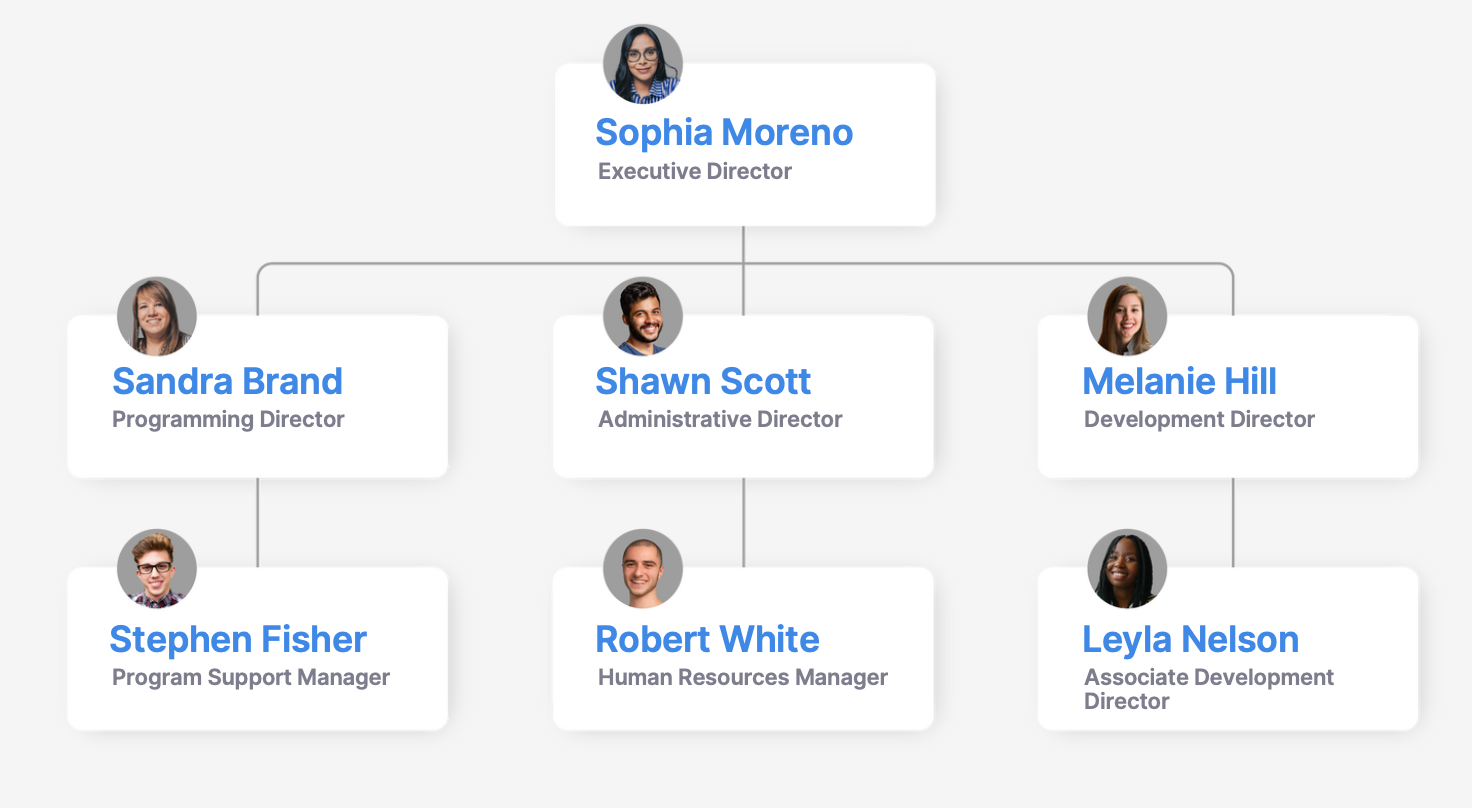
The hierarchical structure follows a clear top-down authority flow, with the board of trustees and executive leadership at the top.
Each subsequent level reports to the one above, creating distinct management layers from department heads to programme staff. This traditional pyramid structure clearly defines reporting relationships and decision-making authority.
Pros
Simple structure that is easy to understand and put in place
Follows clear reporting lines and provides clarity on authority
Cons
Creates communication barriers between levels
Difficult to show cross-functionality, as it cannot explain how teams join forces or share tasks across the organisation
2. Flat org chart
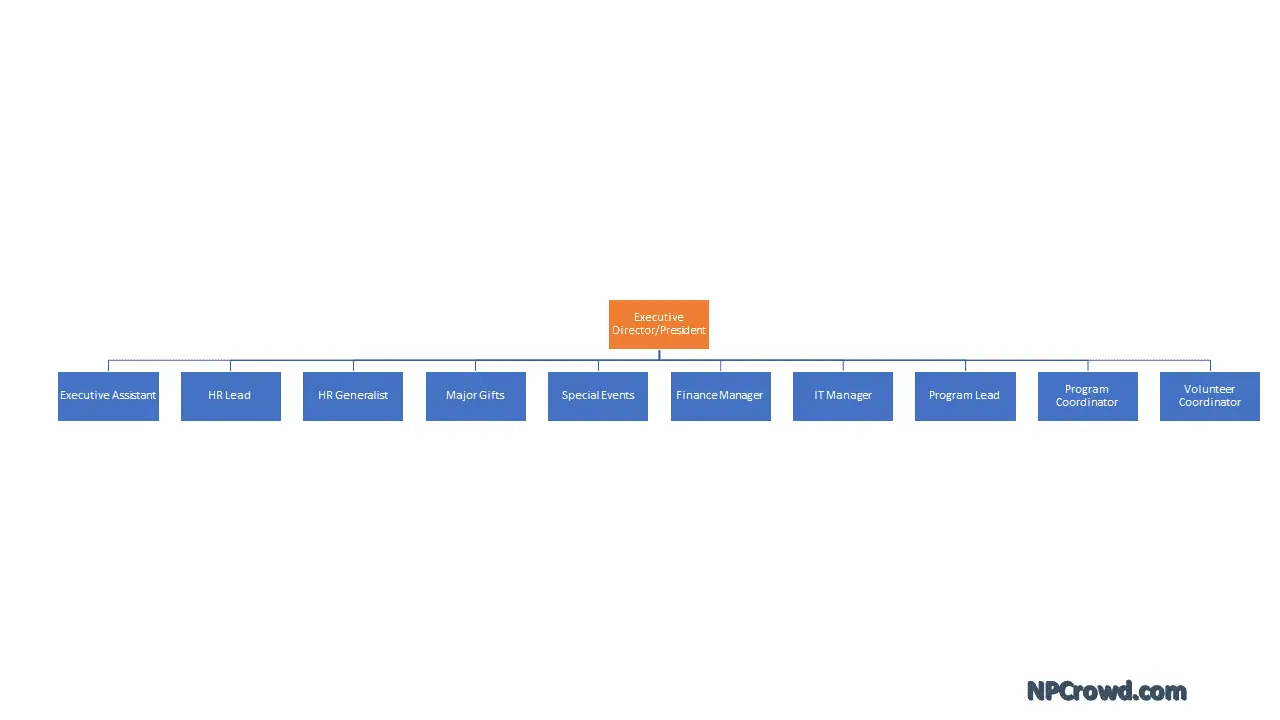
This chart is the opposite of a hierarchical one with fewer management levels, as most members report to the top leaders at the same level. The top-level management is at the centre of the chart. The rest of the roles are built horizontally from there.
Everyone tends to share more responsibility and authority compared to a hierarchical structure.
Pros
Encourages open communication and more collaboration between staff
Empowers self-management and stronger decision-making ability for every employee
Cons
Without clear authority levels, it can be unclear who handles certain tasks or decisions
Executives can get overwhelmed as they have to manage more people without middle managers to help
3. Functional org chart
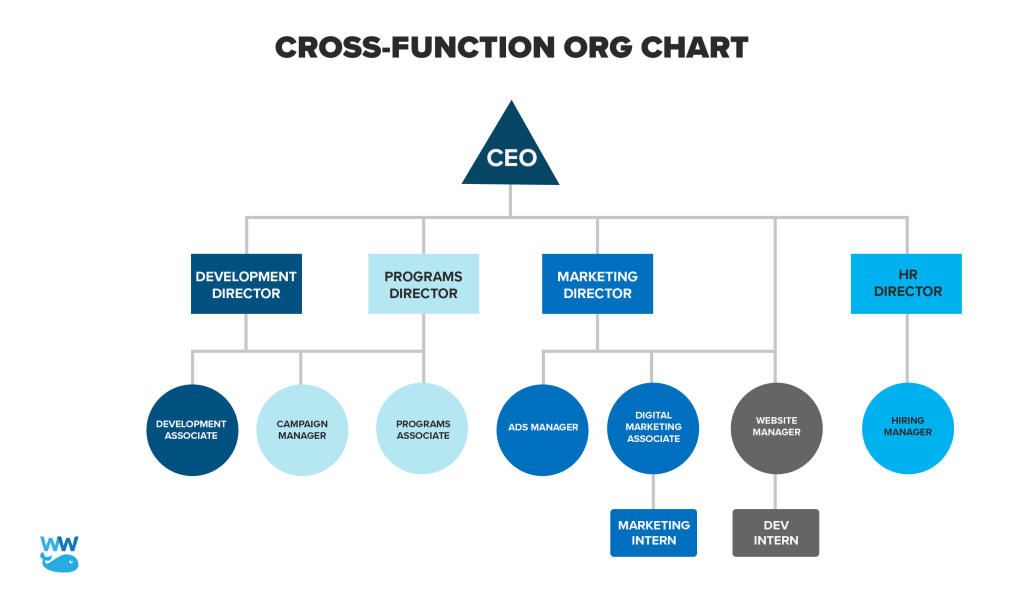
A functional organisational chart structures a charity based on specific departments or functions. These include fundraising, marketing, human resources, finance and more.
The charity's organisational structure starts with senior management at the top, then department heads and their respective teams. The structure shows who handles what area within the charity, making reporting and management easier.
Pros
Streamlines decision-making within different functional areas of an organisation
Facilitates specialisation and defines clear reporting lines
Cons
Lack of cross-department collaboration and communication
Departments can develop their own priorities, leading to conflicts between teams
4. Divisional org chart
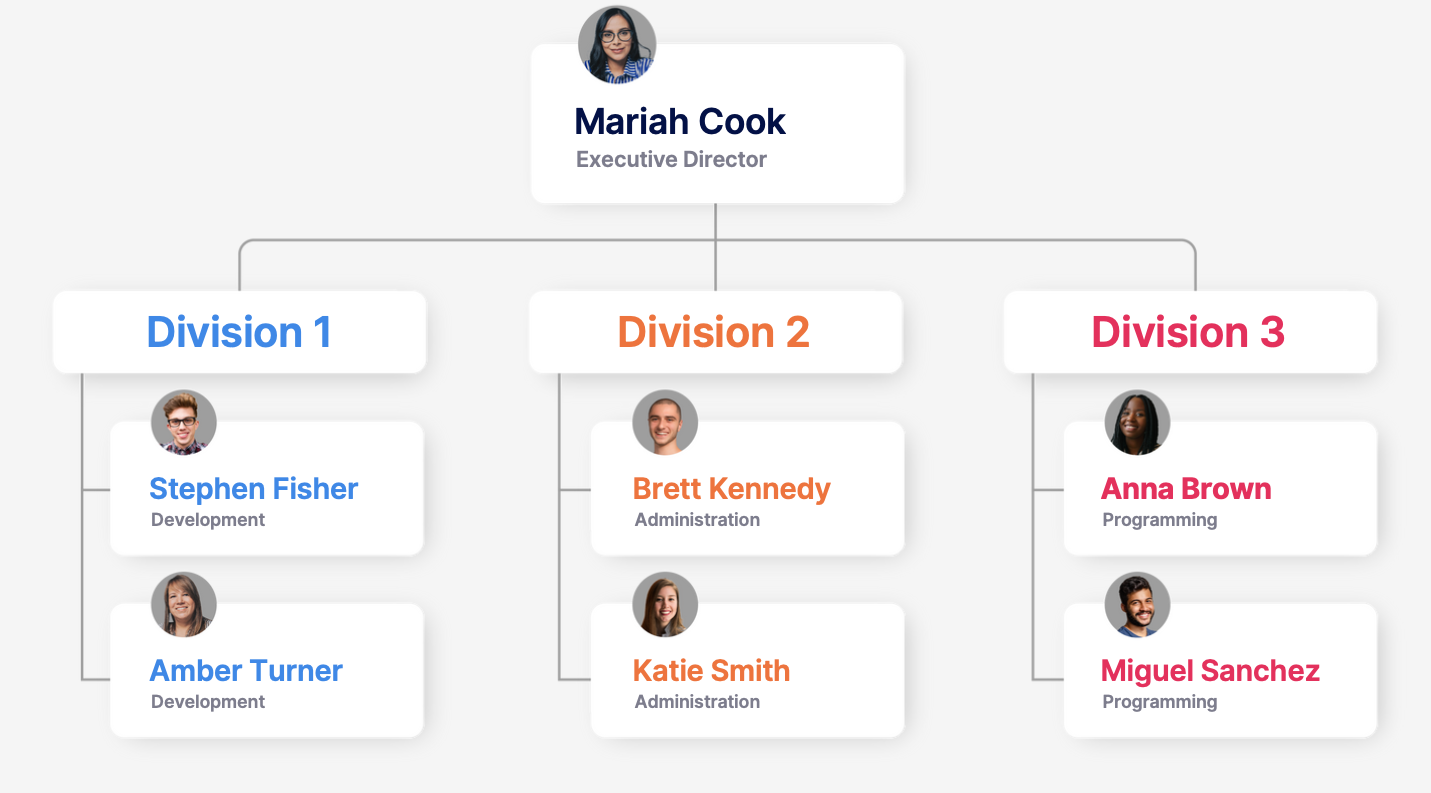
The divisional organisational chart structures your charity into separate divisions or units based on their programmes, projects or geographic regions. Each works independently with its own departments and leaders, while the division head reports to the Chief Executive or board of trustees.
It is like having mini-organisations within the charity, where each division has a separate role but aims to extend the impact of its mission. This structure helps the organisation focus on specific regions or areas.
Pros
Each division focuses on a specific area, leading to better outcomes and results
Greater autonomy and quicker decision-making within divisions
Cons
Divisions can have similar departments like finance or marketing, leading to unnecessary duplication and higher costs
With each division working independently, it is hard to maintain consistent policies
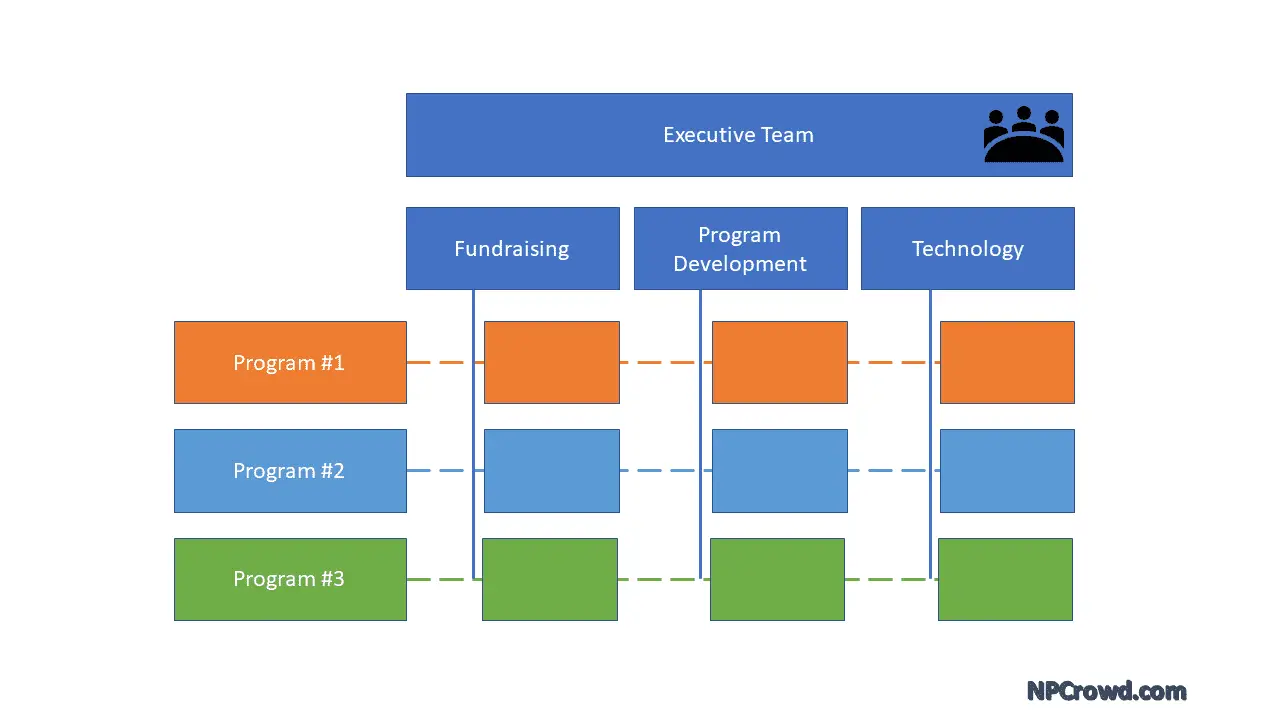
5. Matrix org chart
The matrix design maps functional departments horizontally across the top while listing specific programmes or projects vertically. Staff members appear at intersections where their roles connect with both functional areas and programme responsibilities.
Pros
Employees from different departments work together, leading to shared expertise
Makes resource allocation easier across different areas in a charity
Cons
Having multiple managers can create confusion about who to follow and report to
Managers may have different goals, leading to conflicts between teams or departments
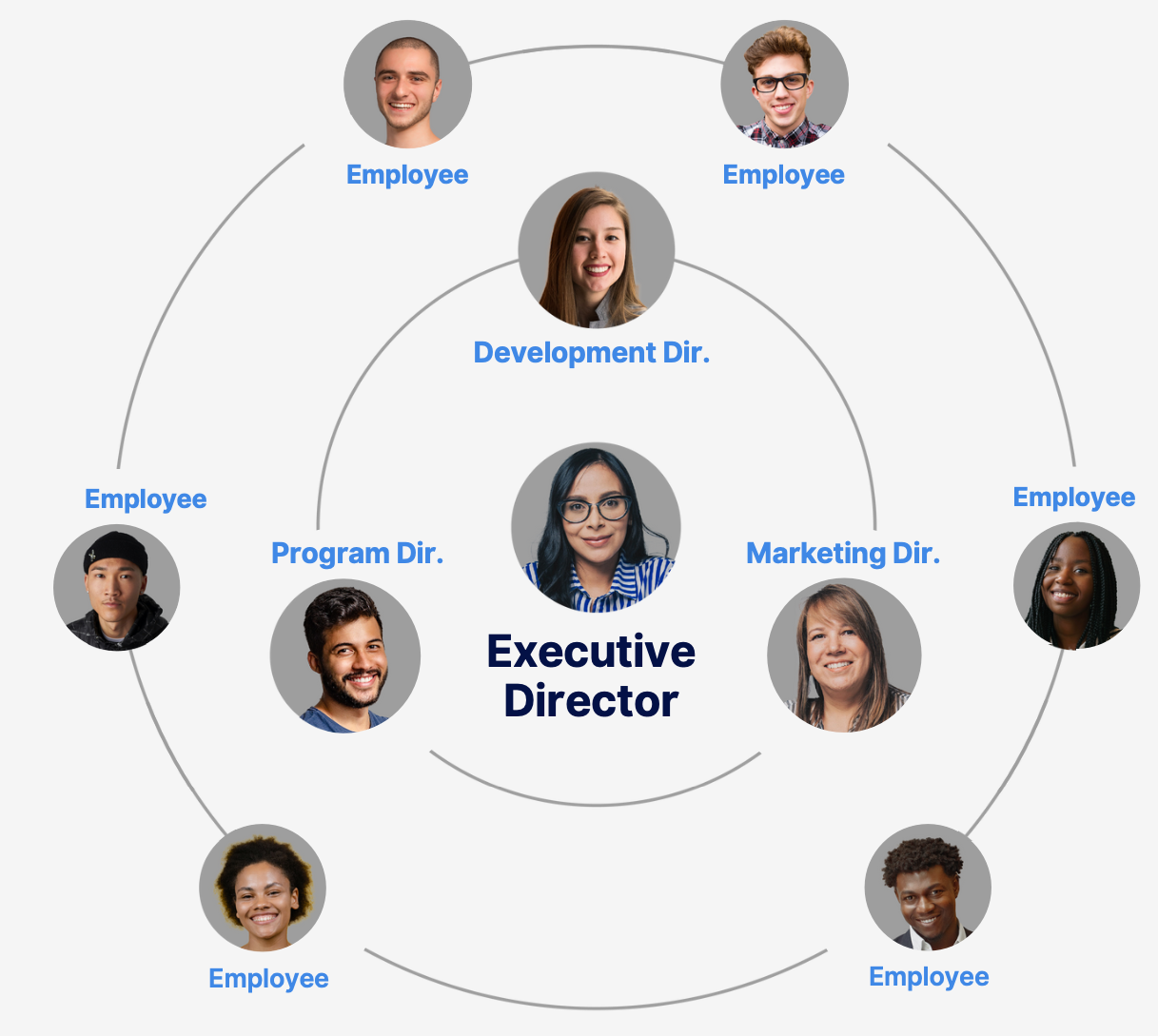
6. Round org chart
The round organisational chart places leadership at the centre, with teams radiating outward in concentric circles. This design emphasises collaborative relationships while maintaining clear reporting structures, showing how all roles support the organisation's core mission.
Pros
Encourages teamwork by showing that everyone is connected and part of a unified system
Emphasises equality, making employees feel more involved and valued
Cons
Unclear lines of authority make it hard to know who handles which tasks or choices
With everything seemingly connected, communication paths can become tangled
How to choose the right charity structure
Knowing the six chart types is only half the equation. The harder question is which one actually fits your organisation right now, given your size, your stage of growth and the nature of your mission. Getting this wrong costs you: the wrong structure creates reporting confusion, slows decisions and frustrates staff who do not know where they fit.
Here is how to think through the decision.
Match your structure to your size and lifecycle
Your organisation's headcount and maturity are the fastest filters for narrowing down chart options.
Small charities (fewer than 5 staff) are typically founder-led, with most people wearing multiple hats. A flat or simple hierarchical chart fits best here. There are not enough layers to justify functional divisions, and too much structural complexity creates bureaucracy without benefit. The Chief Executive is usually managing everyone directly, and the board of trustees plays a more hands-on operational role.
Mid-size charities (5 to 25 staff) have enough specialisation to benefit from a functional structure, where departments like fundraising, programmes and finance each have a clear lead. The challenge at this stage is cross-department coordination. The functional structure supports specialisation but can create silos if you are not deliberate about communication across teams.
Larger charities (25 or more staff) often need a matrix or divisional model. A divisional structure makes sense if your programmes operate in distinct geographic regions or serve clearly different populations. A matrix structure works when staff need to contribute to multiple programmes simultaneously while still belonging to a functional department. At this scale, a purely hierarchical chart becomes unwieldy and slows decision-making.
Factor in your mission type
Your mission is not just what you do, it shapes how your organisation needs to be structured to do it well.
A direct service organisation (foodbank, shelter, health service) typically needs a clear programme management hierarchy with strong operational controls. A functional or hierarchical chart keeps accountability clear when you are managing high-volume service delivery.
A policy or advocacy organisation often benefits from a flatter structure, where teams need to move quickly and collaborate across issue areas. Rigid reporting lines can slow the kind of cross-functional work advocacy requires.
A federated or branch-based organisation, operating across multiple cities or regions, almost always needs a divisional model to give each branch sufficient autonomy while maintaining central governance and brand consistency.
Factor in your legal form and regulator
The legal form your charity takes affects who holds authority and how decisions are documented. A Charitable Incorporated Organisation (CIO) has the trustee board as the legal entity itself, so the board's composition is particularly critical. A charitable company limited by guarantee has both trustees and directors, the same people wearing two hats under charity law and company law respectively. An unincorporated association's trustees are personally liable, which affects how much formal authority can be delegated on the org chart. The chart should make the legal form visible where it affects decision authority. Confirm the requirements for your form with the Charity Commission for England and Wales, OSCR or CCNI.
Use this comparison table to guide your decision
Structure
Best for
Staff size
Key strength
Watch out for
Hierarchical
Traditional nonprofits with clear program areas
Any size
Clear chain of command
Communication bottlenecks
Flat
Early-stage, founder-led orgs
Under 10
Fast decisions, open culture
Leadership overload as you grow
Functional
Established orgs with distinct departments
10-50
Specialization and efficiency
Department silos
Divisional
Multi-program or multi-region orgs
25+
Program focus and autonomy
Duplication of functions
Matrix
Complex orgs with shared staff across programs
20+
Resource flexibility
Reporting confusion
Round
Collaborative, mission-centered cultures
Any size
Sense of equality and connection
Unclear authority
The right structure is not permanent. Many charities start with a flat chart, shift to functional as they add staff, and eventually adopt elements of a matrix model as programmes multiply. Your org chart should reflect where you are now, with room to evolve.
Real-world charity org chart examples
Understanding chart types in the abstract is useful. Seeing how they play out in real organisations is more useful. Below are three representative examples, small, mid-size and large, showing how structure scales and why each organisation made the choices it did.
Example 1: Small community charity, flat structure
Organisation type: Village-hall foodbank or community food project, 3 paid staff, 20 to 30 regular volunteers, unincorporated association or small registered charity
Structure used: Flat
How it looks: The Chief Executive sits at the top. Directly below, on the same horizontal level, are a Programmes Coordinator and a Fundraising and Community Coordinator. Volunteers are shown as a shared resource beneath both coordinators, managed by whoever is running operations that week.
Why it works: With only three paid staff members, a flat chart is the only structure that accurately reflects how the organisation operates. Everyone contributes to fundraising, everyone touches programming, and the Chief Executive makes most decisions directly. A hierarchical chart with multiple layers would misrepresent a reality where all three staff members interact daily and the formal reporting line rarely needs to be invoked.
What to watch for: As volunteer numbers grow, the absence of a dedicated Volunteer Coordinator creates a capacity gap. The flat chart should be revisited when staff headcount crosses five, because the Chief Executive's span of control becomes unmanageable without at least one middle layer.
Example 2: Mid-size regional charity, functional structure
Organisation type: Regional skills or wellbeing charity, 18 staff, operating across three local authority areas
Structure used: Functional
How it looks: The Chief Executive reports to the board of trustees. Below the Chief Executive, four department heads lead distinct functional areas: Head of Programmes, Head of Fundraising, Finance Manager, and Operations and HR Manager. Each department head supervises two to four staff members focused on their functional area. A Volunteer Coordinator sits within the Programmes department.
Why it works: At 18 staff, this organisation has enough specialisation to benefit from clear department boundaries. The Head of Fundraising can focus entirely on grant writing and donor relations without also managing programme logistics. The Finance Manager can maintain financial controls without operational responsibilities bleeding in. The functional structure enables each department to build expertise and accountability within its lane.
What to watch for: Cross-department collaboration, particularly between Programmes and Fundraising, requires deliberate coordination. The org chart does not show the informal communication channels that keep these teams aligned. Many mid-size charities at this stage benefit from adding a brief collaboration protocol alongside the chart to address this gap.
Example 3: Large national charity, matrix structure
Organisation type: National youth mentoring charity, 75 staff, operating in 12 UK cities across England, Scotland and Wales
Structure used: Matrix
How it looks: Functional departments (Programmes, Fundraising, Finance, Communications, HR) run horizontally across the top of the chart. Regional divisions (Scotland, North of England, Midlands, London and South East, South West) run vertically down the left side. Staff members appear at the intersections, a Regional Programme Manager in Scotland, for example, reports both to the national Head of Programmes for programmatic guidance and to the Regional Director for operational decisions within their geography.
Why it works: At this scale, staff need to contribute to both their functional discipline and their regional division simultaneously. A purely hierarchical chart would force false choices about where people sit. The matrix makes dual accountability explicit and gives both functional and regional leadership clear visibility into how staff time is allocated.
What to watch for: A charity operating in Scotland must also be registered with OSCR as well as its primary regulator. Regional divisions in a matrix chart often reflect this jurisdictional split, which is worth making explicit. Matrix structures also require strong communication infrastructure to prevent reporting confusion. Staff with two managers need explicit clarity about who makes which decisions. Organisations using a matrix chart typically supplement it with a RACI chart or decision-rights framework to prevent authority gaps.
These three examples illustrate a consistent principle: the right structure is not the most sophisticated one, it is the one that most accurately represents how your organisation makes decisions and delivers its mission.
Emerging and non-traditional charity structures
The six chart types covered above represent how most charities are structured. But they are not the only options, and for some organisations they are not even the best ones. A growing number of charities are adopting alternative governance and leadership models that better match their values, their communities, or the way their work actually gets done.
Co-leadership and shared executive models
In a co-leadership model, two or more people share the Chief Executive role with equal authority. This structure works well for organisations that want to distribute power intentionally, prevent burnout at the top, or bring complementary skill sets into executive leadership simultaneously.
Co-leadership requires explicit agreements about decision-making authority, communication protocols and how disagreements get resolved. Without those agreements documented, shared leadership can create the same confusion it is meant to avoid. When it works, though, it builds organisational resilience, the loss of one leader does not destabilise the whole organisation.
Worker self-direction and staff-governed models
Some charities, particularly those rooted in social justice or labour movements, operate with worker self-direction, where staff collectively govern the organisation rather than reporting through a traditional hierarchy. In these models, teams make decisions together, leadership rotates, and the board may include staff representatives with voting authority.
This model demands significant investment in group decision-making skills and conflict resolution capacity. It is not suited to every mission or culture. But for organisations where the people delivering services are also the people most affected by the mission, it can create powerful alignment between values and operations.
Sitting under an existing charity, CIC or umbrella body
Rather than establishing a standalone charity from the outset, some projects operate within an existing registered charity's umbrella. This is common with community foundations, Councils for Voluntary Service (CVSs) and other infrastructure bodies that hold restricted funds on behalf of smaller projects. A Community Interest Company (CIC) offers an alternative legal form for social-purpose organisations that do not want or qualify for charity status; CICs are regulated by the CIC Regulator rather than the Charity Commission. Working with a Community Foundation to hold restricted funds is another option for emerging projects at the community level.
One important point for any project operating under an umbrella: Gift Aid can only be claimed by the HMRC-recognised charity. A project operating under an umbrella must remain within the umbrella's Gift Aid registration to access the 25p-per-£1 mechanism. Seek independent legal advice before setting up any such arrangement, as the details matter significantly. This is not the same construct as US fiscal sponsorship, treat references to that term cautiously in any UK context.
Networked and collaborative structures
Some charities operate less like traditional organisations and more like coordinating hubs within a network of partner organisations, community groups and contractors. In these models, the org chart looks less like a pyramid and more like a web: the central staff team is small, but their reach is amplified through formal and informal partnerships.
This structure is increasingly common in collective impact work, place-based initiatives and backbone organisations. If your charity operates this way, a standard hierarchical chart will misrepresent how your work actually gets done. A network map or stakeholder diagram often serves these organisations better than a traditional org chart.
Understanding these emerging models matters even if you do not adopt them. As your organisation grows and your community of staff and volunteers changes, you may find that elements of shared leadership or networked collaboration strengthen what you are already doing.
Legal and compliance considerations for UK charity structure
Your org chart is not just an internal planning tool. It has real legal implications. The structure you put on paper, and the governance you actually practise, must align with your governing document and your regulator's expectations. Misalignment between what your documents say and how you actually operate is one of the most common compliance problems UK charities face.
Legal form and governing document
UK charities take one of four main legal forms: unincorporated association, charitable trust, charitable company limited by guarantee, or Charitable Incorporated Organisation (CIO; SCIO in Scotland). The legal form determines the founding document: a constitution, trust deed, memorandum and articles of association, or CIO constitution. Your org chart must align with the trustee numbers, officer roles and decision rights set out in that document.
Charitable Incorporated Organisations must register with the Charity Commission for England and Wales regardless of income level. Unincorporated associations and trusts in England and Wales are generally required to register only once their gross annual income exceeds £5,000. If your chart reflects a governance structure that contradicts what is in your governing document, you have a compliance gap that needs to be resolved at the document level, not just on the chart.
Trustee minimums and independence
The Charity Commission for England and Wales expects at least three unrelated trustees. Related trustees, spouses, siblings, business partners, count as one voice for independence purposes, and the Commission is explicit that the board must exercise real and independent oversight. OSCR governs all Scottish charities regardless of size, and the Register of Charities is publicly searchable so funders and donors can verify your registration status. CCNI operates a phased register in Northern Ireland.
Your org chart should reflect a trustee composition that actually meets your regulator's requirements. If it does not, that is a structural correction to make before the chart is published or shared externally.
Regulator expectations
The regulator expects the board of trustees to exercise real oversight of the Chief Executive, not just on paper but in practice. This means the board should hold a written conflict-of-interest policy, ensure compensation decisions are made independently, and exercise genuine financial oversight. The annual return and Trustees' Annual Report and Accounts (TAR) are filed with the regulator and are publicly visible on the register, they signal to funders and donors how seriously you take governance.
Your org chart should reflect the structure that makes these policies operable. If it shows a governance arrangement that does not exist in practice, that gap is a risk.
Governing-document alignment
Your governing document is your internal constitutional document. It defines how the board is structured, how trustees are elected or appointed, what quorum looks like for board votes, and how the organisation handles major decisions such as appointing or removing the Chief Executive. If your operational org chart shows a role your governing document does not recognise, for example, a Chief Executive exercising executive authority where the document says 'the trustees manage the charity's affairs', you have created ambiguity that can become a significant risk during leadership transitions or regulator scrutiny.
The Charity Commission is explicit that trustees remain responsible even where day-to-day management is delegated. Review your governing document any time you make a significant structural change to your organisation. It is worth having legal counsel confirm that your governance structure, your org chart and your founding documents are all telling the same story. If yours needs updating, start with your charity's governing document as a reference point.
Gift Aid on your org chart
If your chart shows a fundraising role, it is worth naming who owns Gift Aid record-keeping. HMRC recognition (separate from Charity Commission registration) is what unlocks Gift Aid claims via the Charities Online service. The fundraising function usually owns Gift Aid declarations, and those records must be retained for at least six years after the last donation they cover. The 25p-per-£1 mechanic depends on that record-keeping discipline. Putting a name to that responsibility on your chart avoids the common situation where Gift Aid claims lapse because nobody is clearly accountable.
Fundraising regulation and the Code
If your chart shows a fundraising function, that function is bound by the Code of Fundraising Practice (current version effective 1 November 2025, with Section 9 covering online platforms). The Code is maintained by the Fundraising Regulator and applies across England, Wales, Scotland and Northern Ireland. Naming the role that holds compliance responsibility for the Code, whether that is the Head of Fundraising or the Chief Executive, makes your accountability structure clear.
Cross-border operation
A charity registered in England and Wales must register separately with OSCR to operate in Scotland. CCNI maintains a phased register in Northern Ireland. Multi-jurisdiction operation may need to appear on your org chart, for example as regional divisions that reflect the different regulatory environments in which your charity operates.
Free charity org chart templates
You do not need to build your org chart from scratch. The right template gives you a clear starting point you can customise in minutes, and gets your structure documented before it exists only in people's heads.
Here are three free options worth bookmarking:
Canva offers a range of charity org chart templates you can edit directly in your browser. You can add your own colours, logos and role titles without any design experience. Canva for Nonprofits also offers free access to premium features for eligible charities. UK charities can verify eligibility through TechSoup UK validation.
Google Slides or Google Drawings let you build a shareable, editable org chart that lives in Google Drive and stays accessible to your whole team. Use the shapes and connector tools in Google Drawings to build a clean hierarchical or functional chart, then share via link. Google Workspace for Nonprofits eligibility for UK-registered charities also runs through TechSoup UK.
Lucidchart offers a free tier with org chart templates specifically designed for charities and not-for-profit organisations. You can drag and drop role boxes, add photos and export to PDF or PNG when you are ready to share with staff or post in your knowledge base.
Whichever tool you choose, save a living version your team can update as roles change, and a static PDF snapshot for onboarding packs and board presentations. An org chart that is only current on the day it was made loses most of its value within a year.
How to create a charity org chart
1.Outline key roles and departments. The first step is to clearly understand how your charity runs. You should know who holds leadership positions and which departments make up your organisation. Start by creating a list of those at the higher level, such as trustees and the Chief Executive. Write down your organisation's primary departments or functions, including fundraising, operations, finance and HR. Then define the positions within each of these, including their responsibilities.
2.Define reporting lines and hierarchy. Map your charity's core reporting relationships, beginning with the board's oversight of the Chief Executive. Document both direct supervisory relationships and cross-functional collaborations that drive programme success. Create clear distinctions between strategic leadership roles and operational management positions while highlighting the interdepartmental connections that support mission delivery. Your chart should make decision-making pathways instantly clear to every team member.
3.Choose the right chart structure. Pick an org chart style that fits your organisation's structure, size and departments. A hierarchical or flat chart works best for small or new charities with limited roles. Larger organisations with many departments might use a functional chart. If you operate across multiple regions or nations, a matrix or divisional chart could work best. Whichever chart you choose, it should clearly define the roles and reporting relationships.
4.Design the organisational structure. Professional organisational charts require the right digital tools for clarity and easy updates. Choose a platform that allows easy sharing and quick updates to maintain accuracy. Some common options include: Canva, which offers free and paid templates for organisational charts you can edit to fit your organisation's branding; Airtable, which allows you to create a custom org chart and make it accessible online to everyone on your team; and Microsoft Office, where Word, PowerPoint and Excel all come with org chart illustrations. UK charities can access Canva for Nonprofits and Google Workspace for Nonprofits through TechSoup UK validation.
5.Make it accessible and review it. Integrate your organisational chart into your charity's central knowledge management system. Host it on cloud platforms like Google Drive or SharePoint for universal team access. Schedule quarterly reviews with department heads to capture role changes, new positions and evolving reporting relationships. Include the latest version in onboarding materials and team communications to maintain organisational clarity.
Best practices for designing your charity org chart
1. Add relevant information
A detailed org chart is key in remote or hybrid work environments. Include each person's name, job title and contact information. This helps team members know who to contact when they need help. With this information, staff can find the right person to talk to about any issue or question.
2. Use different colours and shapes
When making your chart, use different shapes and colours to identify departments and levels clearly. Try one shape for trustees and senior leaders, another for department heads, and a third for other staff.
Use different colours for each department or main job function. These visual cues make it easy for each member to navigate the chart and understand where they fit within the organisation.
3. Limit the number of arrows and symbols
Your organisational chart is not simply a visualisation or map of your charity's structure. Its purpose is to highlight the reporting relationships and help employees work more efficiently. Make sure it is as clear as possible.
Reduce the number of different symbols and arrows or connecting lines that you add. Too many lines can make your chart overwhelming and confusing to navigate.
4. Train staff on the use of the org chart
Every member of your charity should know how to access and use the org chart.
Provide training on the selected org chart structure and how it relates to their specific role to develop a shared understanding of your charity's structure.
Understanding reporting relationships is essential for effective collaboration and decision-making across the organisation. This knowledge ensures team members can navigate internal processes efficiently while maintaining clear accountability.
Final words on charity org charts
A good org chart does more than map reporting lines. It forces you to name who owns what: programmes, operations, finance and fundraising. For many small UK charities, one person currently owns fundraising, ticketing and raffles across three or four separate tools. Naming that ownership on the org chart is the first step to understanding where the gaps are and where consolidation can free up capacity.
When fundraising lives on your chart, the platform behind that role decides how much of every pound reaches your mission. Zeffy is the free fundraising platform trusted by over 100,000 charities and not-for-profit organisations worldwide, with more than £2 billion raised at zero cost to the charity. No platform fee, no transaction fee, no credit card fee. One platform for fundraising, ticketing, memberships, raffles and auctions, with Gift Aid handling built in.
Review your org chart at least once a year, or whenever a significant role changes, a new department is created, or a senior appointment is made. Many charities find it useful to review the chart at the same time as their annual return filing with the Charity Commission, OSCR or CCNI, since both require an accurate picture of your governance structure. Build a short quarterly check into team meetings so minor changes are captured before the annual review, rather than leaving the chart to drift out of date for months at a time.
Reporting relationships show who is accountable to whom for day-to-day work and decisions. In a standard charity structure, programme staff report to their Programme Manager, who reports to the Head of Programmes, who reports to the Chief Executive, who is accountable to the board of trustees. Each line on your chart represents a real working relationship, not just a nominal hierarchy. When the lines are clear, staff know who to approach for approval, who to escalate issues to, and who is responsible for their performance review. When reporting lines are ambiguous, decisions stall and accountability gaps appear.
Most small-to-mid charities place fundraising as a single functional department led by a Head of Fundraising or Fundraising Manager, who reports directly to the Chief Executive. Within the department you might show separate roles for individual giving, trusts and grants, corporate partnerships and communications, depending on your organisation's size and income mix. In very small charities, one person may carry all of these responsibilities. Your chart should reflect reality. If your Head of Fundraising is also managing Gift Aid records and donor communications, show that on the chart rather than implying a specialist team that does not exist.
Three sets of documents must reflect your actual governance structure. First, your governing document, whether that is a constitution, trust deed, CIO constitution, or memorandum and articles of association for a charitable company. Second, your regulator registration record with the Charity Commission, OSCR or CCNI, along with your annual return and Trustees' Annual Report and Accounts (TAR). Third, if you are a charitable company, your filings at Companies House. If your chart shows a structure that contradicts your governing document, for example, fewer trustees than it specifies, or a Chief Executive with authorities the document does not grant, you have a compliance gap. Review all three whenever you make a significant structural change.
Yes, and many do. A large federated charity might use a divisional structure at the top level to show its regional branches, and a functional structure within each branch to show how departments are organised locally. A mid-size charity might use a hierarchical chart for its staff team and a round chart for its volunteer network, to emphasise the collaborative nature of volunteer engagement. The key is that each representation is accurate, not aspirational. If you use multiple chart formats, make clear to staff which one governs reporting relationships for day-to-day decisions.
flat org chart reduces management layers so that most staff report directly to a small senior team, usually the Chief Executive and one or two department heads. Authority is shared more broadly and decision-making is faster, but span of control can become unmanageable as the organisation grows. A round org chart places leadership at the centre and shows teams radiating outward in concentric circles, emphasising that all roles exist to support the central mission rather than to serve a hierarchy above them. Both structures suit smaller, collaborative charities, but the round format is particularly useful for organisations that want to signal to staff, volunteers and the public that they value equality and shared purpose. Neither is suited to organisations with complex, multi-layered reporting needs.
Get weekly fundraising tips from nonprofits experts
Thank you! Your submission has been received!
Oops! Something went wrong while submitting the form.
Keep reading :
Nonprofit guides
Free Charity Board Meeting Agenda Template (2026)
A free, UK-adapted charity board meeting agenda template for trustees, CIOs, charitable companies, and community groups. Covers the six trustee duties, Trustees' Annual Report requirements, Gift Aid governance, notice, quorum, and minutes best practice for charities registered with CCEW, OSCR, or CCNI.
Charity Board of Trustees: Roles, Duties, and Best Practices (2026)
A well-structured board of trustees is essential to every registered charity's success. This guide covers UK trustee roles, legal duties under the Charities Act 2011, trustee indemnity insurance, best governance practices, and how to recruit and induct new trustees.
Chair of Trustees: Responsibilities, Duties, and Role Guide for UK Charities (2026)
A strong Chair of Trustees is essential for any thriving charity. This guide covers the full scope of the Chair's responsibilities, the Charity Commission's six trustee duties, key officer roles, succession planning, and what UK law says about trustee pay, with a free job description template included.
Look for people who attend related events, follow relevant Facebook groups, or subscribe to aligned newsletters.These aren’t just potential donors—they’re your future advocates.
Look for people who attend related events, follow relevant Facebook groups, or subscribe to aligned newsletters.These aren’t just potential donors—they’re your future advocates.





.webp)

