We use cookies to improve your experience on our platform. By clicking “Accept all cookies”, you agree to the storing of cookies on your device to enhance site navigation, analyze site usage and assist in our marketing efforts.
Cookies required for basic website functionality.
Cookies used to deliver content most relevant to you and your needs.
Cookies used to deliver content most relevant to you and your needs.
Cookies that help understand the performance of the website, how users interact with it and to identify bugs.
How is Zeffy free?
How is Zeffy free?
Zeffy relies entirely on optional contributions from donors. At the payment confirmation step - we ask donors to leave an optional contribution to Zeffy.
50+ Winter Fundraising Ideas for Nonprofits: A Four-Month Plan (2026)
June 17, 2026
⚡TL;DR — The Short Answer
Verdict: A four-month winter fundraising plan that spreads revenue across November, December, January, and February so your org never lives and dies on one Giving Tuesday push.
What works: Treating Giving Tuesday as a launch, not the whole campaign; varying formats each month; claiming the quiet January and February windows most nonprofits ignore.
What doesn't: Five donation emails a day, one-channel December blitzes, and staying silent in January.
Best for: Small nonprofits and all-volunteer teams looking to build a sustainable winter revenue curve without burning their email list.
Worth considering if: Your current winter fundraising is a single December hockey stick and a dead inbox in January.
Most small nonprofits run their winter the same way: a Giving Tuesday push, a December 31 sprint, then a dead January. The result is a one-month hockey stick of revenue, a burned email list from five-emails-a-day over-soliciting, and a quiet inbox in January exactly when post-holiday operating costs come due.
This guide takes a different approach. Instead of one December campaign, you'll get 50+ ideas spread across four months (November, December, January, February). Every idea is paired with when to run it, a send cadence that won't burn your list, a realistic dollar range, and a lead time. Treat Giving Tuesday as a launch, not the whole season. Claim the quieter January and February windows your competitors leave empty.
November fundraising ideas: Giving Tuesday is your launch, not your whole season
November sets the tone. The mistake most small nonprofits make is treating Giving Tuesday as the campaign itself. It isn't. It's the kickoff. Open the season with a clear November moment, follow through into December, and you'll raise more from a smaller email cadence than one Hail-Mary blast.
For a small nonprofit: November is when you build your list and warm it up. Save the hardest asks for the first week of December. Send no more than two emails per week in November so you have room to push in late November and December without unsubscribes.
1. Veterans Day fundraiser (November 11)
Honor veterans with a USO-themed dinner, a patriotic concert with a local band, or a community breakfast. Offer free entry to veterans and accept donations at the door.
When to run it: the week of November 11.
Send cadence: 1 launch email 2 weeks out, 1 reminder 3 days out, 1 thank-you the day after. Three sends total.
Realistic range: $500 to $5,000 for a small community event.
Lead time: 4 to 6 weeks.
2. World Kindness Day campaign (November 13)
Run a social challenge: supporters perform an act of kindness, then donate every time they complete one. Pair it with a raffle of items donated by local businesses.
When to run it: November 13, with a one-week campaign window.
Send cadence: 1 launch email, 2 social posts during the week, 1 wrap email. Keep it social-heavy, email-light.
Realistic range: $500 to $3,000.
Lead time: 3 weeks.
3. Thanksgiving food drive
Collect food donations, partner with a local grocery for a give-back day, or run a "feed a family" sponsorship where each $50 covers a Thanksgiving meal.
When to run it: the two weeks before Thanksgiving.
Send cadence: 1 launch email, 1 mid-week update, 1 final push the Monday before Thanksgiving.
Realistic range: $1,000 to $10,000 depending on community size.
Lead time: 4 weeks.
4. Fall harvest festival (transitioning to winter)
Pumpkin patch, cider tasting, hay rides, craft market. Charge admission, sell food, raffle local goods.
When to run it: first or second weekend of November.
5. National Philanthropy Day campaign (November 15)
Recognize your top donors publicly. Send personalized thank-you videos, post donor spotlights on social, and invite supporters to "match" a donor's gift.
When to run it: November 15.
Send cadence: 1 spotlight email, social all day, 1 thank-you the next day. Three touches.
Realistic range: $1,000 to $8,000.
Lead time: 2 weeks.
6. Giving Tuesday launch (the Tuesday after Thanksgiving)
Treat Giving Tuesday as the start of your year-end season, not the whole campaign. In 2024, US nonprofits raised $3.6 billion on Giving Tuesday (a 16% increase over 2023), per GivingTuesday's official results. But here's the catch: every nonprofit is fighting for that single Tuesday inbox. The orgs that win pair a Giving Tuesday launch with a planned December follow-through.
Open a dedicated donation form, set a public goal, and rally a small matching-gift pool from board members.
When to run it: the Tuesday after Thanksgiving.
Send cadence: 1 announce email the prior Friday, 1 morning-of email at 7am, 1 midday update, 1 final push at 8pm. Four sends in one day is the maximum. More will cost you subscribers.
Realistic range: $2,000 to $50,000+ depending on list size.
Launch a peer-to-peer page in mid-November for a December event (gala, concert, run). Give supporters six weeks to fundraise from their own networks.
When to run it: launch mid-November, close end of December.
Send cadence: 1 P2P recruit email, 1 weekly update to fundraisers (not your full list), 1 broad reminder per month.
Realistic range: $5,000 to $30,000.
Lead time: 3 weeks to recruit team captains.
For a small nonprofit: pick three of these eight, not all eight. Two list-touch events (food drive + Giving Tuesday) plus one in-person event is plenty for November.
December fundraising ideas: close strong, vary the format
December is the saturation month. Every nonprofit in your donor's inbox is asking, and the December 31 IRS deadline (codified in IRC 170 and confirmed in IRS Publication 526) means urgency is on your side. But the orgs that win December don't out-shout the others. They vary the format: one event, one recurring ask, one merch push. The same list doesn't get five donation emails a day from a single channel.
For a small nonprofit: pick one signature December event and two smaller asks (e.g., a year-end appeal + a recurring conversion ask). Save your loudest send for December 30 and 31.
9. Holiday auction
Online or hybrid. Source items from local businesses, board members, and supporters. Themed items (ski trips, cabin getaways, wine baskets) bid highest in winter.
Seattle Rationality used a winter solstice celebration to host a social dinner and a secular spiritual gathering. They ran the event using Zeffy's free event ticketing and kept 100% of what they raised.
18. Hanukkah candlelighting event
Community menorah lighting, latkes, donuts, music. Family-friendly evening event.
How Santropol Roulant ran a winter campaign with no fees
Santropol Roulant, a Montreal nonprofit working on food security and community, used Zeffy's free event ticketing to run their annual winter campaign. They raised over $88,000 — which was $18,000 above their initial goal — and saved $3,300 in fees on that campaign alone. Over two years on Zeffy, they saved $7,000 in fees and expanded their donor base through repeat donors and follow-up campaigns.
For a small nonprofit: the December lesson is variety, not volume. Three formats (event + appeal + recurring upsell) outperform five donation emails from one channel every time.
This is where most competitor lists go silent. Don't. January is the inbox-quiet window where a peer-to-peer momentum event lands without competing against the December crush. The trick is to switch tactics: stop asking for money the same way you did in December, and start hosting events that ask supporters to do something.
For a small nonprofit: pick ONE January momentum event (Polar Plunge or ski-a-thon are the strongest). Don't run two. The goal here is engagement that converts into spring giving, not maximum January revenue.
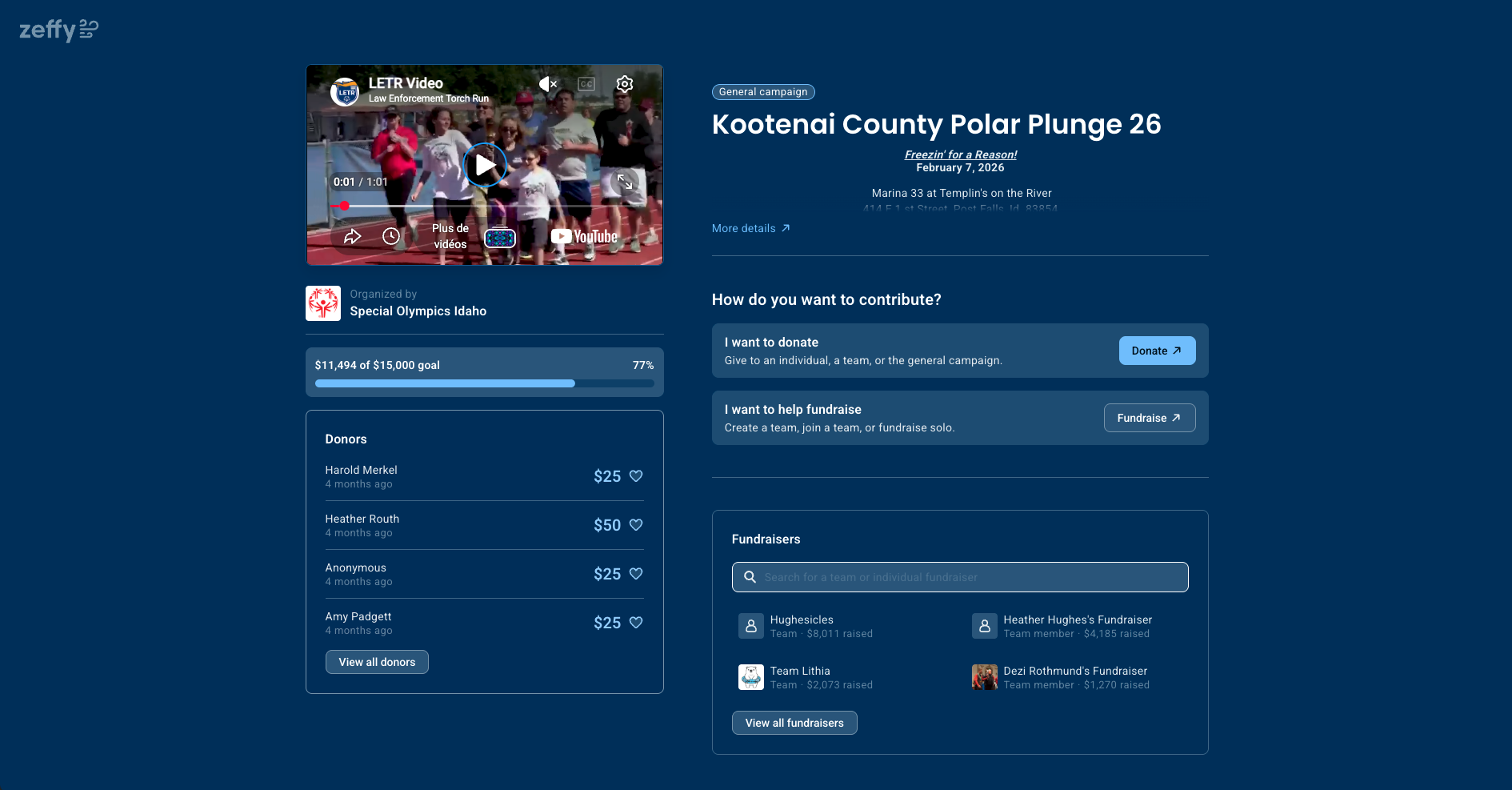
24. Polar Plunge
Supporters jump into icy water for pledges. Polar Plunge is a documented signature winter campaign for Special Olympics, run annually across multiple state programs (see specialolympics.org/polar-plunge). Smaller nonprofits run their own community versions all the time.
When to run it: a Saturday in mid to late January.
Send cadence: 1 P2P-team recruit early January, weekly updates to plungers only (not your full list), 1 broad public invite 2 weeks out, 1 day-of cheer email.
Realistic range: $3,000 to $40,000 depending on participants.
For a small nonprofit: the January play is participation, not solicitation. A 40-person Polar Plunge with team captains who each raise $200 will outperform any donation email you send in January.
February fundraising ideas: the bridge to spring
February is your handoff month. Use it to keep momentum alive, build toward spring, and re-engage donors who lapsed in January.
For a small nonprofit: pick one Valentine's-themed event and one winter-bridge event (gala or workshop). That's plenty for February.
32. Valentine's Day campaign
"Give in someone's honor." Send a Valentine to a friend, with a donation in their name to your cause.
When to run it: February 1 to 14.
Send cadence: 1 launch February 1, 1 mid-campaign February 8, 1 last-day February 14.
Spotlight programs, partners, or beneficiaries connected to the month's themes. Pair with a giving day.
When to run it: February 1 to 28.
Send cadence: 1 weekly spotlight email, social all month.
Realistic range: $1,000 to $15,000.
Lead time: 4 weeks of content prep.
Low-cost winter fundraisers (under $100 to start)
For brand-new nonprofits or all-volunteer teams, these ideas cost almost nothing to launch. Pair them with a free Zeffy donation form and you'll keep 100% of what you raise.
38. Board game tournament (under $50)
Borrowed games, donated snacks, a free venue (school cafeteria, library, community room).
39. Winter wonderland money trail (under $20)
Tape, signs, a hallway. That's it.
40. Gift-wrapping station (under $75)
Wrapping paper, ribbon, scissors. Volunteers handle the rest.
41. Hot chocolate stand (under $50)
Cocoa mix, cups, a folding table. Outside a holiday parade or shopping street.
42. Peer-to-peer mini-campaign (under $0)
Launch a peer-to-peer page, recruit 10 supporters, ask each to raise $100. That's $1,000 with zero upfront cost.
43. Coin jar challenge (under $25)
Distribute jars to classrooms, businesses, or community centers. Whoever fills theirs first wins a small prize.
44. Social media donation challenge (under $0)
"For every share, our board member donates $5." Capped, public, viral-adjacent.
45. Letter-writing campaign (under $50)
Handwritten thank-you cards from beneficiaries to last year's donors, with a soft re-up ask.
For a small nonprofit: under-$100 ideas trade money for time. They work well IF you have engaged volunteers. They don't replace your year-end appeal.
These are the ceiling-raisers. They take 8+ weeks of lead time and a coordinated team.
46. Winter gala / Black Tie Gala
Highest ceiling, highest lift. Plan 4 to 6 months out.
47. Holiday auction (online or hybrid)
Online auctions extend the bidding window and reach donors who can't attend in person.
48. Holiday concert series
Two or three nights instead of one. Different audiences each night, shared production cost.
49. Ski-a-thon with corporate sponsors
Recruit a corporate sponsor to cover lift tickets in exchange for naming rights.
50. Major-donor year-end appeal (private dinner)
Invite top 20 donors to a dinner with leadership. Soft ask after dessert. Year's biggest gift comes from here for many small orgs.
Product-based winter fundraisers
Product fundraisers (discount cards, cookie dough, popcorn, branded merch) work when you have the supply chain figured out. Zeffy handles your storefront and payment processing for free, but Zeffy is not a fulfillment service. You'll need a supplier or in-house production.
51. Discount card fundraiser
Local-business discount cards sold for $10 to $20. Margin depends on your supplier and how many cards you commit to.
52. Cookie dough or popcorn sales
Supplier ships product, you handle distribution. Standard school-fundraiser model.
53. Branded holiday merchandise
T-shirts, hats, mugs with your org logo. Use a print-on-demand supplier so you don't sit on inventory.
54. Calendar sales
12-month wall calendar featuring photos from your year. Pre-sell in November, deliver in early December.
55. Holiday wreath or poinsettia sales
Partner with a local nursery. They handle the product, you handle sales and pickup.
For a small nonprofit: product fundraisers are a logistics commitment. Don't take one on unless you have a volunteer who'll own the distribution. The free Zeffy online store handles the storefront and payment.
Virtual and hybrid winter fundraising ideas
For cold-climate orgs or those with remote supporters, virtual events extend reach without weather risk.
56. Online auction
Extended bidding window (5 to 14 days), national reach.
57. Virtual gala
Livestreamed program, individual at-home dinners shipped to top donors, live giving thermometer.
58. Virtual P2P challenge
Step challenges, reading challenges, fitness challenges run on a P2P page.
59. Livestream telethon
4 to 8 hours of programming, donor call-outs, real-time giving updates.
60. Crowdfunding sprint
30-day campaign with a clear project budget and a public goal thermometer.
Winter fundraising strategy: timing, cadence, and the donor-fatigue problem
Now that you have the ideas, here's the strategy layer that ties them together.
The hockey-stick trap
One nonprofit operator we spoke to put it plainly: their entire revenue curve looked like a hockey stick at the end of the year, and they couldn't sustain it. All the money came at once, from one channel, and the rest of the year was thin. That pattern is the most common failure mode in small-org winter fundraising.
The fix is sequencing. Instead of one December push, run a four-month plan where each month carries a different format. November is your warm-up and Giving Tuesday launch. December is your formal close. January is a participation event. February is your bridge.
The over-soliciting tax
Another operator told us she ran nearly five emails a day during Giving Tuesday and lost roughly a quarter of her subscribers; they unsubscribed. Sending more isn't sending better. The orgs that hold their list through December are the ones that vary the format (event email, P2P update, recurring upsell) instead of stacking five donation emails in a row.
The discipline: no more than two emails per week in November, no more than four sends on any single peak day in December (Giving Tuesday and December 31), and a hard pause in early January before the momentum event ramp.
The December saturation problem
Roughly 17% to 22% of annual nonprofit revenue lands in December, per Giving USA (the often-cited 29% to 31% figure is platform-specific data from Network for Good and is no longer broadly representative). That share is real, but it also means 78% to 83% of giving happens outside December. Claim the quieter windows: late November, mid-January, early February, where your email isn't fighting for inbox space.
Segment your list
The single highest-ROI move for a small nonprofit at year-end is list segmentation. A Giving Tuesday donor doesn't need your December 31 tax-deadline email. A monthly donor doesn't need three year-end appeals. Tag and segment.
The IRS deadline for charitable contributions is December 31 of the tax year (IRC 170, IRS Publication 526). Use that urgency on December 29 to 31, with a maximum of four sends across those three days. Stop on January 1.
How to plan your winter fundraising calendar
Use this template as a starting point. Adjust based on your team size and historical donor behavior.
Month
Event Type
Lead Time
Promotion Start
Key Date to Avoid
November
Giving Tuesday launch + Veterans Day event
6 to 8 weeks
Early October
Thanksgiving week (Wed to Sun)
December
Year-end appeal + 1 event + recurring upsell
8 to 10 weeks
Mid-October
Dec 24 to 26 (holiday silence)
January
Polar Plunge or ski-a-thon (P2P)
10 to 12 weeks
Early November
Jan 1 to 5 (post-holiday silence)
February
Valentine's campaign + winter gala or workshop
5 to 8 weeks
Early January
Super Bowl Sunday afternoon (unless that's your event)
For a small nonprofit: don't fill every cell. Pick one signature event per month and one supporting ask. Four signature events across four months will outperform twelve scattered ones.
Whether you're running a Giving Tuesday launch, a December gala, a January Polar Plunge, or a Valentine's brunch, you'll need donation forms, ticketing, peer-to-peer pages, a storefront, and a donor CRM. Zeffy gives you all of it for free. No platform fee, no transaction fee, no credit card fee. Ever. 100K+ nonprofits use Zeffy, and the platform has helped raise $2B+ for causes worldwide.
Start planning in September, soft-launch in early November with a Veterans Day or Thanksgiving moment, and treat Giving Tuesday as your formal kickoff (not the whole campaign). The most successful small-org winter seasons span four months: November launch, December close, January momentum, February bridge.
Yes, if you switch tactics. The old advice was to stay quiet in January because donors are tapped out from December. The reality is more nuanced: solicitation emails do underperform in early January, but participation events (Polar Plunge, ski-a-thon, P2P challenges) and recurring-donor conversion asks land well. Use January for momentum and monthly upgrades, not for another year-end-style appeal.
Segment your list. A donor who gave on Giving Tuesday doesn't need three December 31 tax-deadline emails. Tag your donors by which campaign brought them in (Giving Tuesday, year-end appeal, January event) and tailor the December and January sends to each segment. You can build these segments inside Zeffy's free donor CRM.
Both, but treat them as one connected season. Giving Tuesday is the launch (and the day many donors first hear from you in the season). Year-end (December 15 to 31) is the close. Don't pick one. Run Giving Tuesday as the kickoff with a smaller goal, then build toward the December 31 deadline with two or three follow-up touches.
Two moves: (1) include a "make this monthly" upsell inside every December thank-you email and donation receipt, and (2) send a dedicated New Year resolution email between January 2 and January 10 inviting one-time donors to become monthly supporters. Conversion rates typically run 3% to 8% on warm lists. You can convert year-end donors into monthly supporters directly inside your Zeffy donation form.
Peer-to-peer campaigns, board game tournaments, gift-wrapping stations, hot chocolate stands, and Carol-oke nights are all under $100 to launch. The overall spend is lower than larger events like a gala or holiday concert. Pair them with a free Zeffy donation form and you'll keep 100% of what you raise.
Galas, holiday auctions, ski-a-thons with corporate sponsors, and major-donor private dinners have the highest ceilings ($10,000+ and often much more for established lists). They also have the longest lead times (4 to 6 months) and the highest production cost. For a small team, a P2P event like a Polar Plunge often delivers the best dollars-raised-per-hour-of-staff-time ratio.
A safe default: no more than two emails per week in November, and no more than four sends on any single peak day (Giving Tuesday morning, Giving Tuesday evening, December 31 morning, December 31 evening). Stacking five donation emails a day burns your list faster than any single missed deadline costs you.
Get weekly fundraising tips from nonprofits experts
Thank you! Your submission has been received!
Oops! Something went wrong while submitting the form.
Keep reading :
Fundraising ideas
20+ Thanksgiving Fundraising Ideas Small Nonprofits Can Actually Run (2026)
Host Thanksgiving fundraisers that capture the spirit of gratitude and giving. Explore Thanksgiving fundraising ideas to make a difference this holiday season.
Look for people who attend related events, follow relevant Facebook groups, or subscribe to aligned newsletters.These aren’t just potential donors—they’re your future advocates.
Look for people who attend related events, follow relevant Facebook groups, or subscribe to aligned newsletters.These aren’t just potential donors—they’re your future advocates.






.webp)

