We use cookies to improve your experience on our platform. By clicking “Accept all cookies”, you agree to the storing of cookies on your device to enhance site navigation, analyze site usage and assist in our marketing efforts.
Cookies required for basic website functionality.
Cookies used to deliver content most relevant to you and your needs.
Cookies used to deliver content most relevant to you and your needs.
Cookies that help understand the performance of the website, how users interact with it and to identify bugs.
How is Zeffy free?
How is Zeffy free?
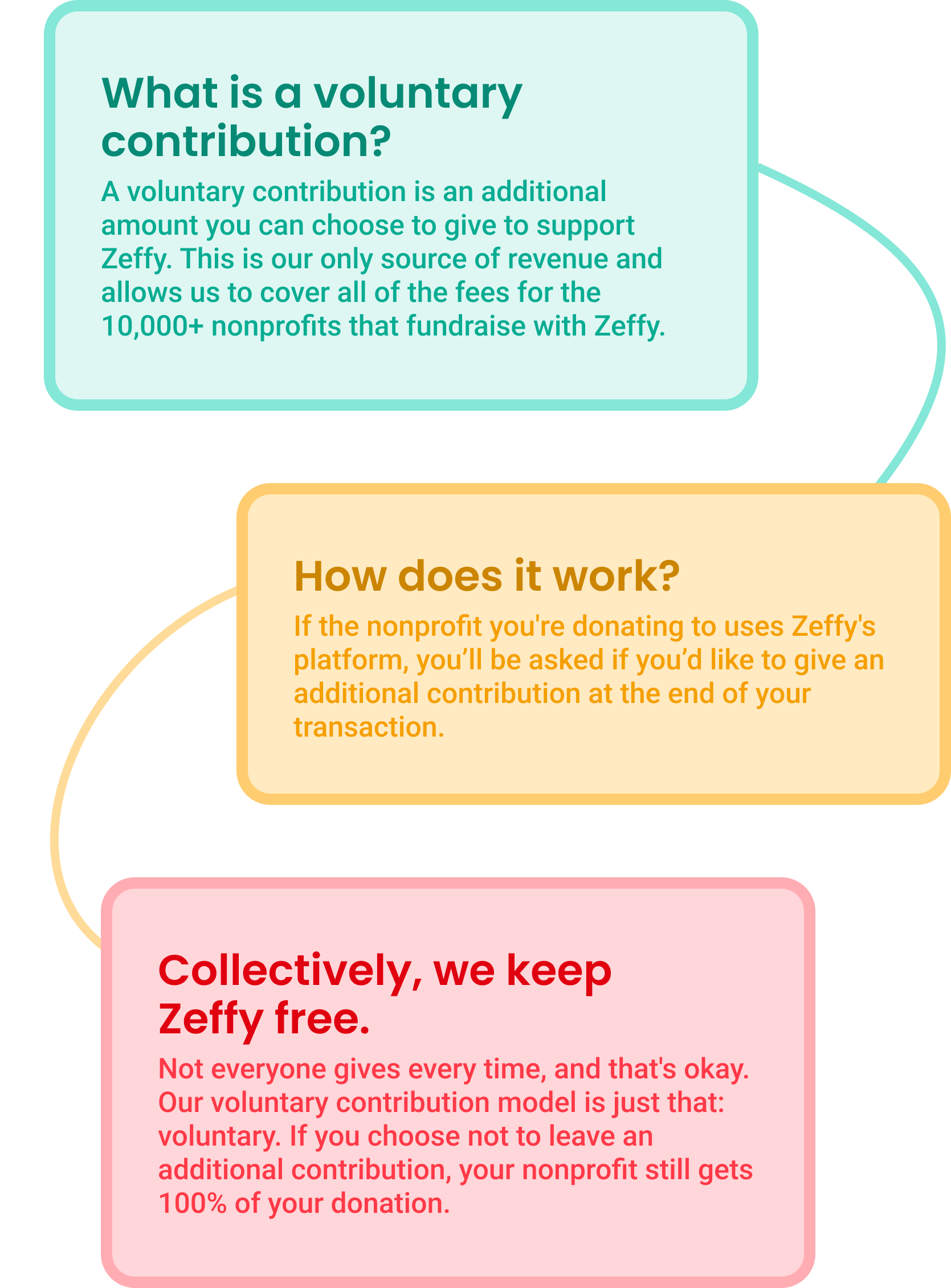
Zeffy relies entirely on optional contributions from donors. At the payment confirmation step - we ask donors to leave an optional contribution to Zeffy.
How voluntary contributions work, and why we don't call them tips
To understand Zeffy's voluntary-contribution model you need to understand why it matters to a small UK charity, why the 'tip' framing used by some platforms has damaged donor trust, and how our approach is different. But first, a short summary.
A longer TL;DR
Small charities already fight the overhead myth
What percentage of donations go 'directly towards the cause'? Why do employees need to be paid? Charities are constantly questioned about how they spend the money they're given, even though their overhead includes the same costs as any other organisation. The only real difference: a charity is likely to be judged on how little it invests in overhead rather than on how much it accomplishes.
To offer our services free of charge, we had to think differently
While other platforms charge platform fees on every transaction, plus card processing fees on top, Zeffy charges nothing. Zero. And we never will. That means charities keep every pound donated to them.
At the payment confirmation step, donors have the option (but are never obliged) to add a contribution to Zeffy. This is our only source of revenue and allows us to cover all fees, including credit card transaction fees, for the 100,000+ charities and not-for-profits using Zeffy worldwide. Zeffy also handles Gift Aid submission to HMRC, so your charity keeps 100% of every donation plus the 25p-per-£1 Gift Aid uplift where the donor is eligible. (Gift Aid guidance, HMRC)
Is the voluntary-contribution model sustainable?
Across the charities and not-for-profits using Zeffy, a majority of donors add a voluntary contribution when given the option. When they do, the average contribution is around 4%. On a £50 donation, that is £2. Some months that is almost enough to cover our costs; other months it is more than enough. Either way, collectively we make it work for everyone.
Why the UK is sceptical of platform tips, and why we are not one
Tipping is not universal. In the UK, a service charge may be added at the table or not expected at all. This is precisely why a 'tip' framing on charitable donations feels wrong to UK donors.
More relevantly, UK donors are familiar with a specific pattern on some fundraising platforms: a suggested contribution defaulted to a double-digit percentage of the donation, presented at checkout. UK donors have publicly noted that they did not realise the extra amount had been added. This has understandably made supporters wary of any 'contribution' prompt on a donation page.
Zeffy's model is the opposite. Our voluntary contribution is never defaulted, never obligatory, and is always presented clearly as separate from the donation to the charity. The charity receives 100% of what the donor intends to give them. The contribution to Zeffy, if a donor chooses to make one, sits on top and never reduces the charity's income.
Why we don't charge charities platform or transaction fees
Giving feels good and makes us happier, but that does not mean we need to give blindly. It is important to make sure generosity has an impact.
Research in behavioural economics consistently shows that spending money on others produces a more lasting sense of wellbeing than spending it on ourselves. The amount matters less than the act: what matters is that the money goes to somebody else rather than being kept.
This is why Zeffy's voluntary-contribution model is built around the idea of giving. We give our services free of charge; donors give a voluntary contribution to help cover the costs. We have accepted that we may be less profitable than platforms that charge fees, and we are comfortable with that. Collectively, we earn enough voluntary contributions to keep the fundraising platform free for charities that use it.
Is the voluntary-contribution model good for charities?
We made Zeffy free because we wanted to lead by example. Yes, relying entirely on the generosity of donors means we make less money. But it also means we can relate to the organisations that use Zeffy and, most importantly, it means we can help charities accomplish their mission.
So yes. Zeffy's voluntary-contribution model works thanks to the donors, organisations, and our team that make it work.
Why voluntary contributions are not tips
Research on tipping suggests people often add a tip out of social pressure rather than to reward good service, and that pressure can leave the contributor feeling worse rather than better. That is precisely the pattern Zeffy's model is designed to avoid.
A donor's choice to contribute to Zeffy has no effect on the service any charity or donor receives from us. To be specific, four things are always true:
The voluntary contribution is optional: donors can and frequently do skip it.
Our team are paid the same whether or not a donor contributes.
The charity keeps 100% of every donation regardless.
The platform remains free for the charity whether their donors contribute to Zeffy or not.
Spending on ourselves produces a kind of happiness that fades over time. The wellbeing that comes from spending on someone else tends to last longer, and the size of the gift matters less than the fact that it went to another person rather than to yourself.
This is the psychology behind Zeffy's model. We give our services free of charge; donors give what they choose to help sustain that. And the charities that use Zeffy get the full benefit of every pound their donors intend for them.
One free platform for your whole fundraising stack
Running a small UK charity today typically means paying for multiple tools: a ticketing platform for your summer fete, a separate donation platform for your autumn appeal, a crowdfunding platform for your Christmas raffle campaign, and a CRM on top of that. The costs and the admin add up.
Zeffy consolidates that entire stack for free. Fundraising, event ticketing, membership management, auctions, raffles and donor management, all in one place, with no platform fee, no transaction fee, and no credit card fee. Ever.
Yes. Zeffy charges no platform fee, no transaction fee, and no credit card fee. The only revenue Zeffy receives comes from voluntary contributions that donors can choose to add at checkout. The charity keeps 100% of every donation.
At the payment confirmation step, donors see an option to add a contribution to Zeffy on top of their donation. It is never defaulted and never obligatory. Donors who choose to skip it pay nothing extra and the charity's income is unaffected.
Yes. Zeffy handles Gift Aid submission to HMRC through Charities Online, so eligible donations generate a 25p-per-£1 uplift for your charity at no additional cost. Gift Aid does not apply to raffle ticket purchases, event tickets sold at fair value, or company donations.
Some fundraising platforms add a suggested contribution defaulted to a percentage of the donation. Zeffy's voluntary contribution is never pre-selected, never taken from the charity's income, and has no effect on the service charities or donors receive. It is an opt-in choice made at the final step of checkout.
majority of donors choose to add a voluntary contribution. When they do, the average is around 4% of the donation (roughly £2 on a £50 gift). This is enough, collectively, to cover Zeffy's costs and keep the platform free for charities.
Zeffy is available to registered charities, community interest companies (CICs), unincorporated associations, PTAs, and other not-for-profit organisations in the UK. You do not need to be a registered charity to sign up, though Gift Aid handling is available only to HMRC-recognised charities.
Get weekly fundraising tips from nonprofits experts
Thank you! Your submission has been received!
Oops! Something went wrong while submitting the form.
Keep reading :
Nonprofit software
Zeffy Reviews: What UK Charities Are Saying in 2026
Zeffy is the only completely free fundraising platform for charities. If you are exploring fundraising software, hearing from real users about what works and what does not is the fastest way to decide. This page brings together Zeffy reviews from charities of all sizes and cause categories, alongside an honest look at pricing, key features, Gift Aid handling, and what to expect from the support team.
The only 0% POS for UK charities: Zeffy Tap to Pay vs SumUp, Zettle, Square and GoodBox (2026)
Choosing a point of sale system for your UK charity is not the same as picking a retail till. Most POS guides are written for shops, where a percentage-per-tap is simply a cost of doing business. For a registered charity, every fee a card reader takes is a gift that never reaches the cause, and none of the standard retail options capture Gift Aid at the point of tap. This guide compares the five POS systems UK charities and churches actually consider in 2026, and explains why only one of them was built from day one for fundraising.
Look for people who attend related events, follow relevant Facebook groups, or subscribe to aligned newsletters.These aren’t just potential donors—they’re your future advocates.
Look for people who attend related events, follow relevant Facebook groups, or subscribe to aligned newsletters.These aren’t just potential donors—they’re your future advocates.






.webp)

