We use cookies to improve your experience on our platform. By clicking “Accept all cookies”, you agree to the storing of cookies on your device to enhance site navigation, analyze site usage and assist in our marketing efforts.
Cookies required for basic website functionality.
Cookies used to deliver content most relevant to you and your needs.
Cookies used to deliver content most relevant to you and your needs.
Cookies that help understand the performance of the website, how users interact with it and to identify bugs.
How is Zeffy free?
How is Zeffy free?
Zeffy relies entirely on optional contributions from donors. At the payment confirmation step - we ask donors to leave an optional contribution to Zeffy.
Platform fees and tool sprawl cost UK charities thousands every year. Here is what actually changes when you build your stack on genuinely free tools.
Zeffy is the only fundraising platform on this list with no platform fee, no processing fee, and no contact or user caps, ever.
Gift Aid adds 25p per £1 for every UK taxpayer who donates. A platform that charges a fee on the Gift Aid reclaim (JustGiving and Enthuse both take 5%) quietly costs more than its headline fee suggests.
UK charities access software discounts through Charity Digital Exchange, not the US-focused TechSoup. Register with your Charity Commission, OSCR, or CCNI number.
Most small UK charities need no more than Zeffy (fundraising, ticketing, donor management, newsletter) plus Google Workspace and a project management tool to run a complete operation.
Platform fees and tool sprawl quietly eat more charity budgets than any single line item. Between fundraising platforms charging 3 to 6 per cent of every donation, CRMs billing per seat, and email tools capping contacts at the worst moment, the cost of running the organisation stacks up fast. This guide cuts through it: 50+ tools across 11 categories that UK charities can use for free, with the catch (or lack of one) spelled out for each.
One thing to flag up front: "free" is a taxonomy, not a category, and the difference matters enormously for your budget. Every entry below is tagged so you can see at a glance what "free" really means for that tool.
In the UK, "free" also means: does the platform handle Gift Aid claims natively? The charity reclaims 25p from HMRC for every £1 a UK taxpayer donates, meaning a £100 gift becomes £125 at no extra cost to the donor (Gift Aid, gov.uk). Platforms that do not automate Gift Aid quietly cost more than their headline fees suggest.
Fundraising platforms are where "free" gets murkiest. Most charge a platform fee, a processing fee, a fee on the Gift Aid reclaim, or some combination of all three, and the difference between charity rates and personal-campaign rates is usually buried in the small print. Here is the honest breakdown for the UK market.
A small UK charity running a £15 fete ticket, an autumn appeal, a Christmas raffle, and a sponsored 5K typically pays Ticket Tailor, JustGiving, Crowdfunder, and a CRM separately. Zeffy consolidates that stack, free, with Gift Aid handling built in.
Platform
Platform fee
Payment processing (UK)
Gift Aid
Honest verdict
Zeffy
0%
0%
Supported
The only UK fundraising platform with genuinely no fees at any scale. Donors are offered an optional voluntary contribution to Zeffy at checkout. 100,000+ organisations globally, over £1.6 billion raised.
JustGiving
0% platform, but a ~17% default donor tip prompt is the single most-criticised pattern in UK fundraising press
1.9% + 20p per donation
5% fee on the Gift Aid value
Household-name brand recognition helps with cold donors. The tip prompt is a known conversion problem and embarrasses many charities at the donate page. Owned by Blackbaud since 2017.
CAF Donate
No monthly subscription; staggered fee by donation type
Varies by method
Supported, automated
Trust-first positioning, used by 8,000+ UK charities. Low flair but solid for embedded donate buttons and Direct Debit. Trustees will recognise the name.
Wonderful.org
0% via Open Banking (Pay by Bank)
0% on Pay by Bank
0% Gift Aid fee
Technically the best-value option per independent UK reviews. Open Banking requires donors to authenticate via their bank app, which converts well with younger donors and less well with older ones.
Essentially mandatory if your charity has TCS London Marathon or Great Run places (exclusive contract to 2034). Outside those flagship events the subscription cost adds up.
Crowdfunder UK
0% for charities
Card processing applies
Supported
The UK's leading crowdfunding platform for time-bound campaigns. Match-funding from the National Lottery and local authorities is the real reason charities choose Crowdfunder. Less useful for monthly giving.
GoFundMe UK
0% platform fee for registered UK charities
1.9% + 20p per donation (charity); 2.9% + 25p (personal)
Passed through free
GoFundMe is mostly used by individuals, not charities. A charity-branded donate page builds more trust than a GoFundMe page with cold donors. See how Zeffy compares to GoFundMe.
Zeffy is the only entry on this list with no platform fee, no processing fee, and no caps on contacts or users. Over 100,000 organisations have raised more than £1.6 billion through Zeffy without paying a single fee. Donors are asked if they want to add an optional voluntary contribution to Zeffy at checkout, which is how the platform stays free for charities. Beyond one-time and recurring donations, Zeffy also supports peer-to-peer fundraising campaigns at no cost. Learn more about Zeffy's donation platform for UK charities.
"Super easy to use. Clean design. Great interface. Easy to understand. Offers all the features we need and is comparable to paid services. Zeffy is truly awesome." Mark R., Capterra
A note on raffles and lotteries: if your fundraiser is a raffle or prize draw, UK gambling law treats it as a lottery. Most charity raffles fall under the small society lottery rules: register with your local council (£40 initial, £20 annual renewal), observe the £20,000 single-draw cap and £250,000 annual aggregate, and ensure at least 20% of proceeds go to your cause. Any "free ticketing" platform for raffle draws needs to sit alongside that registration, the platform does not replace the licence. Zeffy runs raffles for UK charities at 0% fee. (Gambling Commission guidance on small society lotteries.)
This category is intentionally short because CRM and supporter management deserve their own dedicated comparisons. Here is the quick read.
Zeffy includes built-in supporter management as part of its free fundraising platform: contact records, full donation history, segmentation, tagging, and automated receipts, with no caps on contacts or users. For most small and mid-size UK charities it covers the core supporter-management job without a separate tool. See Zeffy's supporter management features.
Beyond Zeffy's built-in tools, the UK charity CRM landscape looks quite different from the US-focused tools often cited in roundups:
Beacon is rated the number one UK fundraising CRM in Fundraising Magazine's annual survey, six years running. It is built specifically for UK charities, with native Gift Aid claim submission to HMRC Charities Online, from approximately £33.50 per month. It is not free, but it is the default modern choice for a fundraising-led small or medium UK charity.
Donorfy offers a free tier for up to 500 constituents (then from approximately £50 per month). Owned by The Access Group, it has broad UK integrations with JustGiving, Enthuse, GoCardless, and Stripe. A pragmatic choice for a growing charity that wants a UK-native CRM without the Beacon price tag.
Salesforce Nonprofit Cloud is available in the UK via the Power of Us programme: 10 free licences for eligible registered charities. Powerful, but NCVO and Charity Digital both flag that most small UK charities under-use it due to the high implementation cost.
Zoho CRM offers a free tier for up to three users with contact management and basic automation. It is a general-purpose CRM rather than a charity-specific tool, so you will be adapting standard sales fields to donor workflows.
Free volunteer management software
Volunteer management is the category most often missing from "free charity software" roundups, even though scheduling, hour tracking, and shift communication are foundational for any organisation running programmes.
Tool
Pricing model
What you get free
Notes
SignUpGenius
Freemium
Basic scheduling, shift sign-ups, email reminders
Works well in the UK; the default for casual volunteer sign-up sheets. Advanced reporting and custom branding sit behind paid tiers.
Track It Forward
Freemium
Hour logging, basic milestone tracking
Narrow focus on hour tracking, useful for UK funder reporting and service-learning programmes.
Assemble
Freemium
Volunteer recruitment and management
UK-used volunteer management platform. Verify current free-tier terms at time of sign-up.
Better Impact
Freemium
Volunteer records, scheduling, hours
Used widely by UK charities and public-sector volunteer coordinators. Paid tiers for larger organisations.
Do-it.org
Free listings
Volunteer opportunity listings
Run by Reach Volunteering, a UK charity. Free to list volunteer opportunities and recruit; not a full scheduling tool.
SignUpGenius remains the default for casual sign-up sheets. Its free plan handles basic scheduling and email reminders well, though advanced reporting and custom branding sit behind paid tiers.
Track It Forward focuses narrowly on hour tracking, which matters when you are reporting volunteer hours back to funders or running service-learning programmes. The free tier covers logging and basic milestone tracking.
Assemble and Better Impact both have established UK charity user bases. Dedicated UK volunteer management platforms tend towards paid tiers for meaningful feature depth; the free-tier landscape here is thinner than the US equivalent. Many UK charities also draw on NCVO and Chartered Institute of Fundraising templates for volunteer management processes and governance.
Tool
Pricing model
What you get on free
Notes
POINT
Free for small orgs
Volunteer profiles, event signups, hour tracking, mobile app
One of the few volunteer tools with a genuinely usable free tier for smaller nonprofits
Reliable for one-off events and ad-hoc shifts; advanced reporting is paid
Track It Forward
Freemium
Hour logging, milestone tracking, basic reporting
Narrow focus on hour tracking — useful when funders require volunteer-hour documentation
InitLive (part of Bloomerang)
Trial / paid
Trial only; sold as part of the Bloomerang suite since 2022
Not a standalone free tool; relevant only if you are already on Bloomerang
Free accounting software for charities
Charity accounting has specific needs, fund accounting, restricted versus unrestricted fund tracking under SORP, Gift Aid claim submission, and annual return plus Trustees' Annual Report and Accounts (TAR) filing with your regulator (the Charity Commission, OSCR, or CCNI), that generic small-business tools handle unevenly. The free-tier picture for UK charities:
Tool
Pricing
Free-tier limit
Charity fit
FreeAgent
Free with qualifying NatWest / Royal Bank of Scotland / Ulster Bank business account
Unlimited while you bank with them
UK-built; handles VAT, Making Tax Digital (MTD) filings, and basic bookkeeping. Best genuinely free option if you already bank with NatWest Group.
Xero
Charity discount (~25% off via Charity Digital Exchange)
No free tier; discounted from approximately £15/mo
Dominant UK small-business accounting; most UK charity accountants know it. No MTD issues. Strong bank-feed and payroll integrations.
QuickBooks Online
Nonprofit discount via Charity Digital Exchange
No free tier; discounted
Industry standard for UK charity bookkeeping; straightforward if your accountant already uses it. Connect Zeffy to QuickBooks and every payout shows up sorted by campaign and fund.
Zoho Books
Free for one user under approximately £42k annual turnover (verify current UK threshold on Zoho's site before signing up)
One user, under £42k income
Useful for very small charities in early stages. No dedicated charity fund-accounting features.
Wave
Free for simple books
No cap, but limited UK support
Wave stopped accepting new UK signups for payroll and invoicing features, confirm current UK availability before relying on it for anything beyond basic tracking. No Making Tax Digital (MTD) support, which is a hard limit for any VAT-registered charity.
A note on Making Tax Digital (MTD) for VAT: UK charities registered for VAT must file returns using MTD-compatible software. Wave does not support MTD; Zoho Books' free tier does not support MTD either. QuickBooks and Xero both do. Not all charities are VAT-registered, but if yours is, this is a hard limit on which free tools actually work for you. The Charity Tax Group is the technical reference on VAT and charity tax matters.
Note that Aplos, sometimes listed in US-focused roundups, is a US-only platform designed for Form 990 preparation, it has no meaningful UK footprint and no relevance for a UK charity filing with the Charity Commission, OSCR, or CCNI.
Free email marketing software
Tool
Pricing
Free-tier limit
Notable feature
Zeffy newsletter
100% free
No contact cap, no send cap
Segment by giving history or campaign, automate receipts and reminders, send donor newsletters, all included with Zeffy.
Mailchimp
Freemium
Approximately 500 contacts / 1,000 sends per month
The most widely known email tool. Most growing UK charities outgrow the free tier within a year. Advanced automation and A/B testing on paid tiers.
Brevo
Freemium
Unlimited contacts; daily send cap (300/day on free tier)
A better free option if your list is large but you only email occasionally. UK charities have flagged the £15/month jump at around 300 active subscribers as a pressure point.
Mailerlite
Freemium
1,000 subscribers / 12,000 emails per month
Clean interface; good automation on the free tier. Popular with smaller UK not-for-profits.
Zeffy's built-in newsletter tool lets you send donor newsletters, segment by giving history or campaign, and automate receipts and reminders, all with no contact cap and no send-volume cap. See Zeffy's email features.
Mailchimp's free tier sits at approximately 500 contacts and 1,000 sends per month, which most growing UK charities outgrow within a year. Advanced automation, A/B testing, and priority support sit on paid tiers.
Brevo takes a different approach: unlimited contacts but a daily send cap. If your list is large but you only email occasionally, Brevo can stretch further than Mailchimp on the free tier.
UK GDPR and PECR note: whichever tool you choose, UK charities must have a lawful basis (consent or legitimate interest) before emailing supporters. The ICO's charity soft opt-in guidance (2026) sets out how legitimate interest applies to existing supporters. Every tool above supports UK GDPR-compliant consent capture, but the responsibility for a valid lawful basis, soft opt-in handling, and maintaining consent records sits with your charity. The Fundraising Regulator's Code of Fundraising Practice (current version effective 1 November 2025, including new Section 9 on online platforms) sets additional standards.
A quick note on deliverability: free tiers often share IP pools with other senders, which can drag inbox rates down. As your list grows, dedicated sending becomes worth budgeting for.
Tool
Pricing model
Free-tier limit
Nonprofit fit
Aplos
Trial / paid
Free trial only; built for nonprofits
Native fund accounting and 990 prep; paid after trial
Wave
Freemium
Invoicing, accounting, basic reporting on free tier
General small-business tool; works for simple nonprofit books
Zoho Books
Freemium
One user, organizations with under £50K annual revenue
Solid cash-flow tracking; tight revenue threshold
QuickBooks Online
Nonprofit discount
Discounted via TechSoup, not free
Industry standard if you have a bookkeeper or accountant
Free event management and ticketing software
Cash is dying at UK community fundraisers. Village halls and PTAs increasingly need card at the door as well as online ticket sales. Per-ticket fees on Eventbrite can wipe out the margin on a £10 fete ticket, one UK community-group organiser told us that most platforms other than Zeffy charge an overhead per ticket that would price small charities out entirely.
Platform
Platform fee
Per-ticket fee (UK)
Tap-to-pay app
Honest verdict
Zeffy
0%
0%
Yes, free
The only 0% ticketing platform with a free tap-to-pay app for door sales. For fundraising events, you keep the full ticket price.
Ticket Tailor
0%
£0.60/ticket pay-as-you-go; as low as £0.22 with pre-purchased credits. 50% charity discount; free for under 2,000 tickets/year
No
UK-founded B Corp. The clear winner on per-ticket cost above £10/ticket. Direct Stripe payouts mean instant access to funds. No discovery marketplace. See how Zeffy compares to Ticket Tailor.
Eventbrite
Flex £7.99/event or Pro from £19/month
Approximately 6.95% + £0.59/ticket in service fees plus payment processing
No
Still useful for events that need discovery traffic. Punitively expensive on a £10 community-fete ticket where the service fee per ticket alone can approach £1.38. Free events over 25 attendees require a paid plan since September 2023. See how Zeffy compares to Eventbrite.
TicketSource
0% organiser fee
Buyer-facing booking fee approximately 10% on lower-priced tickets
No
Welsh-based, STAR award winner. Zero organiser cost is genuine. Trade-off: buyers see a higher checkout total, which can reduce conversion for price-sensitive events.
TryBooking UK
0%
5% + 15p per paid ticket
Yes, included free
PTA and school favourite. Free tap-to-pay app is a genuine differentiator for door sales at fetes and community events.
Humanitix
Booking fee applies
Percentage-based booking fee
No
B Corp; reinvests profits into education programmes. Worth considering if mission alignment is part of your vendor criteria.
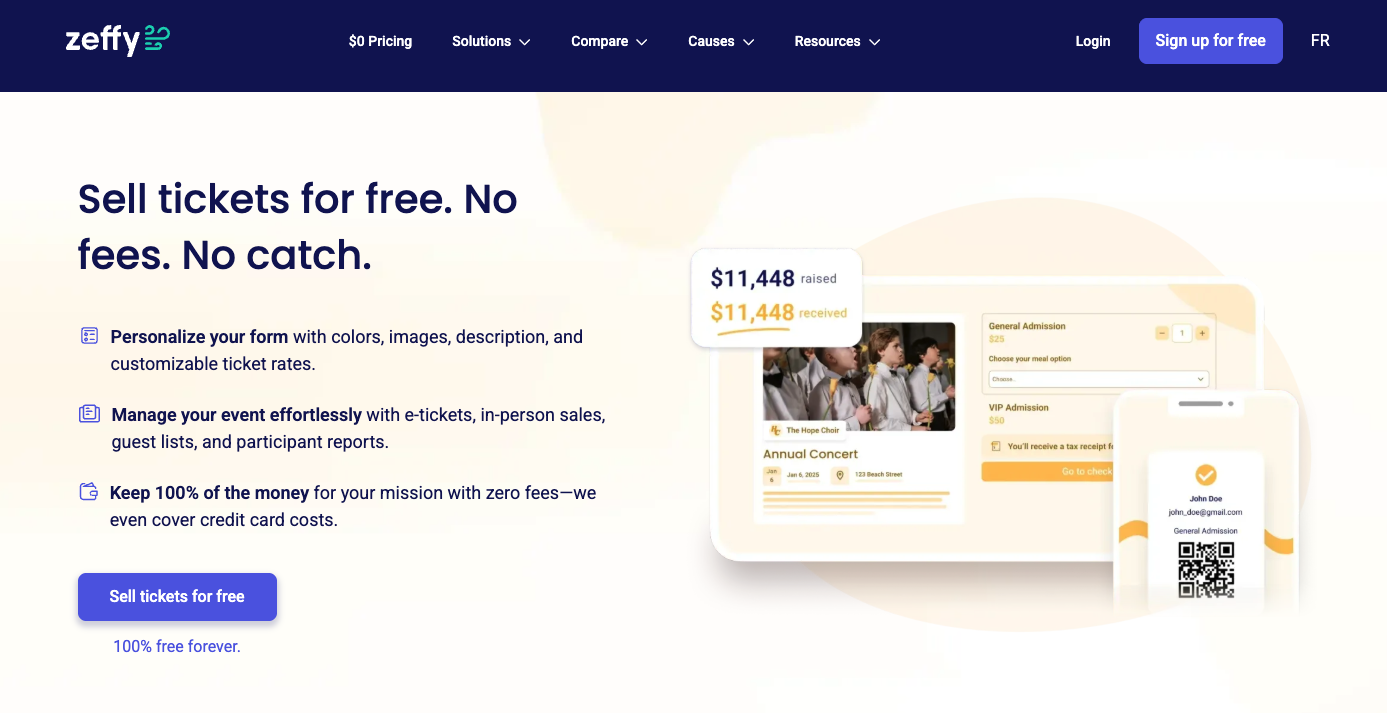
Zeffy handles ticketing, registration, attendee tracking, and on-site check-in (including a tap-to-pay app for at-the-door payments) with no platform fee and no processing fee. For fundraising events specifically, that is the difference between netting the full ticket price and losing 6 to 7 per cent to Eventbrite. See Zeffy's ticketing for UK charity events.
"Zeffy provides an ideal platform for event registrations for my non-profit organisations. Setting up events and managing registrations is quick and easy. The fee structure which ensures our non-profit receives 100% of the proceeds from registrations and donations is terrific." Cynthia L., Capterra
Templates, basic automation, A/B testing on paid tiers
Brevo (formerly Sendinblue)
Daily-cap freemium
Unlimited contacts, daily send cap on free tier
Transactional email and SMS in addition to marketing
Constant Contact
Nonprofit discount
Paid; discount available for 501(c)(3)s
Strong template library, event integration
Free project management software
Tool
Free tier
Ideal for
Trello
Unlimited cards, up to 10 boards per workspace
Visual kanban-style task management; good for small teams
Asana
Up to 10 users; tasks, projects, basic reporting
Structured project tracking; most usable free tier for teams of 3 to 10
Notion
Unlimited pages; collaborative docs and wikis
Combines project tracker, internal wiki, and meeting notes in one place
ClickUp
Unlimited tasks; most features included free
Packs the most features into a free plan; steeper learning curve
Monday.com
Up to 2 seats only
Best experienced on a paid tier; verify current UK nonprofit-discount terms before committing
Trello and Asana have the most usable free tiers for small UK charity teams. Notion is excellent if you want your project tracker, internal wiki, and meeting notes in one place. ClickUp packs the most features into a free plan, with the trade-off of a steeper learning curve.
Free communication and collaboration tools
Most of the major communication tools offer charity-specific programmes or solid free tiers that are available to UK registered charities.
Google Workspace for Nonprofits: free for eligible UK registered charities. Includes Gmail with a custom domain, Drive, Docs, Calendar, and Meet. UK charities apply through Google for Nonprofits; eligibility is verified via Charity Digital Exchange (the UK TechSoup partner). NCVO and Charity Digital both recommend this as the first free-tool claim every small charity should make.
Microsoft 365: discounted via the Microsoft nonprofit grant programme. Note that the previously free Business Basic donation tier (for up to 10 users) ended in July 2025, so Microsoft 365 is now discounted, not free, for UK charities. Verify current programme terms with Microsoft directly.
Slack: free tier with file sharing and instant messaging; message history and integration count are limited. Slack also offers an 85% nonprofit discount on paid plans.
Zoom: free meetings capped at 40 minutes with up to 100 participants. Discounted nonprofit pricing available for paid tiers.
Discord: no cost for community building, especially for volunteer cohorts or youth programmes. Topic-based channels work well for ongoing engagement.
~3.7% + £1.79 service fee plus 2.9% processing per paid ticket (approx. 6.6% + £1.79 all-in)
Strong event discovery, organizer app
Humanitix
Donation model
Charges a booking fee reinvested into education programs; fee scope varies by region
Mission-aligned ticketing
Ticket Tailor
Nonprofit pricing
Discounted booking fees for registered nonprofits
White-label ticketing; no per-ticket platform cut on nonprofit plan
Facebook Events
Actually free
0% (no native paid ticketing)
Reach existing followers; no native paid ticketing or check-in
Free design and content creation tools
Canva for Nonprofits: registered UK charities get free access to Canva Pro, which includes the background remover, brand kits, content scheduling, and premium templates. Apply directly through Canva's nonprofit programme. The single biggest free-design upgrade most charities can claim.
Adobe Express: free tier available; full Adobe Creative Cloud is discounted for charities through Charity Digital Exchange (the UK TechSoup partner).
Unsplash and Pexels: royalty-free stock photo libraries available at no cost. No charity application needed.
Lumen5: free tier for turning blog posts and scripts into short videos; watermark on free outputs.
Free website builders for charities
Builder
Free tier
Charity discount
Notes
Wix
Free with Wix subdomain and ads
Wix for nonprofits programme
Good for small charity sites; the free tier shows Wix branding.
WordPress.com
Free with wordpress.com subdomain
Nonprofit plan available for registered charities
Best for content-heavy sites; requires more technical comfort than Wix or Squarespace.
Weebly
Free with Weebly subdomain
None specific
Basic drag-and-drop; limited in 2026 compared to Wix or Squarespace.
Squarespace
No free tier
20% discount for registered charities (verify current UK availability)
Strong design templates; popular with arts and culture charities.
Webflow
Limited free tier
Verify nonprofit programme terms
More design flexibility than Wix but steeper learning curve; suited to charities with a designer on the team.
For donation forms, all of these builders rely on third-party embeds. The simplest UK setup is to build your marketing site on any of these and embed a Zeffy donation form, no platform fee, no processing fee, and Gift Aid declarations handled inside the form. Whichever builder you pick, most native donate widgets do not handle UK Gift Aid claims; Zeffy's embed does.
Free automation and integration tools
Zapier: free plan covers up to 100 tasks per month with two-step Zaps. Useful for connecting your fundraising platform to your CRM or email list.
Make (formerly Integromat): more generous free tier with multi-step scenarios, but a steeper learning curve.
IFTTT: free tier covers basic recipes; works well for social-media cross-posting and lightweight automations.
Three automation recipes worth setting up in week one:
1.New donor welcome sequence: trigger when a new donation comes in, push the donor to your email tool, and tag them for a welcome series.
2.Event registration to CRM: capture event sign-ups and create or update the contact record automatically, so you are not re-keying attendees after the fact.
3.Recurring-donor thank-you: detect a second or third recurring gift and trigger a personal thank-you note from a team member, not just an automated receipt.
Many of the tools above, and many more, become free or heavily discounted once you verify as a registered UK charity. The primary UK verification hub is Charity Digital Exchange (formerly tt-exchange, run by Charity Digital), which is the UK partner for TechSoup's global network. Several vendors also run their own direct programmes.
The Charity Digital Exchange process, step by step:
1. Register your charity at Charity Digital Exchange using your Charity Commission for England and Wales (CCEW), OSCR (Scotland), or CCNI (Northern Ireland) registration number, plus your HMRC charity reference where required. No IRS determination letter or EIN is needed, the UK verification is against the public charity register.
2. Verification is typically faster than US TechSoup verification; the system cross-references against the live charity registers directly.
3. Once verified, browse the catalogue. Charity Digital Exchange connects UK charities with discounted or donated Microsoft, Adobe, Bitdefender, and other partner software.
4. Many vendors also accept Charity Digital Exchange verification as proof for their own direct programmes, you do not always need to purchase through the Exchange.
5.Scottish and Northern Irish charities: some vendor programmes specifically ask for a CCEW number and may require a support request to accept an OSCR or CCNI number instead. Flag this if you are redirected.
Note on Charity Excellence Framework: Charity Excellence (approximately 50,000-member free UK charity community, run by Ian McLintock) also signposts grant opportunities and free tool resources for small charities that may sit outside the Charity Digital Exchange catalogue. Worth bookmarking alongside Charity Digital Exchange.
Major vendor programmes relevant to UK charities:
Google Workspace for Nonprofits: free for eligible registered UK charities. Apply through Google for Nonprofits; UK eligibility is verified via Charity Digital Exchange / TechSoup Global validation. Includes Gmail with custom domain, Drive, Docs, Calendar, and Meet.
Microsoft 365: discounted via the Microsoft nonprofit grant programme. The previously free Business Basic donation tier (up to 10 users) ended in July 2025; Microsoft 365 is now discounted, not free, for UK charities. Verify current programme details directly with Microsoft.
Salesforce Power of Us: 10 free Salesforce Nonprofit Cloud licences for eligible UK registered charities, plus discounts on additional users. High implementation cost, see the NCVO note in the CRM section.
Adobe Creative Cloud: discounted access for UK charities through Charity Digital Exchange.
Canva for Nonprofits: free Canva Pro for verified UK registered charities, via direct application.
Why charities need free software (and what "free" really means)
Platform fees on other fundraising tools typically run 3 to 6 per cent of donations. On £100,000 raised, that is £3,000 to £6,000 leaving your mission every year, enough to fund a part-time fundraiser, or the Gift Aid reclaim on £20,000 of donations. Free software is not a nice-to-have; it is operating margin.
In the UK, there is a fifth "free" category beyond the four below: Gift Aid handling. A platform that charges a 5% fee on the Gift Aid reclaim (JustGiving and Enthuse both do) is quietly costing you money on top of the headline platform fee. On £100 from a UK taxpayer, Gift Aid adds £25, but only if your platform captures a valid declaration and lets you submit through HMRC Charities Online.
But "free" hides several very different realities:
Actually free means no platform fee, no processing fee, no contact caps, no user caps, no Gift Aid fee, no upsell. Zeffy is the only tool in this guide that fits cleanly here for fundraising.
No platform fee, but processing fees apply: the platform itself does not charge you, but card processing still takes a cut per donation. GoFundMe UK for verified charities is a good example: 0% platform fee, 1.9% + 20p in processing per donation.
Contact-capped freemium means free until you grow. Mailchimp's approximately 500 contacts and 1,000 monthly sends is the canonical version of this pattern. Most growing UK charities hit the ceiling within 12 months.
Charity Digital Exchange verified means free or near-free, but only after you register and verify. Google Workspace for Nonprofits and Canva for Nonprofits are the cleanest wins here.
A quick decision framework:
Budget size: under £50k in annual income, lean hard on actually-free and Charity Digital Exchange-verified tools. Above £250k, paid tiers usually pay for themselves in saved staff hours.
Team size: one to three people, prioritise tools with no per-seat charges. Five or more, factor seat pricing into every comparison.
Technical comfort: lower comfort means fewer integrations and tools; higher comfort makes automation via Zapier or Make a real lever.
Builder
Pricing model
What you get on free plan
Notable for nonprofits
Wix
Freemium
Subdomain site with Wix branding
Drag-and-drop ease; donation forms via third-party embeds
Weebly
Freemium
Subdomain site with limited features
SEO-friendly templates
Webflow
Freemium
Staging site for development
Most design flexibility; steeper learning curve
WordPress.com
Nonprofit plan
Free tier with WordPress branding
Discounted upgrades available for nonprofits
Squarespace
Nonprofit discount
20% off for verified nonprofits; not free
Strong templates and integrated commerce
When to upgrade from free software
Free tiers stop being free when they start costing you time, donors, or compliance risk. Signs you have outgrown a free plan:
You are hitting contact or send limits on your email tool and skipping segments to stay under the cap.
You need reporting your free tier does not offer: Gift Aid claim reporting, recurring-revenue dashboards, restricted versus unrestricted fund tracking under SORP.
You have compliance or audit requirements that need role-based permissions, audit logs, UK GDPR data subject access request (SAR) response tooling, or a Fundraising Regulator consent audit trail (the Code of Fundraising Practice, effective 1 November 2025, includes new Section 9 on online platforms).
Manual workarounds are eating staff time: every hour spent copying data between tools is an hour not spent on the mission.
You need integrations the free tier blocks: many platforms gate API access and Zapier-style connectors behind paid plans.
Rough budget thresholds: most UK charities start paying for at least one core tool, usually CRM or accounting, once they cross approximately £250,000 in annual income. Email tools tend to be the next paid line item, typically between £250k and £500k in income. Fundraising, on the other hand, never has to be a paid line item: Zeffy stays free at every scale.
Building your charity tech stack
Three sample stacks by organisation size, all anchored on free or discounted tools:
Startup charity (under £50k annual income):
Fundraising and supporter management: Zeffy (free)
Email: Zeffy newsletter (free) or Mailchimp free tier
Accounting: FreeAgent (free with NatWest/RBS/Ulster) or Zoho Books (free under £42k income)
Productivity: Google Workspace for Nonprofits (free via Charity Digital Exchange verification)
Design: Canva for Nonprofits (free Pro via direct application)
Project management: Trello or Asana free tier
Volunteer management: SignUpGenius or Track It Forward
Not yet a registered charity? Unincorporated community groups, CICs, PTAs, and village halls may not qualify for "registered charity" tiers on Google Workspace, Canva, or Salesforce. Zeffy remains free regardless of legal status. Check your eligibility with each vendor using your Companies House or local authority registration where a charity number is required (CCEW threshold: income above £5,000; OSCR: all sizes must register).
Growing charity (£50k to £250k annual income):
Fundraising and supporter management: Zeffy (free)
Email: Zeffy newsletter for donors; Mailchimp paid or Brevo for broader marketing lists
Accounting: QuickBooks Online or Xero (discounted via Charity Digital Exchange)
Productivity: Google Workspace for Nonprofits (free)
CRM (if you outgrow Zeffy's built-in supporter management): Donorfy (free up to 500 constituents) or Zoho CRM free tier
Fundraising and supporter management: Zeffy (free) for the public-facing layer; Beacon or Donorfy for full CRM
Email: dedicated tool (Mailchimp paid or Brevo paid)
Accounting: QuickBooks Online or Xero (both full MTD support)
Productivity: Google Workspace for Nonprofits or Microsoft 365 (discounted)
Project management: Asana, Monday.com, or Notion
Automation: Zapier paid or Make
Events: Zeffy for fundraising events; Ticket Tailor for larger paid programmes that need a flat per-ticket model
Volunteer management: Assemble or Better Impact
Notice the constant in all three stacks: fundraising and supporter management on Zeffy stays free no matter how large you grow. That is the single biggest line item your tech stack never has to budget for.
Zeffy is the only UK fundraising platform with no platform fee, no payment processing fee, no Gift Aid processing fee, and no caps on contacts or users at any scale. JustGiving charges a 5% fee on Gift Aid values and has a default ~17% donor tip prompt. Enthuse charges 5% on Gift Aid and 3.5% + 75p per event ticket. Wonderful.org is genuinely 0% via Open Banking, but its reach is narrower than JustGiving and it requires donors to authenticate via their bank app. CAF Donate has no monthly subscription and low fees across donation types. GoFundMe UK charges 1.9% + 20p per donation for registered UK charities. Zeffy keeps 0%, the platform stays free because donors are offered an optional voluntary contribution at checkout.
For verified UK registered charities, GoFundMe charges no platform fee and approximately 1.9% + 20p in payment processing per donation. Personal (non-charity) campaigns pay a higher processing rate of approximately 2.9% + 25p per donation. GoFundMe is used predominantly by individuals rather than registered charities in the UK, and a charity-branded donation page generally builds more trust with cold donors than a GoFundMe page. For a full comparison, see Zeffy versus GoFundMe.
UK registered charities apply through Google for Nonprofits. Eligibility is verified via Charity Digital Exchange (the UK TechSoup partner) or TechSoup Global validation, you will need your Charity Commission (England and Wales), OSCR (Scotland), or CCNI (Northern Ireland) registration number. Once approved, Google Workspace for Nonprofits gives your charity Gmail with a custom domain, Drive, Docs, Calendar, and Meet at no cost. NCVO recommends this as one of the first free-tool claims every small charity should make.
Charity Digital Exchange (formerly tt-exchange) is the UK's primary charity-software verification hub, run by Charity Digital. It is the UK equivalent of, and official UK partner for, TechSoup's global network. UK charities register using their Charity Commission, OSCR, or CCNI charity number; no IRS determination letter or EIN is required. Once verified, you can access discounted or donated Microsoft, Adobe, Bitdefender, and other partner software. Many vendors also accept Charity Digital Exchange verification as proof for their own direct programmes, such as Google Workspace for Nonprofits and Canva for Nonprofits.
Zeffy supports Gift Aid declaration capture in the donation flow, allowing UK charities to collect the information needed to submit Gift Aid claims to HMRC. Gift Aid adds 25p per £1 donated by a UK taxpayer, a £100 gift becomes £125 at no extra cost to the donor (HMRC Gift Aid guidance). This is the single most-asked UK question about Zeffy, and it is the clearest illustration of why the right platform choice goes beyond the headline platform fee: a platform that charges 5% on Gift Aid values (as JustGiving and Enthuse do) quietly costs UK charities money on every single Gift Aid claim.
No, Zeffy is free regardless of your legal status. Unincorporated community groups, Community Interest Companies (CICs), parent-teacher associations (PTAs), village halls, and faith groups can all use Zeffy to fundraise and sell tickets at no cost. However, some other tools on this list, Google Workspace for Nonprofits, Canva for Nonprofits, Salesforce Power of Us, require a registered charity number from the Charity Commission (England and Wales, income above £5,000), OSCR (Scotland, all sizes), or CCNI (Northern Ireland). If you cannot yet access those tiers, Charity Excellence Framework (Ian McLintock's free UK charity community) provides tool guidance and grant signposting that does not require registered-charity status.
UK charities must comply with UK GDPR and the Data Protection Act 2018. All tools listed in this guide process donor personal data and should provide a Data Processing Agreement (DPA), ask any vendor for one before signing up. For direct email marketing, the Privacy and Electronic Communications Regulations (PECR) also apply: you need a lawful basis (consent or legitimate interest) before emailing supporters. The ICO has published soft opt-in guidance for charities (2026) covering how legitimate interest applies to existing supporters. The Fundraising Regulator's Code of Fundraising Practice (effective 1 November 2025, Section 9) sets additional standards for online fundraising platforms. Before adopting any tool that stores donor data, ask: where is data stored (UK or EU servers are preferable post-Brexit), what is the retention policy, and is there a DPA in place?
Get weekly fundraising tips from nonprofits experts
Thank you! Your submission has been received!
Oops! Something went wrong while submitting the form.
Keep reading :
Nonprofit software
14 best fundraising software tools for UK charities in 2026
A practical guide to the best fundraising software for UK charities in 2026. Covers 14 platforms, from free all-in-one tools to specialist CRMs, ticketing platforms, and auction tools, with UK pricing, Gift Aid handling notes, and honest verdicts for small-to-mid charities.
Best event registration software for small UK charities (2026 guide)
Running events is one of the most effective ways UK charities raise funds and build supporter relationships. But the registration software you choose can quietly eat into every pound you raise. This guide compares the leading event registration platforms available to UK charities in 2026, from Zeffy and Eventbrite to Ticket Tailor, TicketSource, TryBooking and more, with honest takes on UK fees, Gift Aid handling, and what actually works for small, volunteer-led teams.
Look for people who attend related events, follow relevant Facebook groups, or subscribe to aligned newsletters.These aren’t just potential donors—they’re your future advocates.
Look for people who attend related events, follow relevant Facebook groups, or subscribe to aligned newsletters.These aren’t just potential donors—they’re your future advocates.



.webp)




%201.avif)

.webp)

